What Size Were Brooches in the Middle Ages – Part 8 – Manufacturing Buckles and Belt Ends

Last time we were talking about how generous the modern belt makers are with their metal – something that is a readily available and cheap resource today.

Comparing the belt fittings that we purchased at Pennsic to actual artifacts was very revealing. The first thing that I noticed was how thick and heavy the new metal pieces were in comparison to the actual artifacts. The thickness of the Pennsic purchased mounts on my belt was almost 1/16 of an inch, which was comparable to the pre-1600s mounts, but the mounts on my husband’s belt were a full 1/8 of an inch thick. The majority of the actual period mounts that I own are only about 1/16 of an inch thick. They often have hollowed out backs to reduce the amount of metal that is needed to make the piece, while making the piece look large.

Looking at the buckles, my buckle was 3/16 of an inch thick. My husband’s buckle was 1/4 inch thick at the end of the plate that is riveted to the belt, and 3/16 of an inch thick where it wraps around the cast part of the buckle.

But what did the real pre-1600 buckles and belt ends look like? Well, here are a few examples. You will notice that the form of the belt end immediately to the right of the buckle is virtually identical to the form of my husband’s belt end.
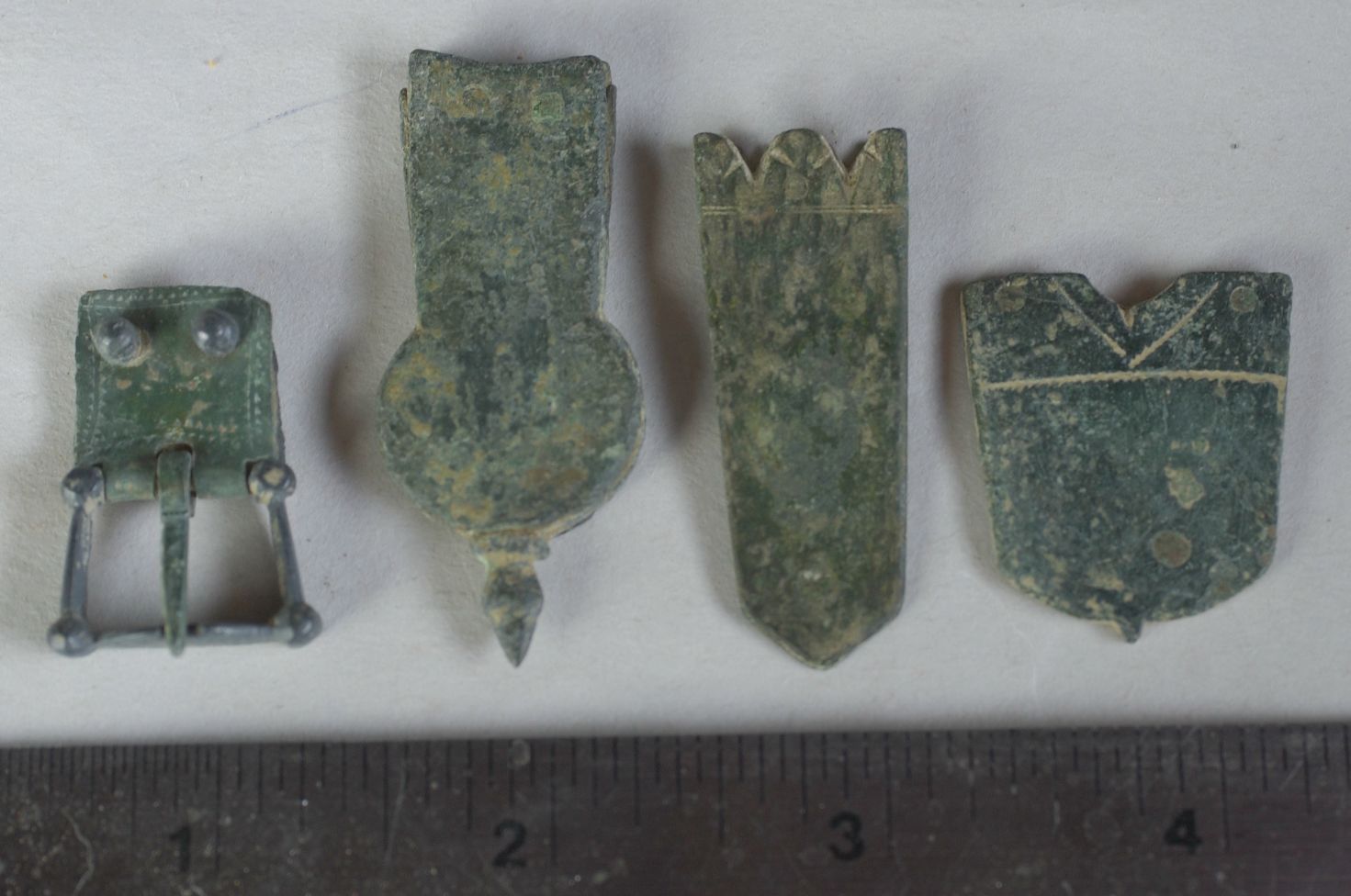
belt buckle and  belt endsThese belt ends and the buckle look very much like the pieces that we bought, a tad smaller, but in the same ballpark, until we look at the construction techniques and the thickness and weight of the metal.
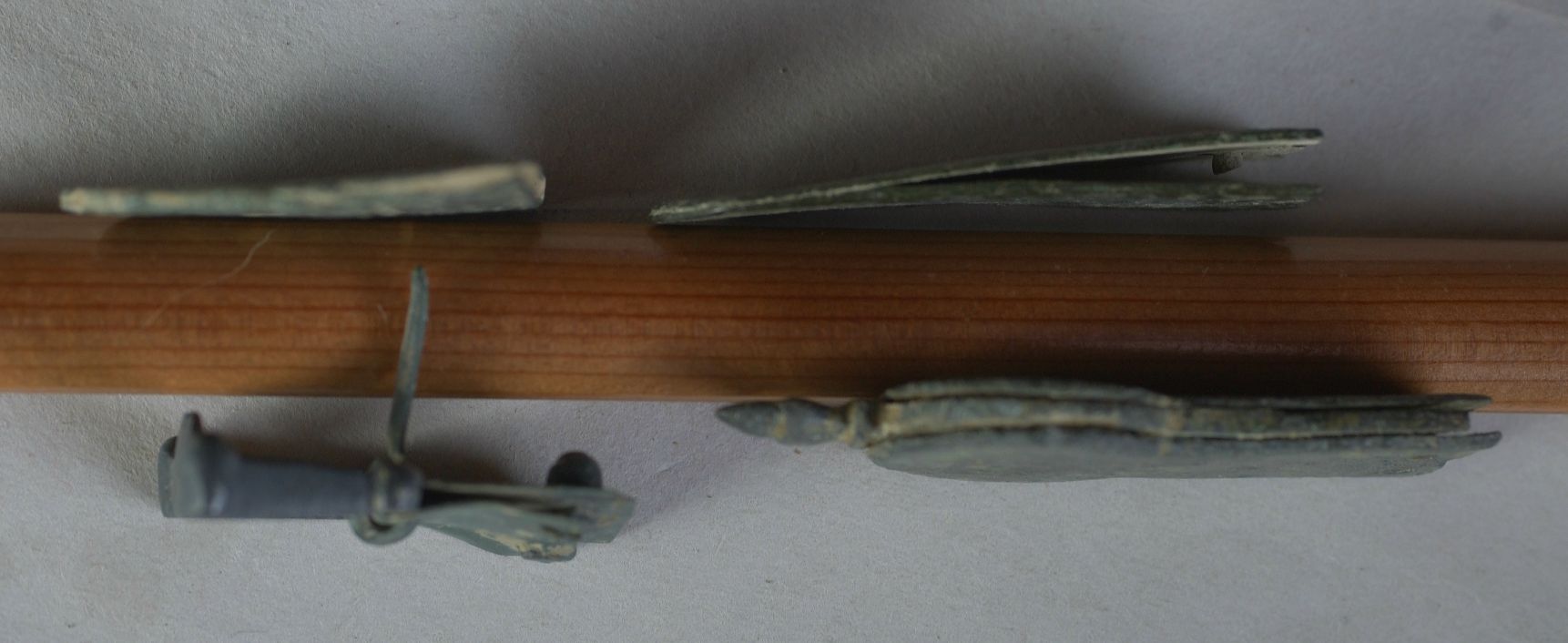
artifact buckle and ends sideviewAnd here is a side view of the actual artifacts. The artifacts are all laid against the sides of a large charcoal pencil. Looking at each one in turn, the buckle is in the lower left hand position. You can see that the cast part of the buckle is held in place by a folded piece of sheet metal, just like my husband’s buckle. The biggest difference? The thickness of the metal – my husband’s buckle is made with metal sheet that is almost 1/16 of an inch thick, while the period artifact is less than 1/32 of an inch thick, even allowing for the fact that my husband’s buckle is larger, the modern metal sheet is definitely quite beefy. One of the fun things about having intact rivets on this sort of buckle is that you can tell how thick the end of the leather belt was where it fit into the buckle. My husband’s leather belt is 3/16’s of an inch thick, and the pre-1600’s leather belt would have been 1/16 of an inch thick.

The belt end that looks like my husband’s is in the lower right position. You can see that it is not a solid cast piece. It is actually a sandwich of three pieces of metal, two outside pieces of thin sheet (each about 1/32 of an inch thick and a center cast piece of metal that is 1/16th of an inch thick. This makes the entire piece 1/8th of an inch thick, and it weighs, with the rivets still in place, .4 ounces. The leather belt would have been just about 1/16 of an inch thick.

The two top belt ends are both made from two single sheets of metal, riveted together. The upper right belt end has the thickest metal sheet – 1/16 of an inch thick, and the leather looks as if it would have been 1/16th of an inch thick. The upper left belt end was made with much thinner metal, only about 1/32 of an inch thick and the leather would have been 1/16th of an inch thick.

But what does all of this mean? Well we will talk about the possibilities next time!

What Size Were Brooches in the Middle Ages ? – Part 7 – More Buckles

So last time I was wondering why buckles might be a bit smaller than we might expect. I proposed that some of the reasons could include cost, difficulty of construction, fashion, and functionality.

Looking at cost first – metal was expensive and valuable. Metal was dug out of ore deposits by hand and the smelting and processing of all metals was extremely labor and fuel intensive. Metals that were not available locally had to be imported, adding to the cost. Even the least expensive tin trinkets were cast in such a way as to minimize the use of metal while maximizing the effect. They were made as thin as possible while still allowing them to be functional.

I never really appreciated how much the frugal use of metal affected the manufacturing techniques used for dress accessories until I began making them myself and purchasing actual artifacts.

An excellent example are these buckles and belt ends. They are on two belts that my husband and I purchased at the Pennsic War about 18 years ago. We were looking for narrow belts with some pretty mounts, a buckle, and a belt end. I had seen lots of portraits with narrow belts and a few actual belt ends in museums, and these belts looked pretty good and seemed functional enough. And to be honest, they have worked perfectly well for all these years, and will probably make it for at least another five or six years. But now that I know what the real belt fitting look like it is very interesting to see the construction techniques.

First we have my belt buckle, belt end, and mounts.


The leather of the belt is 3/4 of an inch wide, a respectable width. The mounts are of an appropriate size, and while the buckle and the belt end are fairly large, they are believable.

If we look at the pieces from the side we can understand the actual construction techniques that were used.

my buckle sideviewThis picture shows graphically what it looks like when your solder does not match the color of the main pieces of metal. The actual forms of the pieces are fairly close to the forms of several dismantled pre-1600 buckles and belt ends that I have seen, but the period belt ends and buckles were not soldered, they were simply riveted together.

My husband’s belt uses slightly different construction techniques and suffers from slightly different flaws.

Henry's Buckle top view


The leather belt in this case is 1 inch wide – again an acceptable width. The basic form of the pieces is based on period buckles and belt ends. And then we have the mounts.

Henrys belt mount


Lovely cast pieces that are definitely a period form and look quite nice.

And a side view of the buckle and belt end to show the actual construction techniques.

Henrys buckle side view


You can see that the plate that holds this buckle in place is actually just a folded piece of metal, and the rivets hold the metal tight to the belt. The belt end is a solid cast piece with just a small area where the end of the leather belt can be inserted. The belt end weighs a ton – about an ounce all by itself. By Medieval terms this is a TOTAL waste of metal.

But how thick should the metal be? We will talk about that next time!

What Size Were Brooches in the Middle Ages – Part 3 – Hooks – Sharp and Blunt

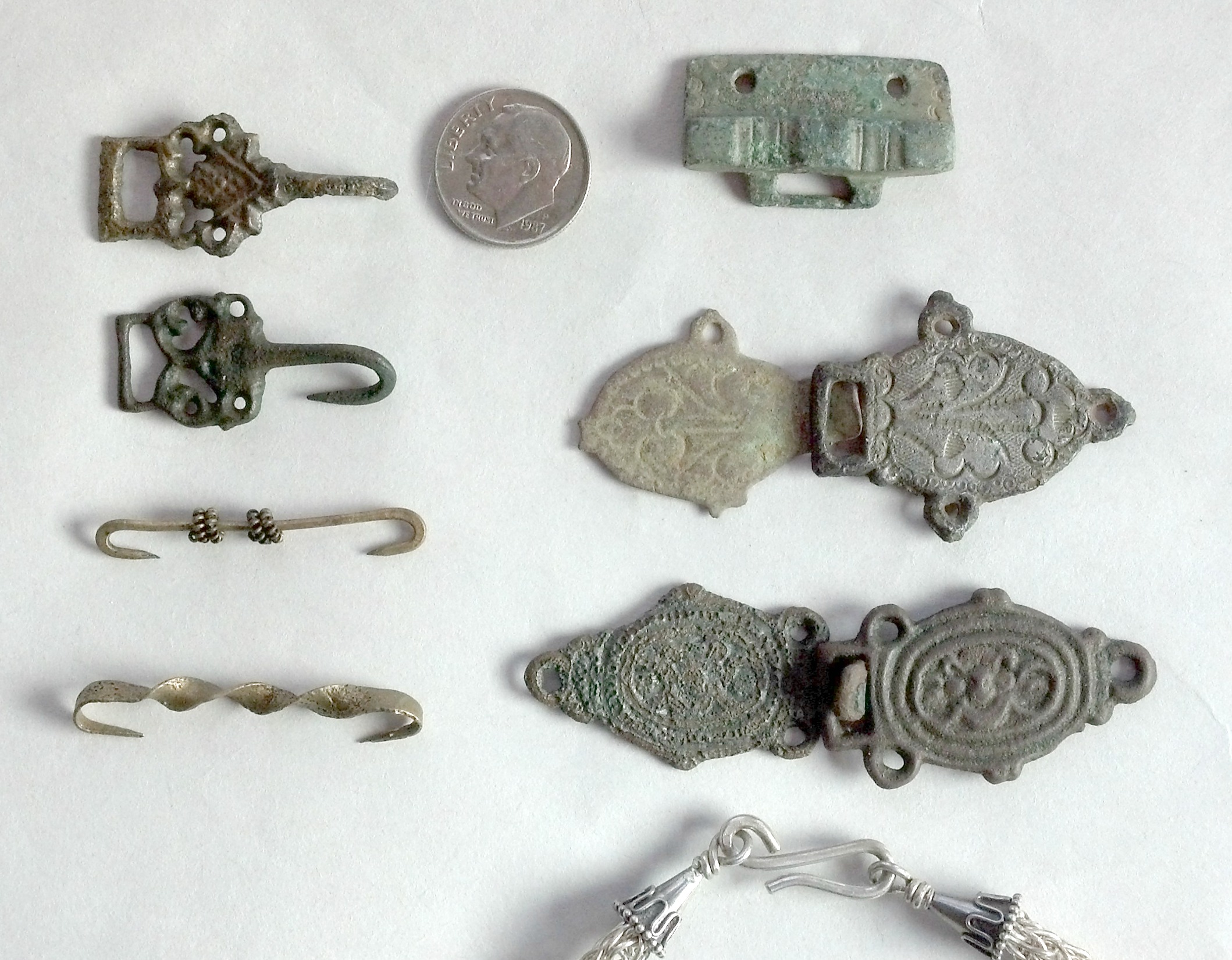
The pre-1600 hooks that are different from our modern hooks and eyes can be broken down into two main classes, sharp and blunt. The blunt hooks were designed to either be used with a large eye hook, or with some other kind of loop or hole. Any of these hooks can either be cast, or cut from metal sheet or wire. They can be plain or decorated with stampings, engraving, glass gems, enamel, rivets, or any combination of these techniques. These hooks can be made of tin, lead, bronze, or silver (or a gazillion other in-between alloys). They were sometimes tinned, silver plated, or gilded to make them appear to be more valuable. We usually only see solid gold items used in jewelry.

Blunt hooks were frequently used in jewelry to close necklaces, bracelets, and torques. A blunt hook could also be used to hold a belt closed (we may think of them as buckles, but technically a flat plate with a hook on the underside or the end, is a hook). They could also be used to close pouches and bags. They were often very decorative, and we have an example of a surviving jacket with large versions of these all the way down the front. Most of these hooks only have one hook. The wrist clasps that were used by both Anglo Saxons and Vikings are a form of blunt hook and eye. Some of the Anglo Saxon wrist clasps were riveted onto a leather band, but most wrist clasps were probably sewn in place.

types of real hooksA selection of hooks. All of the hooks in the picture, with exception of the jewelry hook, are real artifacts. The hooks in the left column are all sharp. The top two are dress hooks from England (the hook on the bottom one is squashed sideways, but the top hook is just as sharp), and the two hooks at the bottom are from Germany. The right column is all blunt hooks. The blunt hooks start at the top with the eye side of a wrist clasp, then two dress hook and eye sets, and then at the bottom a simple jewelry clasp.

The sharp hooks come in many configurations. I am aware of hooks with one hook, two hooks, three hooks (evenly spaced in a circle), and four hooks (two on each end). To be honest, we are uncertain of all of the uses for these hooks. They are usually found as “occasional finds” by metal detectorists. That means they were probably lost while in use, or the fabric or other organic material that they were attached to has disintegrated and they are found in a context that would determine or explain their use.

How were sharp hooks attached? Some were probably sewn in place, and others, especially those attached to leather, were often riveted in place. A single point hook could be used to close leg wraps, clothing, and purses. Two pronged hooks (one on each end – see picture above) could be used to close the neck of a lightweight cape or cloak, and so can a four pronged hook with two hooks on each end. These were not sewn in place – they relied on the hooks to keep them in place. A three pronged hook could also be used to support the back of a ladies skirts to keep them clean.

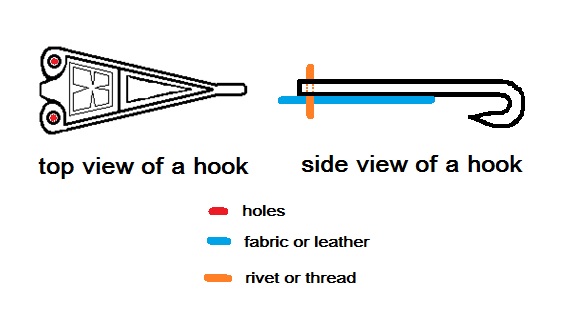
Anatomy of a hookHow big are these hooks? The ones that I have seen range from an inch long (not counting the portion of the hook that is underneath the hook), to about an inch and 3/4 long. The really large hook and eye sets (either cast or sheet work) can be as large as four inches from end to end. They all suffer from the same problems – they can open if they are not kept under at least a minimum amount of tension. The really large blunt hooks often have enough length to the hook that they are unlikely to unhook, but they are also several inches long, as a set. The large blunt hook sets can also be fairly bulky, and are usually only used on the outside of a garment.

Next time: Buttons and Toggles