Purses Part 6: The Tip of the Iceberg

Last time I mentioned that there are a considerable number of other types of metal purse frames, including some that are truly odd, and some that are totally over the top.

So first let’s start with an odd one. This next purse belongs to the Museum of London and dates from the 14th or 15th century. It has a single metal support bar. The leather, which is original, is cut in an unusual asymmetrical shape and is beautifully tooled. Be sure to look at both of the pictures, the back is plain, but the front has two incised hearts with lattice patterns. There are no metal purse frame rings or attachments and no obvious indication that there ever were any. The leather is attached directly to the support bar. I would love to be able to see an x-ray of this piece to determine if the original attachments were simply broken off and the support bar was reused, or if it was actually designed that way from the beginning.

After a simple purse like this is seems appropriate to go in a completely opposite direction – all the way to the over-the-top luxury purse. This purse belongs to the British Museum. It is dated to around 1450 and is believed to have been manufactured in France or Flanders. The British Museum actually dismantled the purse frame as part of an effort to conserve the piece, which does show some damage from previous conservation actions. You will notice that this purse frame has even more rings than usual. The smaller partial frame would have created an additional pocket in the purse. The artifact listing has something like nine pictures, including pictures of the purse while it is taken apart. It is a really nice, and fairly elaborate purse frame, but NOT the fanciest that I have seen.

Here is a purse that belongs to the Metropolitan Museum of Art. Made of Iron – a material that most people do not think of a being capable of delicate detail. The top of the purse is a true masterpiece of the iron worker’s art.

And just so that you don’t think that this purse is the only one of its kind, here is one from the Metropolitan Museum of Art collection that is even more magnificent. This piece is also made of iron, and was probably made in France. I have actually seen several of these elaborate “rose window” purse frames in my travels, and they are really quite amazing.
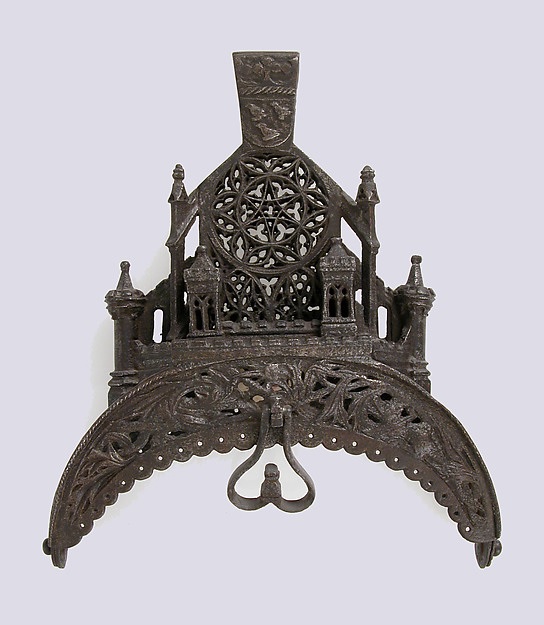
Iron Purse Frame MET

And then there is this purse from the Museum of London. It is a simpler form than the previous two purses, more like the original simple purse frames that we looked at, but the level of decorative detail is outstanding. The Niello decorations and words on the frame are truly masterful. It also shows us another form of purse frame rings that was fairly standard during the 1500 and 1600’s. Be sure to enlarge the image so that you can see the details!

Next Time: Back Down to Earth

Purses Part 4 What the Clues tell us and More about purse forms!

So last time we looked at the most common form for a large purse. And I mentioned that the picture of the purse held a very important clue.

Purse Frame Collage

Take a look at this composite picture. The left most picture shows the typical purse frame, and the right two pictures are of the piece of purse frame that I own. The picture on the top right shows the fragment of purse frame in the same position as the intact purse frame is in on the left hand picture. You can see that this purse frame fragment also has Niello decorations, this time in the form of floral swirls that act as spacers between words. DEO and H are the only visible letters on the frame fragment. The original inscription was probably “DEO HONOR ET GLORIA” – Honor and Glory to God. The use of standard inscriptions was very formulaic in Medieval times, but that is another blog.

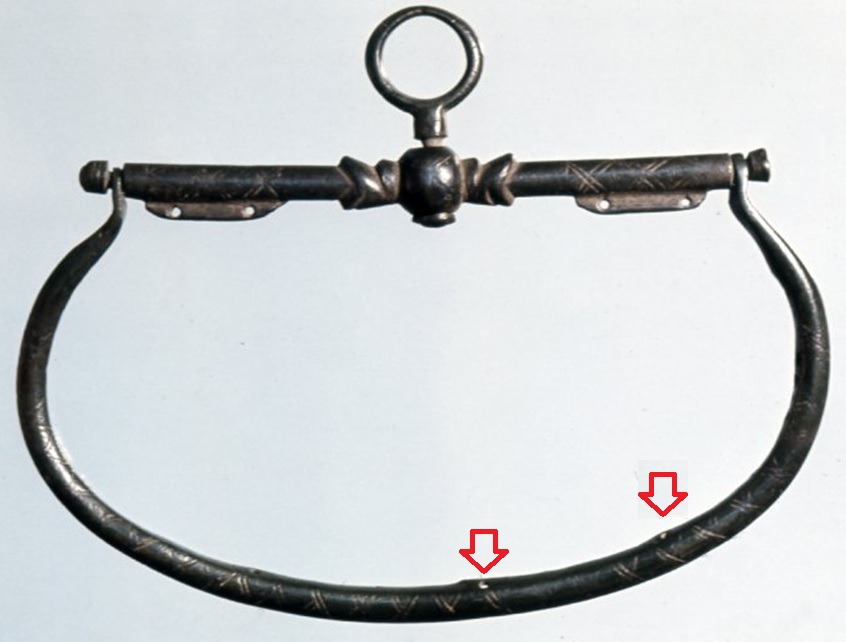
The picture on the right bottom shows the cross section of the purse frame. As you can see, the frame is NOT flat, but rather L shaped. The back of the L, which doesn’t really show from the outside of the purse unless the frame is bent, is pierced to allow the bag portion of the purse to be attached. The two red arrows show two locations where the purse frame is pierced. I am certain that there are others, but these holes show because the frame is bent. The fragment of purse frame that I own has two holes in the back section of the frame that are 1 3/8 inches apart. Both of these holes are elongated from extreme wear and stress. Most purse frame pieces that we see show extreme wear. The main support bar is often bent and the holes in the frame that were used to support the fabric or leather bag usually show signs of wear. I have seen at least some examples where the top of the fabric bag was actually sewed to, and supported by, a heavy wire, which was then attached to the purse frame with wire loops. These wire loops would have put a considerable amount of point stress on the purse frame, causing both wear and stretching or bending of the purse frame. I would also suspect that purse frames, being an expensive item, were reused until they were totally worn out. It seems as if putting a new cloth or leather bag on a metal purse frame would have been a way to relatively inexpensively update an important accessory.

Before we go any further I should give a set of standard terms that I am going to use to describe purses. I have looked at a lot of purse frames in person and in online collections and my terminology aligns with what I see most of the museums using. Here is a graphic showing the basic purse frame with terms. It really isn’t that complicated, but having a set of standard terms will make it simpler when we are discussing the basic construction techniques that are used in the more complex purses later.

typical purse frame Parts

Next Time: What other forms of purse frames do we find?

Purses Part 3 Understanding the Basics of a Frame Purse

Way back when I saw my first purse frame, I really did not completely understand the mechanics of the frames. What was the most common form of purse frame? What sort of fancy frames were available? Was there a bargain basement purse frame available? How were they worn?

So let’s start at the beginning. When I started writing this blog I remembered that I had seen my first purse frame ever at the Victoria and Albert Museum in London, England. So I went looking for it in their digital collection. This is the purse frame that I saw at the V&A. I actually found it online in their collection! And now I totally see why I was confused. This is not a “typical” purse frame. Add to that the fact that the frame was displayed flat on a board, without any clarifying pictures, or or an explanation of how it would have been used.

If you go to the link you can see the Niello decoration on the one purse frame loop, and the top. I admit I spent a couple of hours “off in the bushes” doing a little Latin research to see if I could figure out exactly what it says on the purse frame. Some of it is quite obvious. O Domine on the left part of the top bar, IHS on the center pivot, and Chrisste on the right side of the bar. The curved bar says: Ave Maria Gracia Plena, Dominus tecum, Benedicta tu in melieribus et… but then they lose me in the abbreviations. For non-Latin scholars that last part is the beginning of the “Ave Maria” that was said as part of the rosary – Hail Mary, full of grace, the Lord is with thee; blessed art thou amongst women. According to the museum listing it also says St. Maria and St. Barbara somewhere on the purse frame, probably on the back of the main support bar. The origins of the purse says it was found near Binham priory. Binham was a Benedictine Priory that, like all of the Catholic Priories in England was suppressed in 1539 during the reign of Henry VIII. It makes me wonder if this piece belonged to the Prior (head of the Priory) when the suppression occurred. Several Abbots were actually executed and hung from the gates of their own monasteries, and the looting of the monasteries and churches was commonplace.

Anyway, back to purse frames. The most common form of large intact purse frame that we find looks like this.

typical purse frame

Intact frames are moderately rare. Usually we find broken pieces of the curved bars, because they are more fragile than the rather beefy crossbar. I have added two red arrows to this picture because the picture has a very important construction clue. I might not have understood this clue if I didn’t own a broken piece of an actual purse bar frame.

Next Time: What the Clues tell us and More about purse forms!