Last time I asked, “How could they make cast and formed pieces look heavier than they really are?”
One of the things that I noticed when I first actually handled the pre-1600 artifacts that I own was the extremes that they would go to make it LOOK like the piece was solid and thick.
The biggest tricks that were used involved carefully cast, or formed, pieces of metal, that were riveted together to create hollow structures. Even if a buckle or belt end looks very solid, like the belt end form that was common to both my husband’s belt and one of the artifacts, the originals were actually hollow.
 This set of pictures compares my hubby’s belt end, on the left, to the period belt end. The graphic overlay on the right picture shows some common options for the inside piece of the belt end. Remember, the artifact belt end is actually a sandwich of three pieces of metal, two exterior pieces and a center cast piece. The most common form that I have seen for this central piece of metal is a combination of the blue and green areas, but I have also seen larger belt ends with the green portion of the cast piece removed. In either case having the center of the belt end hollow uses a lot less metal, and also makes the belt end lighter.
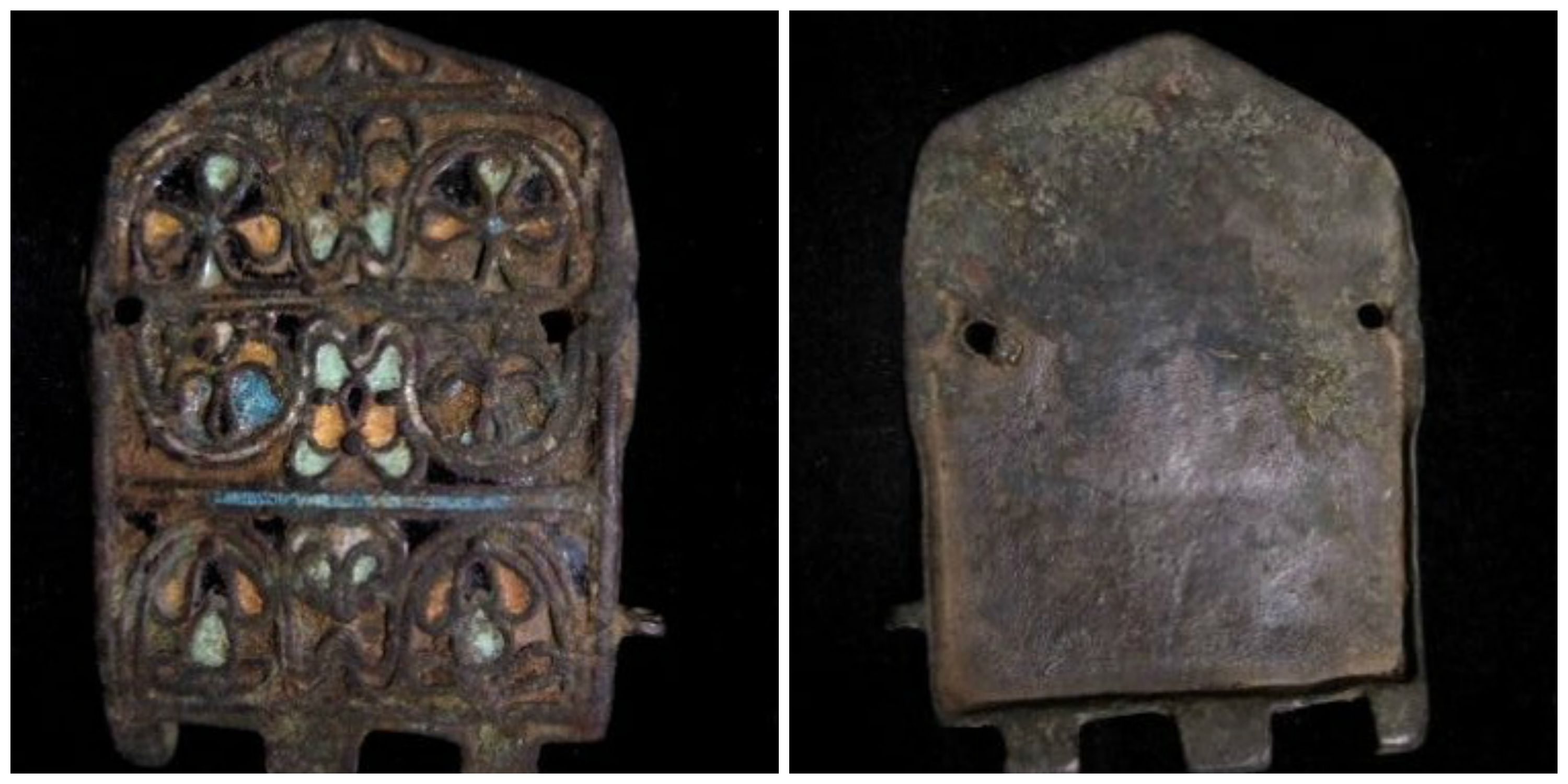 This chunky looking Byzantine buckle front may look heavy, but as the picture on the right shows, it is actually hollow. The back plate is missing, and would have had a hook to actually close the belt.
Another square belt buckle fitting that I have is actually a carefully cast hollow form. The leather belt fills the entire inside of the hollow belt, and the metal is carefully riveted to the leather. The metal wraps down around the sides of the leather. The only way to tell that the belt buckle fitting is hollow is to turn it over and look at the back – a perfect fake heavy buckle.
Going back to manufacturing techniques, one of the most common differences between pre-1600 belt fittings and modern ones is that many of the modern versions of belt fittings are soldered.
Soldering was NOT common for non-precious metals on jewelry and accessories that were made prior to 1600. They did not have all of the fancy matching solders that we have today. And they certainly did not have oxy-propane torches.
Precious metals, like gold and fine silver can be fused, either in a furnace or soldered with a lamp and a blow-pipe, but base metals were generally riveted. Precious metals have different properties – they can be spot heated, but with base metals you have to heat the entire piece in order to solder them.
One of the important exceptions to this rule is the soldering of the heads of dressing pins. There was a decree during the reign of Henry VIII requiring that the heads be soldered. The solder that was used was lead based, and would show up badly – like the solder on my buckle below. (The decree was actually a form of trade sanction to make it more difficult for pins from the Low Countries to compete with British made pins.)
 So what are my theories on where these misconceptions came from, and what else is not as big as we might think? We will talk about that next time!