What size Were Brooches in the Middle Ages – Part 6 – Buckles!

Buckles. It seems an easy enough topic, but it turns out to be quite the pile of spaghetti.

First of all, based on most of the buckles that I see at SCA events buckles were huge prior to 1600. But, based on the artifacts that I see in my collection, and museum collections, they were often quite moderate in size.

Second, a buckle, is a buckle, is a buckle. Or is it?

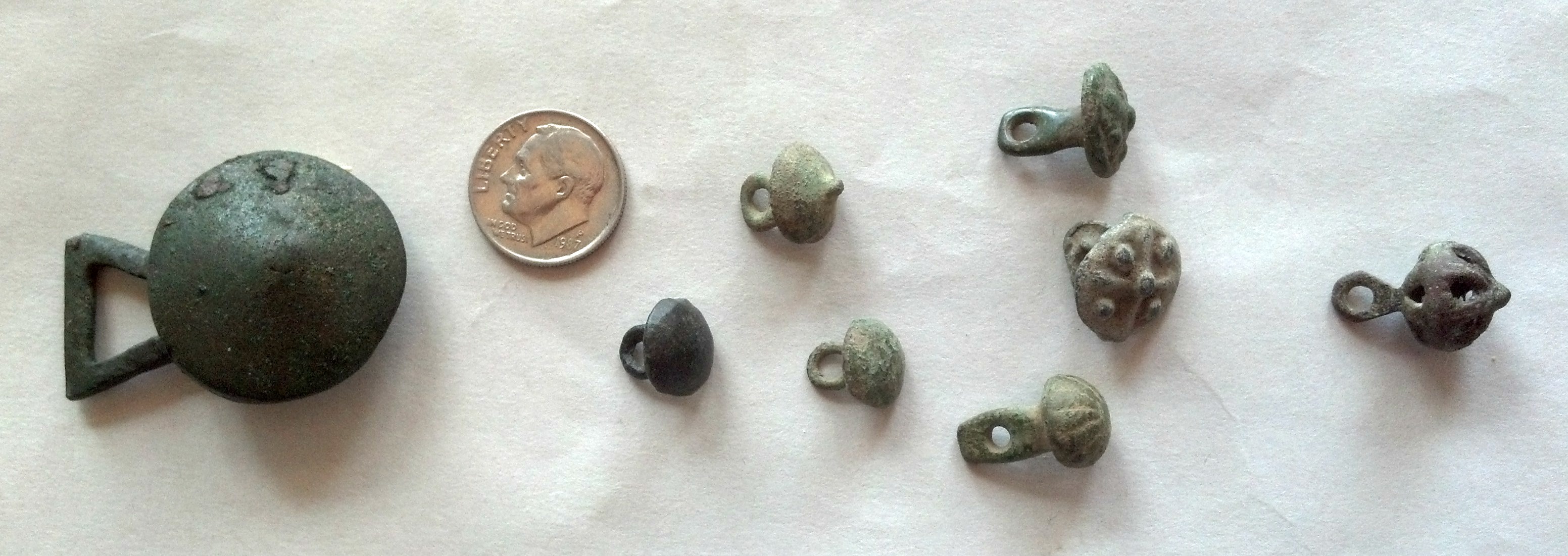
Buckles(photo credit: Irene Davis 2015, from the Eirny Historic Collection)

This picture shows just a few of the Medieval buckles in my collection. The buckle with the strange looking hook is called a locking buckle, and this particular one, along with the buckle in the top left corner are both from Northern Ireland. The other buckles are all from England.

So let’s start with the simplest part – the size of buckles. It really isn’t a mystery. While buckles big enough to make a rodeo cowboy drool may look pretty cool, they really have very little to do with the buckles that were actually worn by most people prior to 1600. We have tons of buckles available for viewing on museum sites and lots of portraits of people wearing belts with buckles.

Let’s look at an example. How about a family portrait of Archduke Maximilian II, painted in 1563? If anyone could afford a big fancy buckle, he sure could. But you won’t find one in this picture.

This portrait of Queen Mary I, by Master John, shows the belts that were typical for women during this time frame. There is no real buckle, just some sort of fastener that allows the length of the belt to be adjusted.

Well surely someone had big buckles before 1600! So I went to the Metropolitan Museum of Art and the British Museum online collections, and looked for the biggest buckles that I could find. This amazing Frankish buckle (675-725 AD) is 6 inches by 2 11/16 inches. Pretty respectable!  And this Visigothic buckle (550-600 AD) is 5 3/8 by 2 3/8 inches.

The first thing that I noticed when I started looking for big buckles was that large display type buckles were usually made up of several pieces. This Merovingian buckle is an excellent example. Each individual piece of the buckle is really not that huge, but the overall effect of the pieces when they are put together is pretty spectacular.

The second thing that I noticed about larger display type buckles, is that even most of those were really not that wide (the top to bottom dimension on our giant Frankish buckle in the Met was less than 3 inches).

Why do we see these limitations in size in pre-1600 buckles? Some of the obvious possibilities include cost, difficulty of construction. fashion, and functionality.

And that is what we will talk about next time.

What size were brooches in the Middle Ages – Part 5 – Fibulae, Dress Pins and Miscellaneous Brooches

So, the first thing I should probably do is describe a fibula (singular). Think safety pin without the safety. Fibulae (plural) appear on the scene by about 1,000 BC in Mesopotamia, and we still use their descendents today, in the form of kilt pins and safety pins. Pre-1600 fibulae can be made of bronze, iron, silver, or gold, They can generally not be made of lead or tin because these metals are too soft and will break when flexed repeatedly. Fibulae can be plain and functional, or large and ostentatious. This gold Etruscan Fibula shows just a hint of the type of complexity and beauty that was put into crafting some of the ancient fibulae. And this winged fibula from Panonia (an area that bordered the Danube) is an exquisite example of the jewelers art.

But on a practical level, most fibulae were relatively plain and functional. This picture shows a selection of fibulae and pins that I own. The left hand column is a 1500’s pin, a Celtic fibula (3rd to 2nd c BC), and a Celtic fibula (from Yugoslavia 1BC to 1 AD). The large dress pin on the left is a Roman silver hairpin pin (found in Yugoslavia 1st to 3rd c BC – and yes, that is a duck on top), and the large pin on the right is a silver reproduction Viking dress pin that I use for closing my shawl. The right hand column contains reproduction pieces from The Treasury. Three sets of two: dress pins – 1200’s to the Victorian Age. The top set are small brass pins, the middle are large brass pins, and the bottom are large nickel silver (looks like silver). The bottom of the column is two small fibulae, one in brass and one in nickel silver.

Fibulae and PinsAnd what about dress pins? I personally believe that dress pins are probably one of the oldest types of closures that were used by mankind. A large thorn, a sharpened stick, and eventually sharpened pieces of metal were used by almost every culture to close a cloak, hold hair in place, or close a more complex garment. The size and complexity of construction of dress pins varies dramatically depending on the available materials used, and the technology available to the maker. Earlier dress pins were generally (always a dangerous word!) larger, usually three to six inches long. Later period dress pins could be much smaller, often only 1 to 1 1/2 inches long, but larger specialty dress pins, in the form of hair pins and hat pins are still in use today.

And then there are the “miscellaneous brooches”. Different shapes, different sizes, different metal alloys, and we often find them out of context. What were they used for? Were they decorative? Were they functional? Were they both?

It is known that in Roman times there were specific large brooches awarded to certain men of rank. This bow brooch, which is a specialized form of fibula, is an excellent example of this sort of brooch.

And some of the huge ring brooches that we find in Scotland and Ireland, certainly fall into the “I am obviously important” display category. This brief article on the Tara Brooch has a couple of great pictures.

There are also tons of brooches shaped like animals, hearts, flowers, and geometric shapes, just to name a few. But going back to our possibly long forgotten original point – most don’t lay flat, and while they may work well on an outside layer of clothing, they don’t work well on an interior layer.

Next Time: Buckles!

What Size Were Brooches in the Middle Ages Part 4 – Buttons and Toggles

Buttons and Toggles. When did they appear, and is everything that looks like a button or toggle actually used to close your clothes, or are they just decor? What size were they and what were they made of? Who wore them? And does your definition of a button require that the button actually be pushed through a hole in fabric or leather, or can the button be used with a loop?

toggles and buttons(photo credit: Irene Davis 2015, from the Eirny Historic Collection)

This picture shows some typical ancient artifacts. On the left we have a Celtic or Roman toggle, the middle six buttons are typical medieval buttons and the right most button is a fancy Tudor button.

Lots of questions, and not as many definitive answers as I would like to have. One of the problems that we deal with is that the older the button, the less likely we are to find it attached to a piece of clothing. In Egypt, for instance, we find a lot of “button-like objects” some of which are made of really beautiful blue faience. Many date from 1479 to 1458 BC. But when they are found in well-preserved burials we see them used as part of necklaces.

By the time we get to Persia, in about the 3rd to 7th century AD, we are seeing hundreds of button-like objects, most taking the form of round disks, made of ivory or bone, and some have simple carved designs on them.

Could these disks have been used as buttons? Sure. Were they? No clue. We know that by the early 1500’s we find tons of Persian Miniature Paintings that show buttons in use on clothing. In this Painting “Standing Youth with Staff”, we can see that his outer coat is closed with a row of buttons, probably anchored closed with loops – not pushed through button holes.

The Romans and Celts both appear to have used toggles. Here is a Celtic Iron Age Toggle. And here is another toggle where they are uncertain if it is Roman or British.  The Roman carving that is known as the Camomile Street Soldier shows the use of both buttons and toggles on his clothing.

And what about colder climates? Logically keeping your clothes tighter around yourself would be more important if the weather was colder. We find buttons in the graveyard in Birka, Sweden. These look like standard Medieval buttons that you could find anywhere in Europe. This pdf includes a picture of the buttons along with a picture of a leg wrap hook and some other assorted artifacts.

The Skjoldehamn bog find includes a shirt. This page has a diagram of the shirt, which has been carbon dated to 995-1029 AD. The striped square (actually strips of trim on a flap) that covers the neck opening on the shirt, is closed with a bead that is used as a button, and a loop.

And then there is the question of who wore them. I just got a message from a friend asking about buttons on women’s dresses. We do see them sometimes on the outside layer of a Gothic fitted gown, but all of the structural “stress” is controlled by the underlayer, which is laced. The expansion and contraction that most women experience every month (not to mention pregnancy) is controlled by lacing or the use of pins to hold plackets in place. So most buttons in Europe, prior to the 1600s were worn by men.

Next Time: Fibulae, Dress Pins, and Misc Brooches