
Purses Part 3 Understanding the Basics of a Frame Purse

Way back when I saw my first purse frame, I really did not completely understand the mechanics of the frames. What was the most common form of purse frame? What sort of fancy frames were available? Was there a bargain basement purse frame available? How were they worn?

So let’s start at the beginning. When I started writing this blog I remembered that I had seen my first purse frame ever at the Victoria and Albert Museum in London, England. So I went looking for it in their digital collection. This is the purse frame that I saw at the V&A. I actually found it online in their collection! And now I totally see why I was confused. This is not a “typical” purse frame. Add to that the fact that the frame was displayed flat on a board, without any clarifying pictures, or or an explanation of how it would have been used.

If you go to the link you can see the Niello decoration on the one purse frame loop, and the top. I admit I spent a couple of hours “off in the bushes” doing a little Latin research to see if I could figure out exactly what it says on the purse frame. Some of it is quite obvious. O Domine on the left part of the top bar, IHS on the center pivot, and Chrisste on the right side of the bar. The curved bar says: Ave Maria Gracia Plena, Dominus tecum, Benedicta tu in melieribus et… but then they lose me in the abbreviations. For non-Latin scholars that last part is the beginning of the “Ave Maria” that was said as part of the rosary – Hail Mary, full of grace, the Lord is with thee; blessed art thou amongst women. According to the museum listing it also says St. Maria and St. Barbara somewhere on the purse frame, probably on the back of the main support bar. The origins of the purse says it was found near Binham priory. Binham was a Benedictine Priory that, like all of the Catholic Priories in England was suppressed in 1539 during the reign of Henry VIII. It makes me wonder if this piece belonged to the Prior (head of the Priory) when the suppression occurred. Several Abbots were actually executed and hung from the gates of their own monasteries, and the looting of the monasteries and churches was commonplace.

Anyway, back to purse frames. The most common form of large intact purse frame that we find looks like this.
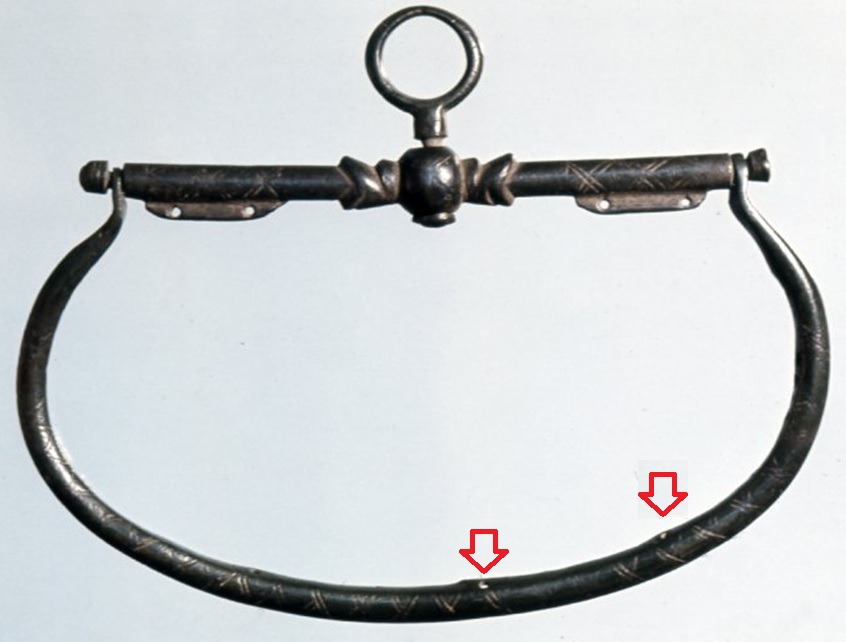
typical purse frame

Intact frames are moderately rare. Usually we find broken pieces of the curved bars, because they are more fragile than the rather beefy crossbar. I have added two red arrows to this picture because the picture has a very important construction clue. I might not have understood this clue if I didn’t own a broken piece of an actual purse bar frame.

Next Time: What the Clues tell us and More about purse forms!

Purses Part 2 My First Attempt at a Purse With a Frame

My first introduction to seeing a purse frame in person occurred a very long time ago on a trip to England. I was wandering around the Victoria and Albert Museum when I discovered a display in the Bronze Department of a purse frame with Niello inlay. Niello is a decorative metal working technique that is used to create contrast on metal surfaces (for more information read this blog).

The purse frame was not complete, and I admit that I only had a vague concept as to how it worked, but I remembered the little metal frame coin purses that were popular when I was a little kid, and I knew that it had to be similar. A few months later I was in the midst of the year long Arts and Sciences Competition in the West Kingdom, known as the Golden Poppy. I wanted to make a purse with a frame, and I knew about the purse lid from the Sutton Hoo. I really wanted to do something Viking, but I couldn’t find anything like this, so I settled for Anglo Saxon. The fact that I even looked for something like this from the Vikings really shows how little I understood about Viking technology and working styles, but that is another blog.

So, based on what I knew about the purse frame that I saw in England, purse frames that I was able to find in books, and the Sutton Hoo Purse Lid, I made a purse.

Frame Purse Lid

I wrote a blog to give detailed photographic views of the purse. Here is the first part, and here is the second part.

If you are interested in the original detailed documentation here are the links to read it. It includes all of the steps, why I did what I did, and the bibliography.

Part 1

Part 2

Part 3

Part 4

Part 5

Part 6

If you are interested in understanding the basic process of enameling, which I used to decorate the disk on the lid of the purse, here is a blog explaining the process.

Next time: Understanding the basics of a frame purse

Purses Part 1

Purses. They take many forms, they are used by all social classes, and they are an important accessory for just about everyone from at least the Late Stone Age on. The actual definition of what constitutes a purse is a more complex issue than you may think. What are the size limitations, the materials that they can be made of, the method of construction, the method of closure?

Probably the most common materials are leather and cloth, and the most common closures are a draw string or toggle. I know that for the first ten years of my life as a reenactor that describes all of the purses that I, or any of my friends had. Simple bags with drawstrings, or leather belt pouches with some sort of toggle or latch completed our need for carrying small things (like money and eyeglasses). We often had other small bags and pouches in our purses to control the chaos that tended to develop in the purses.

Now that is not a complaint or any sort of put-down. Some of these purses, were truly lovely, embroidered pouches with silver spangles and tassels, leather belt pouches with leather tooling, appliqué, studs, or lacing. Totally documentable, and something that anyone should be proud to wear.

There are some excellent resources out there for people who are interested in making a reproduction of one of these types of purses. Archaeological reports often have very good pictures or drawings of the purse patterns. Probably the most notable collection of solid archaeological information on purses, that has been made much more user friendly with the inclusion of photographs, drawings, Medieval illustrations and good explanations is “Purses in Pieces” by Olaf Goubitz. Although the book focuses on the Archaeology of the Netherlands, the purse forms are fairly universal throughout Europe, just as any important accessory would be today. As a side note, the reason so much leather survives in the Netherlands is because of the soil conditions. The naturally wet conditions often preserve the leather instead of causing it to rot. We find the same sorts of preservation of leather and wood in the Novgorod (Russia) “black earth” areas.

As I mentioned before, the size and materials that an item is made of might also define its name. At what point does a purse become a Pilgrim’s bag? At what point does a net bag become Shepherd’s purse? But I have to admit that my plan is to leave that discussion for another place and time. Despite the fact that the purse forms that I have mentioned are very common in Medieval Illustrations they are definitely NOT the only form of the purse that we see represented. What interests me, and in fact has become something of a research obsession for me, is purses with frames.

Now that may seem a bit confusing at first, but most people are familiar with at least one purse that has a frame, the elaborately decorated purse lid from the Sutton Hoo burial.

Purse-lid from the Sutton Hoo ship-burial 1, E...

Purse-lid from the Sutton Hoo ship-burial 1, England. British Museum. (Photo credit: Wikipedia)


Next time: My first attempt at making a purse with a frame.