But Where Can I Learn This Stuff? Figuring out where you can learn the things that you want to learn.

I am a class junky.

I just finished taking six days of classes and watching at least an additional dozen demonstrations before and after class. My classmates included people from the United States, Canada, Mexico, Honduras and Guatemala. I am officially tired and suffering from information overload, but I am also very happy and looking forward to actually using all of the new skills that I have learned.

Where did I go? The Rio Grande Winter Workshop in Albuquerque, NM. Why there? I have been to Rio events before and they bring together some of the finest jewelry and metal working teachers in the world, all in one location, for six jam-packed days. Vendors like Fordham, Swanstrom Tools, Fretz Hammers, and Bonny Doon Press, just to name a few, send representatives and do demos, and in some cases actual classes. In addition to their Winter Workshop they also do individual classes during the rest of the year on a variety of jewelry topics.

But what if you can’t travel to a major international class event? What can you do closer to home?

Regional schools greatly reduce the need to travel large distances.

In North Carolina the Penland School of Crafts is a major learning location for all sorts of arts and crafts.  Most regions of the US have locations like this. Haystack Mountain School of Crafts on Deer Isle, Maine is open year round, but holds most of its classes during the summer.

There are also plenty of schools that specialize in a particular area of study. For example, in the Boston area, MetalWerx runs jewelry classes all year, plus special workshops in the summer.

In Corning, New York, the Corning Museum of Glass runs a huge number of glass working classes – everything from making glass beads to glass sculpture and glass blowing.

CorningGlassTower

CorningGlassTower (Photo credit: Wikipedia)

Beyond the private schools, community colleges often provide a very affordable and local alternative for learning. When I lived in California I used to drive down to Monterey Peninsula College once a week for an all day jewelry class. They have extensive continuing education classes in addition to their regular curriculum, and occasional weekend workshops.

Adult Education programs often have a wide selection of classes available, usually at very affordable prices. Local craft stores, both privately owned, and big box, often teach a wide variety of classes that relate to the products that they sell.

Quilt

Quilt (Photo credit: Wikipedia)

But what do you do if you don’t live close to the classes that you want to take, or the classes do not fit your schedule? I will discuss that next time!

Jewelry: Understanding Enamel

When I first thought about doing this article I considered all of the very detailed information that has been written about enameling, and then I thought sometimes people want to just have a basic understanding of a process, without too many details. So basic it is.

Enameling is a process of decorating the surface of metal with color. The earliest examples of enamel work appear to have been done in Egypt about 1600 BC, so the process has been around for a very long time.


Box with angels, intended to contain small bot...

Box with angels, intended to contain small bottles of holy oils. Champlevé enamel over gilt copper, early 13th century, Limoges (Limousin, France). (Photo credit: Wikipedia)

Unfortunately, in modern times the word enamel has come to refer to a type of paint. But we are not talking about paint, we are talking about melted glass. We are also not talking about “cold enamel”, which is actually colored epoxy.

Enameling is usually done only on fairly high carat gold or fine silver objects, but it can be done on true bronze and copper. Why the limitations on the types of metal? Because the process of heating the metal to adhere the enamel causes the metal to share molecules with the enamel in the form of metal salts. Metal salts are what are used to actually color glass, so additional metals salts will change the color of the glass.

The basic enameling process goes like this. Glass is ground up and then rinsed in clean water to remove any cloudiness. The powdered glass is then placed in contact with an appropriate metal. It can be held in place by indentations in the metal, or wires. It can also have organic glue, which will burn off during the heating process, mixed with it to help hold the powdered glass in place.

The actual process of heating up the metal and glass is called “firing”, the same as with pottery. The metal and powered glass are heated until the glass fuses back together into a sheet on the surface of the metal. The glass is now enamel.

You may wonder what makes the glass stick to the metal. Molten glass generally likes sticking to metal, as any lamp worker who has ever had a bead get stuck on a tool or mandrel can tell you. This natural tendency can also be improved by carved out depressions in the metal for the enamel to melt into, and these depressions can be made even more efficient by creating an “undercut” on the sides of them. This undercut creates a physical lock on the sides of the enamel that helps to hold it in place.

The care and feeding of enamel. Enamel is, after all, glass. If you bend the metal on which it is placed it will very likely crack and it may even pop off. Smacking a piece of enamel on a hard, sharp object will almost certainly chip the enamel, the same way your windshield is chipped by a flying stone. The fact that we have thousands of pieces of jewelry, and decorative pieces that still have enamel on them, after hundreds, and sometimes thousands of years, is a testament to the fact that enamel is a wearable and functional form of decoration.

I hope that this brief article has given you some insight into the basic concept of glass enamel.


picture of enamel

picture of enamel (Photo credit: Wikipedia)


Enhanced by Zemanta

Basic Jewelry – Understanding Wire: Part 3

This is the third in my series of blogs about understanding wire. If you will remember, the three basic things that you need to understand about wire are:

1. What the wire is made of.

2. How hard the wire is.

3. What gauge the wire is.

Today we are discussing wire gauges. So what exactly is a wire gauge? It is simply a unit of measure that tells us how large the wire is. It is based on the diameter of a cross-section of the wire.

There is more than one gauge scale that is used to describe the size of wire. And which scale you use is determined by where you live and what type of wire you are dealing with. In the United States and Canada the common wire gauge system that is used for measuring the type of wire that jewelers usually use is the American Wire Gauge, most often known as Brown & Sharp (B&S). It was developed in about 1855 in England by Messrs. Brown & Sharpe. The British Standard System was adopted in England in 1986. It uses a measurement system that is based on the metric system.

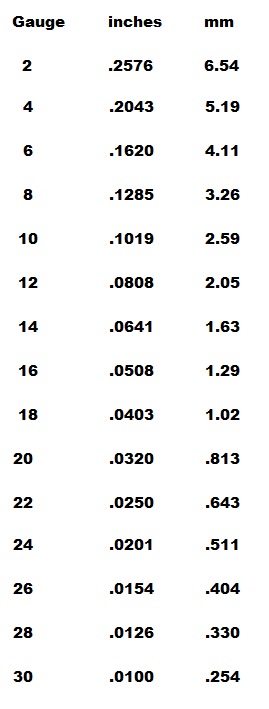
What is important to the artist is knowing which system of gauges is being used and what size the wire is. Obviously, if you are buying the wire in person you can simply look at it and decide which size of wire to purchase, but if you are purchasing wire online, sending someone else to buy the wire for you, or trying to duplicate a piece of wire work exactly, knowing the correct wire gauge is important. I have included a copy of the actual measurements that are associated with the B&S system. If you are working with any other gauge system or with specialty wires (iron, steel, electrical) you will need to determine what the actual measurements for that system are.

wire gauges

The first thing that you should notice about this system is that the larger the gauge number, the smaller the wire. The second unusual thing is that only even numbers are used. I have seen companies use odd numbered gauge sizes, but this is usually only done with the larger sized wires.

If your brain is saying “this whole thing is meaningless to me, it is just a bunch of numbers” then I have a couple of suggestions. The easiest thing to do is to get a ruler with metric markings on it and estimate the size of the wire that you want that way. Another solution is to create a little sample chart on a piece of poster board with actual examples of the different sizes of wire that they use most often- labeled. Still anoither solution is to purchase a wire gauge.

A wire gauge.

A wire gauge. (Photo credit: Wikipedia)

This is what a wire gauge looks like. It is a flat round piece of metal with little notches on the edge that show the actual size of the wires. It can be used to physically measure a piece of wire to determine what the gauge of the wire is, and it can also act as a visual reminder of the size of the different gauges of wire.

I hope that this brief article makes it easier for you to find the correct gauge of wire for your project!

Enhanced by Zemanta