Wire Weaving – Not as Simple an Issue as it Seems -Part 4 – Wire Weaving and Trichinopoly: Are they the same?

So when I took that class at Gulf War, I was immediately excited when I saw the information that the teacher was presenting. Sad to say I actually remembered having run across it a couple of years earlier, while looking for something else. It was one of those things that I planned to “get back to”. I tried to explain to the teacher how important her information was and that she could use fiber terms to help her students to understand the structures that she was discussing. Her response – I don’t do fiber. OK. But a LOT of people do – more than the number of people who do metal. This is why I require my apprentices to have an open mind towards at least understanding the basic technology of crafts other than their own.

Back in 1774 a hoard was located in an old tin mine. Known as the Trewhiddle Hoard. It had some very unusual and unique metal items, including what is believed to be the oldest surviving Christian ceremonial scourge. The scourge was made of silver wire. The Reverand Philip Rashleigh managed to acquire most of the find and wrote a report on it in 1788, which was published in the Society of Antiquaries journal, Archaeologia, IX, 187. As was typical of many of the discoveries that occurred during this timeframe, a considerable portion of the original find has disappeared. Fortunately, the scourge has survived and is in the British Museum.

The original report by Rashleigh does not shed any light on the structure of the scourge, being a simple listing of the items that were found. The decision to call the technique Trichinopoly is lost somewhere in my archives. I thought that I had discovered the gentle’s name, but I can’t currently locate it. Supposedly the story was that being stationed at some point in Trichinopoly, India, a British Colonial Administrative District, the individual in question recognized the technique as something that he had seen in India, and gave the technique a name.

In 1961 D.M Wilson and C.E. Blunt published an article, again in Archaeologia (Jan 1961, Vol. 98) titled, The Trewhiddle Hoard. And they detailed the structure of the scourge wire.
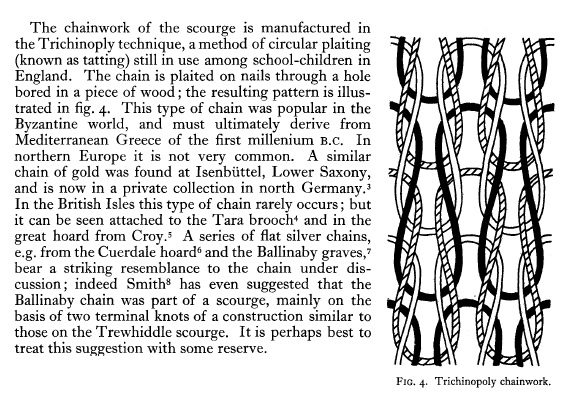
Trewhiddle Hoard Scourge FOrmI have to admit, this brief excerpt makes my head hurt. Looking at the picture the structure of the scourge is obviously knit. The author’s description of the “circular plaiting” as tatting is incorrect. According to the Merriam-Webster’s Dictionary tatting is: a delicate handmade lace formed usually by looping and knotting with a single cotton thread and a small shuttle. My Mother used to make tatted doilies, I know what it looks like. Interestingly enough, their description of the spool knitting that the children were doing is correct at least as far as the structure of the “plaiting” is concerned. I decided to investigate the individual finds that are mentioned to try to determine if they were being consistent in the use of the word Trichinopoly, or not.

Next time: Consistent or Not, and Why is ANY of this Significant?
Wire Weaving – Not as Simple an Issue as it Seems – Weaving, Nahlbinding, and Knitting

Last time we discussed three basic forms of chains – simple linked chains, loop in loop chains, and wire weaving. The reason that I needed to discuss those things was because we need to start looking objectively at the words we are using to describe a craft. And this time we are supposed to talk about Weaving, Nahlbinding, and Knitting.

Why? Because our ultimate topic is Wire Weaving.

If we enforce the idea of the name of a process being correct, based on the definitions of the words in that name, we need to look at each word separately. The chains that we have looked at all use wire, but the way in which that wire is used is dramatically different.

According to the name of the chain we are supposed to be talking about a type of weaving. Dictionary.com gives this definition of weaving: ” to form or construct something, as fabric, by interlacing threads, yarns, strips, etc. ” OK, I have to admit that my personal definition tends more towards the warp and weft theory of fabric construction, but if we use their definition, we are OK.

As always, being a crafty geek I don’t do just metal work, I also spend a lot of time doing fiber things, and one of those things that I tried was Nahlbinding. Now one of the first things that you will notice about this craft is that no one seems to be able to agree on how the name of the technique should be spelled. Why is that? Because every Scandinavian language has their own word for the technique, and they are each slightly different.

But getting back to the basics of the technique… guess what? The pattern that is used for the classic “Viking Wire Weaving” is the same as the Coptic stitch in Nahlbinding.

I had also been involved for a long time with the study of Nahlbinding vs. Knitting, and the arguments about which came first and where they both originated. So discovering that the Vikings were using the same technique for working in both wire and fiber was not really particularly shocking to me.

Craftspeople in less technologically isolated cultures (the crafts are often done in semi-home workshops, rather than in technology parks and factories) would have been more likely to be exposed to the techniques that were used in crafts other than their own. The Egyptians were using the “Viking Wire Weaving” technique long before there was such a thing as Vikings. And they were also using the technique of Nahlbinding to make socks before there were Vikings. This pair of socks owned by the Victoria and Albert Museum is an excellent example of that. http://collections.vam.ac.uk/item/O107787/pair-of-socks-unknown/

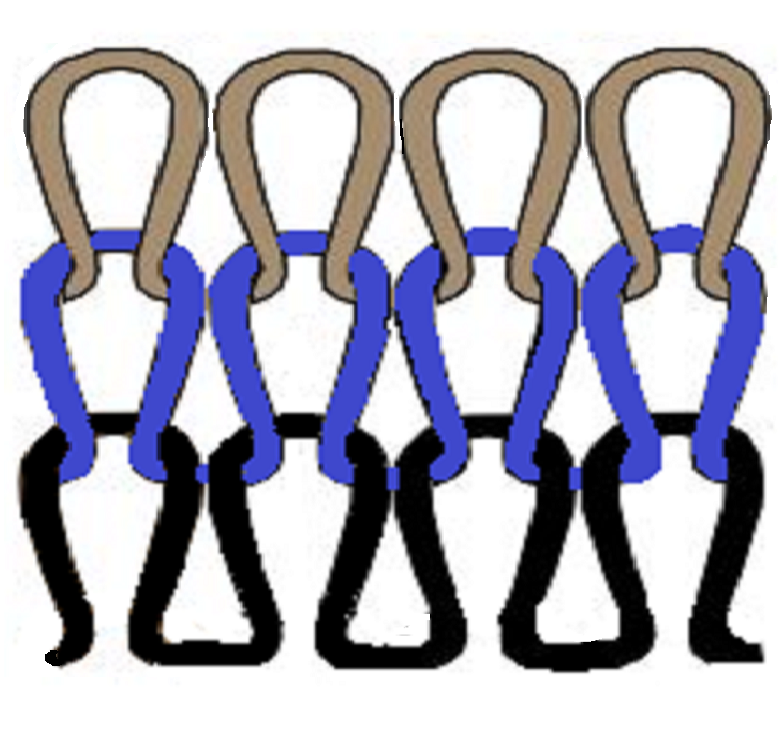
Another unfortunate name for wire weaving is Knit Chain. But at least to Knitters, knitting means something very specific. The graphic below shows the structure of a simple knit piece, a very different structure from Nahlbinding.

Knit structureJust in case you have forgotten, this is the structure of Nahlbinding.

wire weaving

So obviously, Wire Weaving, or Viking Wire Weaving, is NOT a knit chain.

Next time: Wire Weaving and Trichinopoly: Are they the same?

Wire Weaving – Not as Simple an Issue as it Seems – Part 2

So last time I talked about taking a class at Gulf Wars and mentioned that it reorganized my thoughts on Wire Weaving and a couple of other skills. Before we can go any further everyone needs to have a basic knowledge of “Viking” Wire Weaving, Linked Chains, and Loop in Loop.

All three of these techniques use wire. For simple linked chains, the wire is wrapped on a dowel or other mandrel, individual links are cut, and then those links are joined together to form a chain. This diagram shows how a basic chain mail style chain is made.

Making a Simple Chain

Loop in Loop is a variation on the standard chain. It starts the same way, wrapped wire on a dowel, and then the wire is cut to create a link, but then the link is soldered. The link is then formed, and the formed links are woven together. This diagram shows the simplest form of this chain. This chain is very strong because the links are soldered and more than one wire goes through each link connection.

Loop in Loop chainThis type of loop-in-loop forms a very simple linked chain. The actual shapes of the wires can easily be seen. But more complex forms of this chain can create very complex interwoven shapes that actually resemble wire weaving. A considerable number of the modern Balinese silver chains, the ones that almost look like a snake chain, are made this way.

And then there is the “Viking” form of wire weaving that I learned and teach. This chain doesn’t use links, instead the wire is cut into pieces, usually 12 to 18 inches long, and the chain is “sewed” to create the structure of the chain. Here is the basic process, excerpted and abbreviated from my class notes that I use for teaching the Wire Weaving Class.

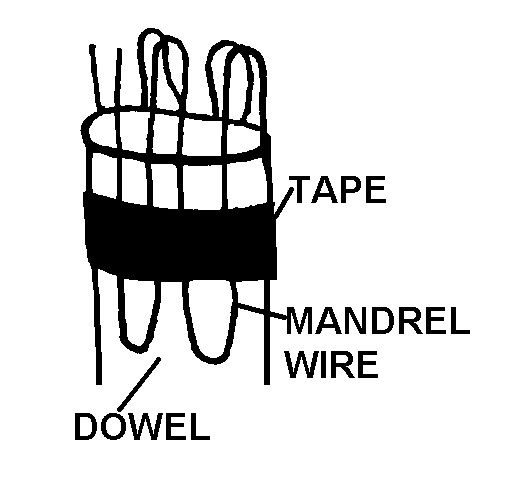
The first step in making a chain is to create a mandrel to hold the first line of loops. These mandrel loops are then spaced as evenly as possible around the mandrel and held in place with a piece of masking tape or a wire.

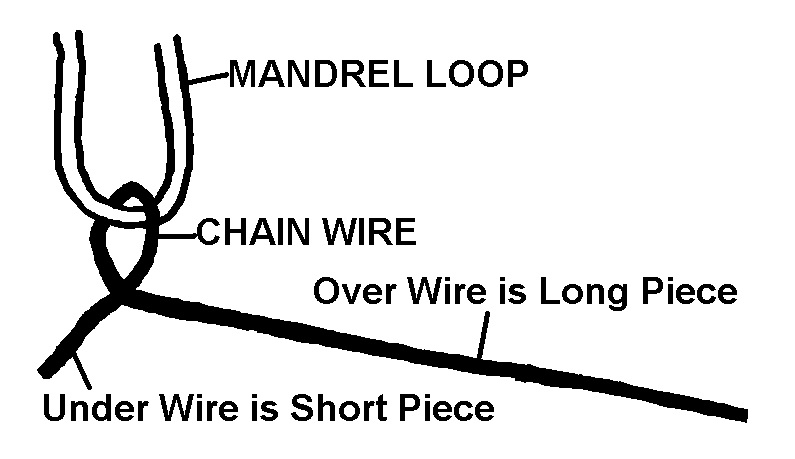
wire on mandrelOnce the mandrel is in place, cut a piece of the chain wire about 12-14 inches long and make a hook in the end of the wire that has about a ½ inch “tail”. Hook this “tail” through a loop on the mandrel and cross the tail under the remainder of the piece of wire.

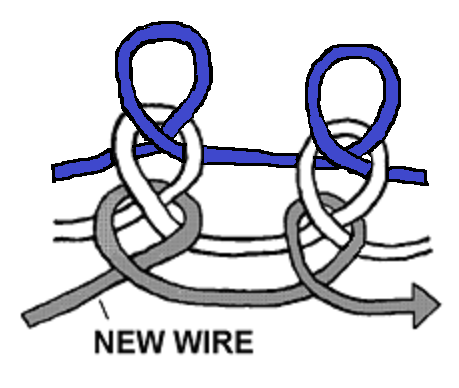
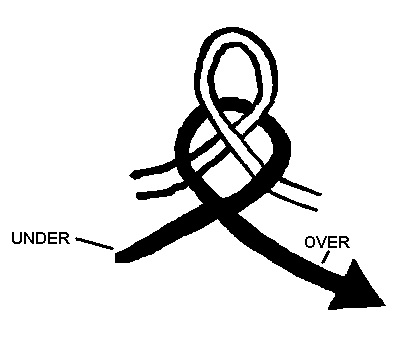
mandrel loop and wireTake the free end of the wire and loop it through the next loop of the mandrel, going over the mandrel wire and then under it and cross the chain wire. Repeat this process until all of the mandrel wire loops have a wire loop in them. Try to make the loops as even as possible, but do not despair – when you draw down a chain through a draw plate the process evens out the chain more than you can possibly believe. Continue this process on the chain wire loops. Important: As the chain increases in length, slide it off of the end of the dowel so that only about an inch and a half, or two inches of the chain remains on the dowel.

wire on wire loopWhen you run out of wire, simply cut another piece about 14 inches long and piece it by adding it in the same way as the first piece. Be careful to tuck any loose ends under the following rows.

wire weavingNow, this brief explanation of how a “Viking Knit Chain” is made should give you some insights into some of the problems that we have with terminology. Can you guess what they are?

Next Time: Weaving, Nahlbinding, and Knitting