What Size Were Brooches in the Middle Ages Part 4 – Buttons and Toggles

Buttons and Toggles. When did they appear, and is everything that looks like a button or toggle actually used to close your clothes, or are they just decor? What size were they and what were they made of? Who wore them? And does your definition of a button require that the button actually be pushed through a hole in fabric or leather, or can the button be used with a loop?
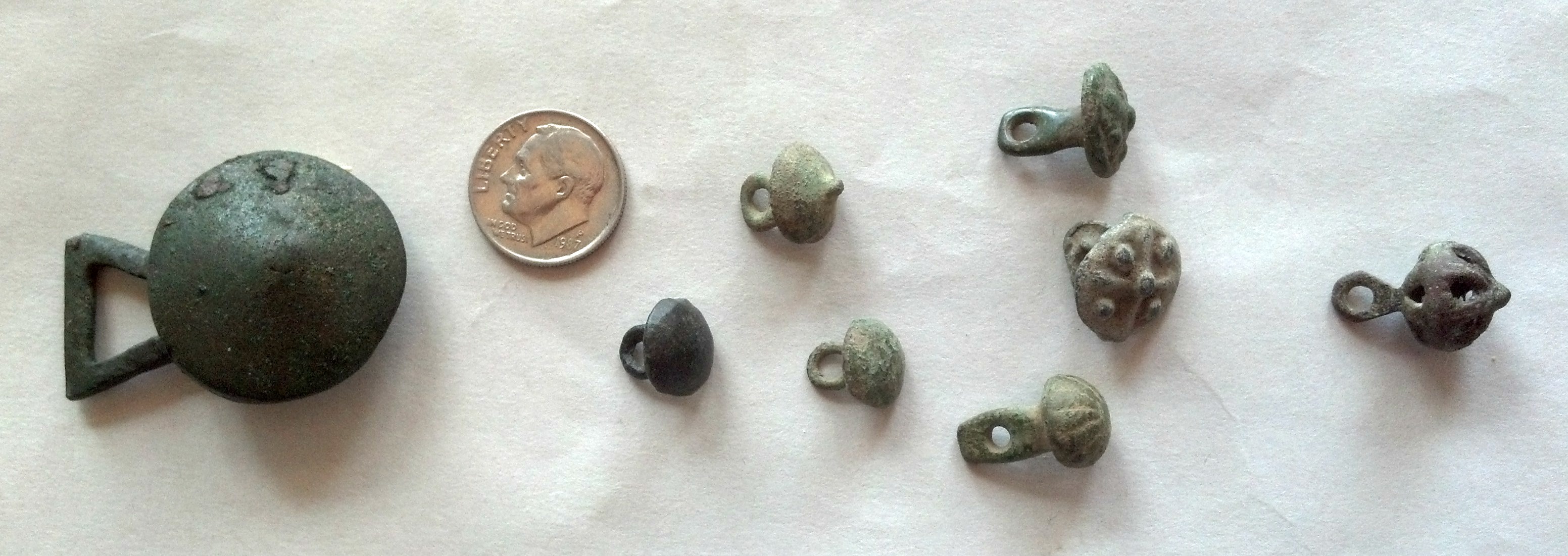
toggles and buttons(photo credit: Irene Davis 2015, from the Eirny Historic Collection)

This picture shows some typical ancient artifacts. On the left we have a Celtic or Roman toggle, the middle six buttons are typical medieval buttons and the right most button is a fancy Tudor button.

Lots of questions, and not as many definitive answers as I would like to have. One of the problems that we deal with is that the older the button, the less likely we are to find it attached to a piece of clothing. In Egypt, for instance, we find a lot of “button-like objects” some of which are made of really beautiful blue faience. Many date from 1479 to 1458 BC. But when they are found in well-preserved burials we see them used as part of necklaces.

By the time we get to Persia, in about the 3rd to 7th century AD, we are seeing hundreds of button-like objects, most taking the form of round disks, made of ivory or bone, and some have simple carved designs on them.

Could these disks have been used as buttons? Sure. Were they? No clue. We know that by the early 1500’s we find tons of Persian Miniature Paintings that show buttons in use on clothing. In this Painting “Standing Youth with Staff”, we can see that his outer coat is closed with a row of buttons, probably anchored closed with loops – not pushed through button holes.

The Romans and Celts both appear to have used toggles. Here is a Celtic Iron Age Toggle. And here is another toggle where they are uncertain if it is Roman or British.  The Roman carving that is known as the Camomile Street Soldier shows the use of both buttons and toggles on his clothing.

And what about colder climates? Logically keeping your clothes tighter around yourself would be more important if the weather was colder. We find buttons in the graveyard in Birka, Sweden. These look like standard Medieval buttons that you could find anywhere in Europe. This pdf includes a picture of the buttons along with a picture of a leg wrap hook and some other assorted artifacts.

The Skjoldehamn bog find includes a shirt. This page has a diagram of the shirt, which has been carbon dated to 995-1029 AD. The striped square (actually strips of trim on a flap) that covers the neck opening on the shirt, is closed with a bead that is used as a button, and a loop.

And then there is the question of who wore them. I just got a message from a friend asking about buttons on women’s dresses. We do see them sometimes on the outside layer of a Gothic fitted gown, but all of the structural “stress” is controlled by the underlayer, which is laced. The expansion and contraction that most women experience every month (not to mention pregnancy) is controlled by lacing or the use of pins to hold plackets in place. So most buttons in Europe, prior to the 1600s were worn by men.

Next Time: Fibulae, Dress Pins, and Misc Brooches
What Size Were Brooches in the Middle Ages – Part 3 – Hooks – Sharp and Blunt

The pre-1600 hooks that are different from our modern hooks and eyes can be broken down into two main classes, sharp and blunt. The blunt hooks were designed to either be used with a large eye hook, or with some other kind of loop or hole. Any of these hooks can either be cast, or cut from metal sheet or wire. They can be plain or decorated with stampings, engraving, glass gems, enamel, rivets, or any combination of these techniques. These hooks can be made of tin, lead, bronze, or silver (or a gazillion other in-between alloys). They were sometimes tinned, silver plated, or gilded to make them appear to be more valuable. We usually only see solid gold items used in jewelry.

Blunt hooks were frequently used in jewelry to close necklaces, bracelets, and torques. A blunt hook could also be used to hold a belt closed (we may think of them as buckles, but technically a flat plate with a hook on the underside or the end, is a hook). They could also be used to close pouches and bags. They were often very decorative, and we have an example of a surviving jacket with large versions of these all the way down the front. Most of these hooks only have one hook. The wrist clasps that were used by both Anglo Saxons and Vikings are a form of blunt hook and eye. Some of the Anglo Saxon wrist clasps were riveted onto a leather band, but most wrist clasps were probably sewn in place.

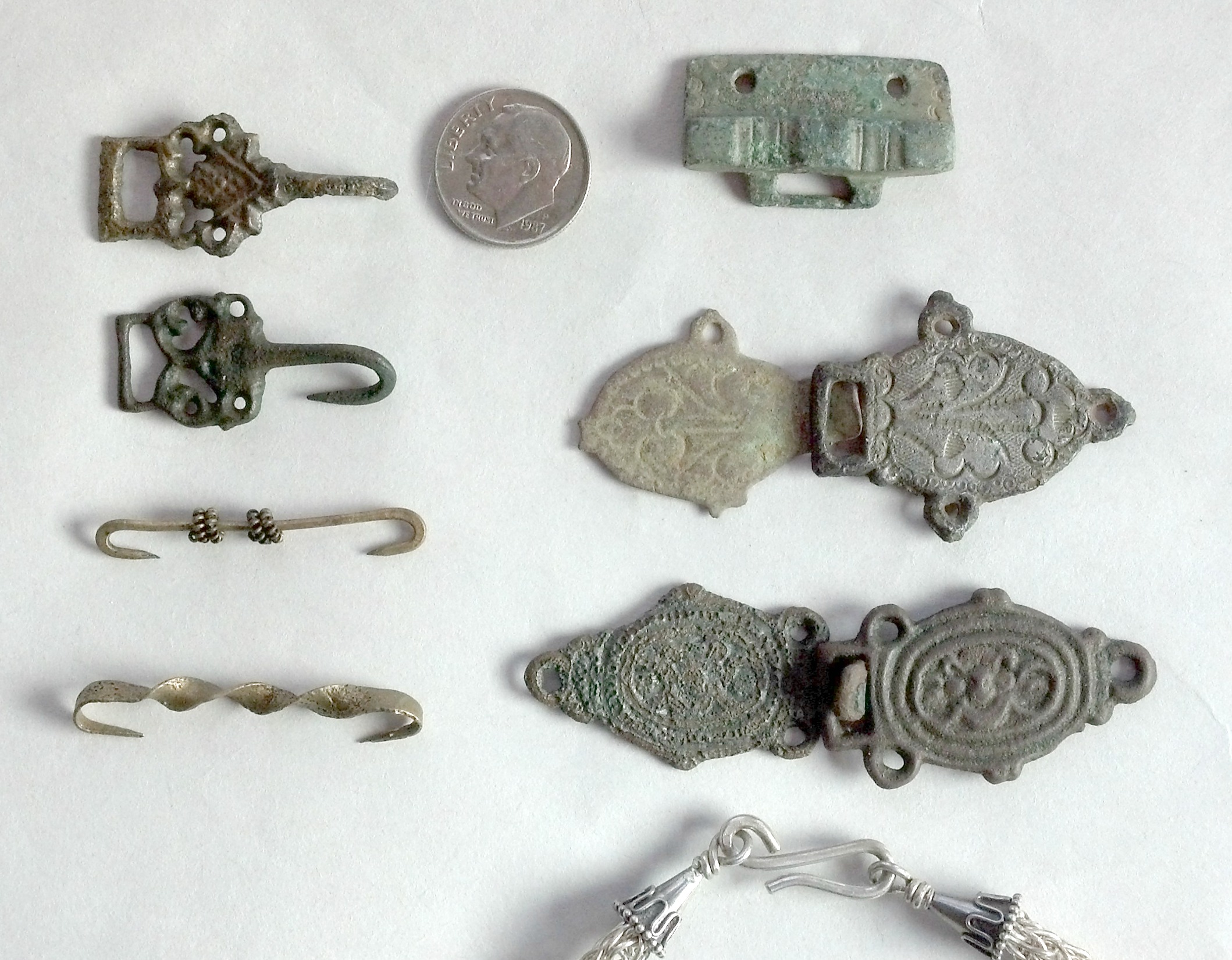
types of real hooksA selection of hooks. All of the hooks in the picture, with exception of the jewelry hook, are real artifacts. The hooks in the left column are all sharp. The top two are dress hooks from England (the hook on the bottom one is squashed sideways, but the top hook is just as sharp), and the two hooks at the bottom are from Germany. The right column is all blunt hooks. The blunt hooks start at the top with the eye side of a wrist clasp, then two dress hook and eye sets, and then at the bottom a simple jewelry clasp.

The sharp hooks come in many configurations. I am aware of hooks with one hook, two hooks, three hooks (evenly spaced in a circle), and four hooks (two on each end). To be honest, we are uncertain of all of the uses for these hooks. They are usually found as “occasional finds” by metal detectorists. That means they were probably lost while in use, or the fabric or other organic material that they were attached to has disintegrated and they are found in a context that would determine or explain their use.

How were sharp hooks attached? Some were probably sewn in place, and others, especially those attached to leather, were often riveted in place. A single point hook could be used to close leg wraps, clothing, and purses. Two pronged hooks (one on each end – see picture above) could be used to close the neck of a lightweight cape or cloak, and so can a four pronged hook with two hooks on each end. These were not sewn in place – they relied on the hooks to keep them in place. A three pronged hook could also be used to support the back of a ladies skirts to keep them clean.

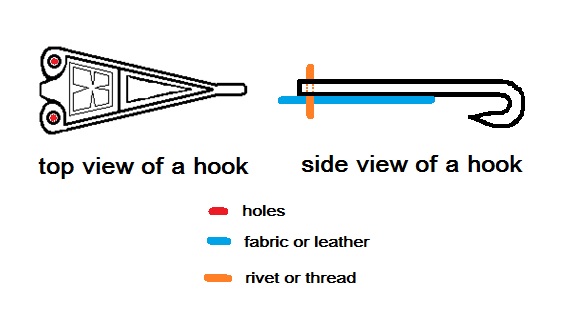
Anatomy of a hookHow big are these hooks? The ones that I have seen range from an inch long (not counting the portion of the hook that is underneath the hook), to about an inch and 3/4 long. The really large hook and eye sets (either cast or sheet work) can be as large as four inches from end to end. They all suffer from the same problems – they can open if they are not kept under at least a minimum amount of tension. The really large blunt hooks often have enough length to the hook that they are unlikely to unhook, but they are also several inches long, as a set. The large blunt hook sets can also be fairly bulky, and are usually only used on the outside of a garment.

Next time: Buttons and Toggles

What Size Were Brooches in the Middle Ages Part 2 – Bronze Brooches and Other Tiny Things

Last time I mentioned the fact that a lot of pre-1600 items are actually quite a bit smaller than we might modernly assume. In addition I mentioned the easy manufacturing techniques involved in lead and tin items.

Bronze requires dramatically more heat – nearly four times the heat! Temperatures near 2000° F require a furnace, with some sort of blower system, like a bellows. Bronze items would therefore have been a more specialized and expensive production. Not as elite as silver or gold, but not the bottom rung of lead and tin either. And even more important, bronze is much stronger than tin or lead.

Getting back to tiny things, let’s talk a little more about tiny brooches. Tiny brooches can’t be used on thick fabrics. This does NOT mean that they can only be used on linen, cotton, or other plant fiber fabrics. It just means that the fabric needs to be relatively thin.

Brooches like the little one that I bought have a big advantage over penannular brooches. A penannular brooch, if tugged and shaken enough can eventually open. But an annular brooch has to break, bend a lot, or have the fabric that it is attached to tear in order to let go. This gives it a couple of big advantages over the other forms of simple closures that were available pre-1600. It won’t open and it can lay super flat.

ringandbrokenringbroochesThe brooch on the left is an annular brooch and the one on the right is a penannular brooch, with a dime for scale (18mm). I chose a heart shaped annular brooch because I wanted to make a point about annular brooches. They must form a closed ring, but that ring can be just about any shape.

What forms of closures were available pre-1600? Laces or ties, hooks, hooks and eyes, buttons and toggles, penannular brooches, annular brooches, fibulas, dress pins, and other miscellaneous brooches. We already discussed penannular and annular brooches, so let’s look at the other options – remember we are looking at tiny things here, preferably things under half an inch, because that was the size of my little brooch. And there must have been a reason for that size, right?

Laces and ties. Easy to make, inexpensive and widely used. They can be made by the average person with commonly available supplies. They can be made to lie extremely flat, but they can break or untie, and it is very difficult to make them really tiny and still have sufficient structural integrity.

Hooks, and hooks and eyes. Exactly what is the difference? Modernly hooks and eyes are small metal sewing accessories that are available at any sewing supply store. Pre-1600 folks did have small hooks and eyes that were made out of metal wire, and they were definitely used extensively in the 1500’s, but there were also many other types of hooks used, and even some large cast hooks and eyes. Earlier cultures, like the Celts and Anglo Saxons sometimes used what I call “hooks and eyes on steroids” – sets where the individual pieces are each an inch or more long.

hooks and eyesThis picture shows a modern selection of hooks and eyes in various sizes on the right (the numbers are the sizes) and a 1500’s collection of hooks and eyes, from the Netherlands on the left. The size 3 modern hook is about 7/16th inch tall (12 mm).

So, if size is an issue the large hooks are out. The tiny hooks and eyes can lay fairly flat, and they meet the size criteria, but unlike many of their modern versions they did not have a little “bump” on the inside of the hook that make the hook and eye set “lock”. This means that the older hook and eyes would have to rely on tension pulling on them and keeping them in place. Without the tension, they open.

Next time: Hooks – Sharp and Blunt, and Buttons and Toggles