Chains Part 6

Last time we talked about chain links that start out as figure 8s, and I said that my next area of focus would be on a capital letter B. Before I do that I want to share a picture of some links that I couldn’t find last week in time for the blog. These were purchased from an old collection of metal detector finds from the Balkans. They are supposed to be Medieval, which is plausible. The most poorly crafted chain in the batch is actually the forth down from the top. The links look like they were cut with a chisel (there is at least one double strike) and no attempt was made to make the ends of the links square. It reminds us that not all “old” craftsmanship was good (but that is still no excuse for lousy modern craftsmanship).
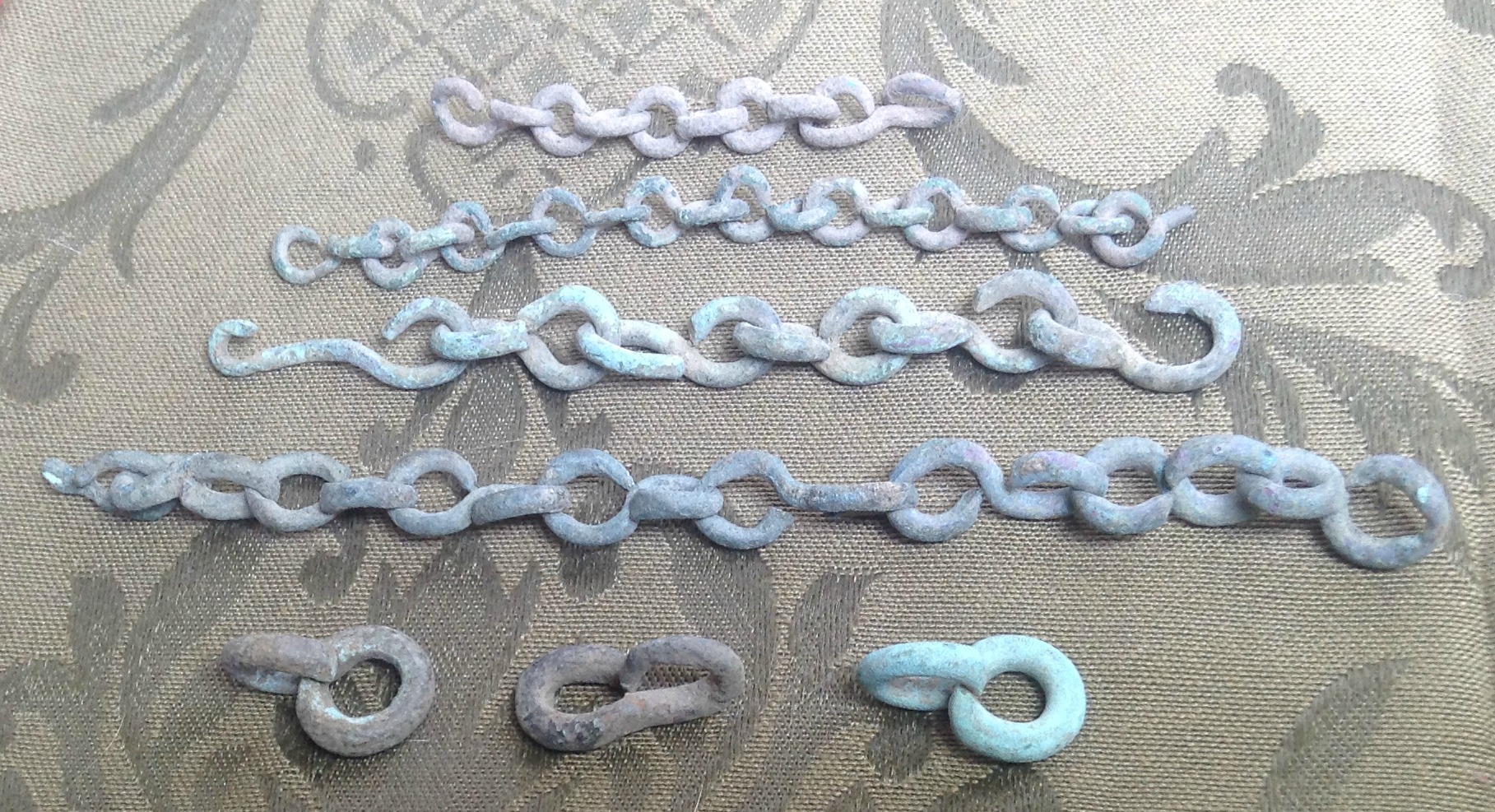
old twisted 8 links

I admit that another week of research on the topic of link forms has changed my mind a little. I have talked about this before. One of the dangers of continuing to do research in digital archives all over Europe, while writing blogs, is that sometimes you change your mind. A thing is not exactly what you thought it was. So in this case “B” is for bent.

Now “bent” may seem a bit obtuse, but imagine that you have made half of one of those last figure eight links that we talked about, and then instead of making the other half, you simply bent the remaining wire down in a gentle arch until it reached the bottom end of the formed bottom of the eight… confused? Here is a photo of some links to clarify. The top picture shows the links from straight down, and the bottom picture shows them from the side so that you can see how 3D they are. The figure eight link is the one that I mentioned. The link to the right of that shows what I mean by only making half of the figure 8, then the middle link shows the beginning of the bending process, and the forth link from the left shows the completed link. The link all the way to the right is the same link form flipped on to its side so that you can see the half circle clearly. Better?
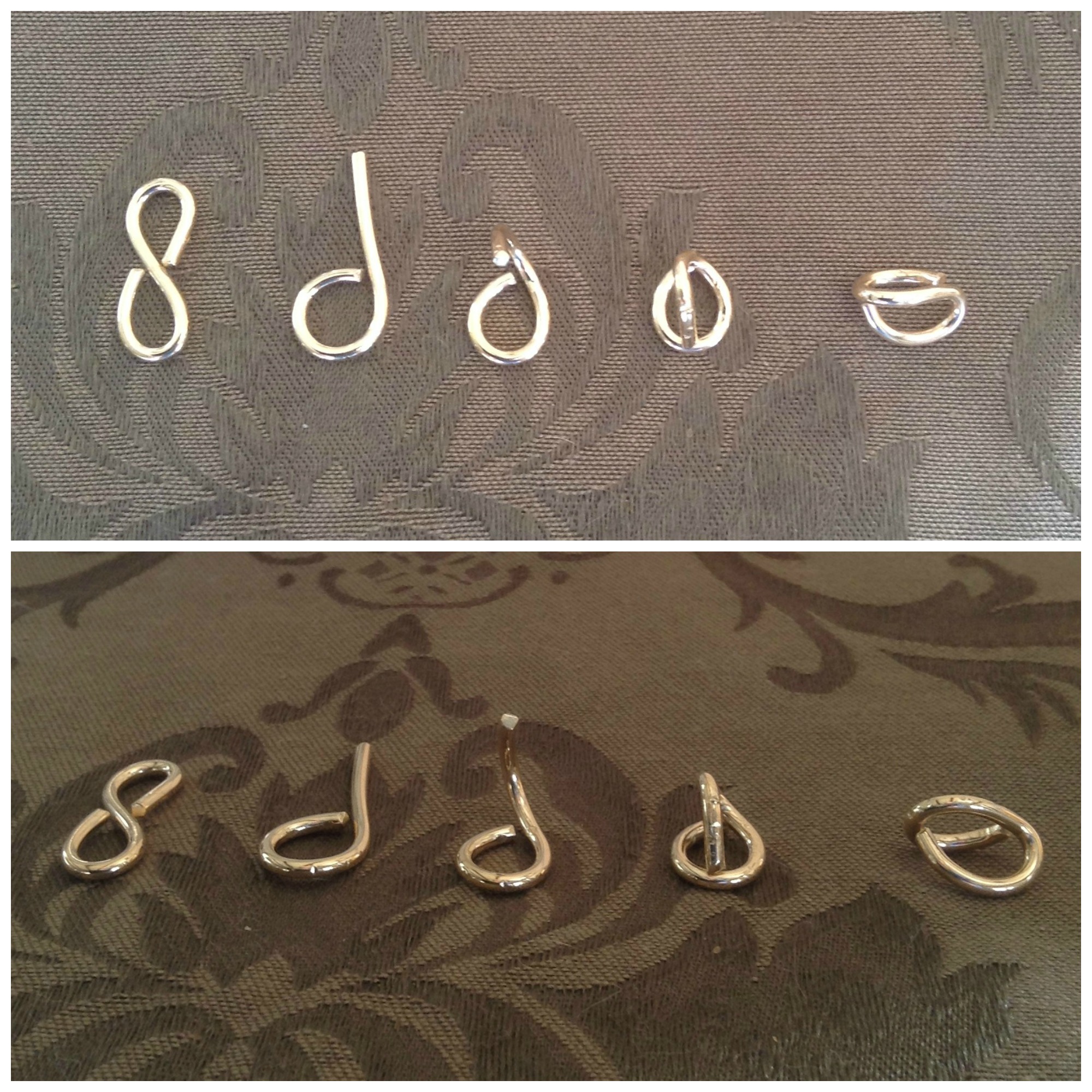
bent link collage

Take a look at the chains on this chatelaine at the British Museum. This 7th century Merovingian piece has three identical chains hanging from it. But if you look at the last link on the bottom of the center chain you can see exactly the form that I am talking about. It is half of an eight with the other end of the wire bent to form a half circle.

Now I think that this link form was one of the ones that really confused me when I first looked at it about five or six years ago. So I went in search of other similar links in other areas of Europe. I like to see how pervasive a form is, and how long we seem to find the form. Is it a local fad, or do we find it in a lot of places? I found several chains with the ‘bent” links in the Swedish National Museum, four from Gotland and one from Öland, and all from the Viking Age. I was trying to locate the museum’s technical definition of the Viking Age, since not everyone uses the same exact dates, but I couldn’t find it, so we will go with A.D. 793–1066. This picture has three pieces of chain, from the island of Gotland. If you click on the small picture it will bring up a bigger one. The top piece is a simple two in one link pattern, but the bottom two are both the “bent” links. The middle chain is particularly nice because the last two links on the left side are both slightly open, which allows you to see exactly how they were formed and put together.

I was still looking for a few more examples from other places in Europe, I am sure that there are more, it is just a matter of spending enough hours going through digital archives. At the last minute I found this piece from Germany in the Metropolitan Museum of Art. It is a Censor for burning incense, dating to the 12th Century. This close-up shows the form of the links really nicely.

And Next Time: A couple of other unusual, but not uncommon, link forms.

Chains: Part 5

Last time we discussed some of the natural, and fairly simple variations on round chain links. And I promised that this time we would talk about chain links that may make your brain hurt. Or maybe it is just trying to describe the chains that makes my brain hurt…

Before we go on to the more complex 3D forms let’s look at one more way to form a figure eight. This Greek Cymbal with Chain, from the Metropolitan Museum of Art, is characteristic of the cymbals that the Greeks used in ecstatic rituals around the 5th-4th century BC. The picture clearly shows the figure eight shaped links. This time they are made by making a loop on each side of the main line of the wire, without any crimping of the central wire, and the ends of the wire are opposite one another on most of the links.

And now on to the more complex forms. These chains all start out as figure eights (like the cymbal chain) but then instead of being flat links, half of the link is twisted 90 degrees. I should note that these chains seem to be used starting at least as early as the Greeks and going solidly down into at least the 1500’s in Europe. I have found them all over Europe and the Mediterranean and at least as far east as Persia. I have not studied Far Eastern chains extensively, so I can’t speak for that area. But yet I had never seen any modern jewelry chains that were obviously made this way. It would be interesting to try to figure out when and why they stopped making these chains for jewelry, or whether they are just not represented in Museum collections.

Pictures are definitely your friends when talking about these sort of things. So here is a chain, just like the one used on the Greek Cymbal, except half of the link has been turned 90 degrees from the rest of the link. I call this a Twisted Figure Eight, just for convenience. This censor in the collection of the British Museum still retains one of the chains that were originally used to hang it. The ends of the links are rounder than the cymbal chain, but the basic form is the same, until you twist it.

This next example is also a Twisted Figure Eight. This chain is part of a Byzantine suspension piece, from the British Museum. I case you are wondering what a suspension piece is, one use for them is to incorporate them into large chandeliers that suspended oil lamps or candles in cathedrals. But back to the chain. What makes this chain look different is the fact that the large chain at the top of the piece is made with square wire. The smaller links on the secondary chains are made with round wire.

I put together a simple photo of the type of links that I discussed in this blog so that you can see them all at once. Making the links has given me a renewed appreciation for the ancient craftsmen.

Figure 8 links

Number 1 shows the basic cymbal chain link. Number 2 shows the same link twisted. Number 3 shows the rounded link form and 4 shows the twisted version. 5 and 6 are done with square wire to show how much it changes the look. The wire for all of the links is brass, except for the square wire, which is copper. I didn’t have any square brass wire. And 7 shows what a couple of #4’s look like when they are hooked together.

Next time: Moving on to the letter B!

Chains Part 4

What sort of Shaped Chains do we find?

If you remember, last time I divided shaped chains into chains that started out round, and chains that may not have started out round. The reason that I say “may not” is because we have no way of knowing, based on the final shapes of these chains if they started out as round links, or some other shape. Round links are definitely one of the easiest shapes to wrap, but modern link making equipment also uses square, oval and triangular mandrels to wrap loops. I have recently begun experimenting with unusually shaped mandrels. It definitely takes a little getting used to, but it has potential. Unless we found a mandrel, in use, that was just left there with unfinished links (and a few cut ones and a partial chain just to help us know what was going on) we have no positive proof of exactly how a link was made, all we have is the final result.

I should also mention that I am only currently discussing chains that are made from wire, not chains made from cast links. The chain on this gold enameled pendant from Germany is an excellent example of how cast links can be used, and just how elaborate some of them can be. And a La Tené chain with cast loops shows that simple can still be impressive.

Anyway, probably the simplest change from round is oval. This 9th to 8th century BC bronze chain from Iran is a classic example. The picture is good because you can actually see where most of the links open.

Another relatively easy way to change a link is simply to squish that oval even further. The basic form becomes a figure eight, without any crossing of wires. This iron chain shows the concept. I know that I have seen a better example, but of course, when you actually go looking for something…

And once you have squished a link into a figure eight, you can make the squished part of the link longer and wrap the center of the figure eight with a wire spiral. I have actually seen two different forms of this type of link, one where a separate spiral of wire is wrapped onto the link and another where the wrap is actually created from the same wire as the link. The first entry on this Pinterest page is a copy of a page from the original publication on the finds at Birka, Sweden. The page shows just a few of the different types of chains that were found there. Number 13 shows one of the chains where the wrap is actually the same wire that the link is made from.

progression of link shapes


This graphic shows the sort of natural progression that we can create in link formation. The links can be made as long as we want to, limited only by the limitations of the type of metal and the size of the wires that we use. Picture number 11 in the Birka chains is an excellent example of a long exaggerated link.

Next time: Link shapes that may make your brain hurt.