
Metal Techniques Part 2: Chasing and Repousse

Lately I have run across several instances of people having no idea how a technical word should be pronounced. First let’s learn how to say these words correctly. Chasing is said just the way it looks – the dog is chasing the cat. But the second is a french word: repousse is pronounced ray – poo – say.

The process of chasing and repousse almost looks like stamping, until you look closely. When we use stamps on metal, the metal sheet is placed on another hard metal surface and the stamp literally crushes itself down into the surface of the metal sheet. The metal sheet remains mostly flat with only a tiny ridge of metal around the stamped design.

Chasing and Repousse uses tiny stamps, usually in simple shapes, to form the metal.The metal sheet is backed with a flexible substance, and the metal becomes three dimensional.

Here is an example of the sort of simple tools that are used to do chasing and repousse.
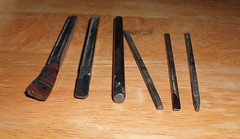
Chasing Tools

So what EXACTLY do these words mean? Repousse is hammering the metal sheet from the back to raise the surface of the metal and chasing is lightly stamping the raised design from the front to add more detail and refine the raised shape.

These techniques were developed a couple of thousand years ago and were most famously used on gold sheet by groups that included the Scythians, Greeks, Romans, Celts and Franks.

Here is an example of what chasing and repousse can look like.This is a 16th century gilt copper piece from Tibet.

Gilt copper repoussé from Tibet, 16th Century.

How can you hammer on a piece of metal from the back and allow the metal to stretch and become three dimensional? Pitch! Pitch is a flexible substance, which becomes semi-liquid when heated. It is melted and placed into a special heavy metal bowl. The metal is placed into the surface and allowed to stick there. If you place the metal face down in the pitch you can then shape and hammer it from the back to create your design. The pitch bowl is heavy and very stable – so you have both hands free to hold your tools. When the design is completed, the pitch is reheated and the metal is removed and cleaned. The metal can then be flipped over and re-anchored in the pitch for the chasing portion of the work.

Here are two pictures which show the before and after of a chasing project. The black substance in the background is pitch. The artist has taken a simple silver spoon, set it into pitch, drawn the design on the spoon and then used the chasing tools to form the metal.
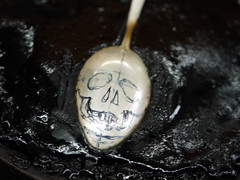
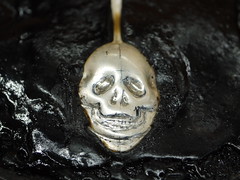
 Skull-Spoon Chased 1Skull-Spoon Chased 2

There is no repousse involved in this project because the artist is using the already domed bowl of the spoon for that part of the project.

Here is another example of chasing without the repousse. The artisan is simply hammering the metal down into pitch the create a low relief design.
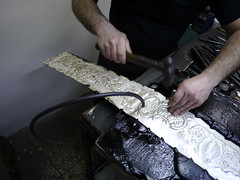
Chasing Workshop in the Grand Bazaar - 2

It is also possible to do simple chasing and repousse on a sand bag, which is exactly what it sounds like – a leather bag loosely filled with fine sand. This system is less stable and is generally not used for extremely detailed small pieces because of the difficulty of holding the pieces while working on them.

I hope this brief account of the technique of chasing and repousse gives you a better understanding of the complexity of the process and the amount of work involved. It may sound simple, but it really is quite time consuming and requires a LOT of attention to detail.

Next Time: Engraving


Stamping on Metal

Chatting with friends and customers has made me acutely aware of why it is important for people to understand the basics of metal working. Having insight into how a metal object is made allows you to better understand a piece, whether you are doing research, ordering a custom piece, or buying an off-the-rack item. There are a number of methods used to shape metal for utilitarian purposes, decoration, and personal adornment. Using a hammer on metal is one of the oldest techniques used to shape metal – so the first blog will be on stamping metal.

What do we need to stamp metal? A hammer, a surface to hammer on, a stamp, and the metal that will be shaped.

Let’s start with the stamp. Stamps are usually made by softening a piece of steel, shaping the stamp, and then re-hardening the steel.

How does all of this softening and hardening take place? Heat!

The process of making the steel, or any other metal, softer is called annealing. The metal is heated to an appropriate temperature, which varies from metal to metal, and  then allowed to cool slowly. This process removes the stress that is left over from manufacturing and softens the metal.

Why does removing the stress from manufacturing the metal matter? The stress in the metal affects the way the metal behaves when you work it by hammering, compressing, or bending. Stressed metal can crack or chip when you work with it.

So the steel for the stamp has been annealed. Now it can be shaped to make the design that you want, using drills, saws, and files. Once the shape of the stamp is correct, the steel is reheated. This time it is quenched, usually in oil. This process is called tempering. It hardens the steel in a specific way, which makes it hard, but not too brittle. Most people purchase their stamps. It’s also important to know that some metals like brass can not be hardened by heat treatment – they’re generally not good to use as a metal stamp.

Let’s talk about hammers. DO NOT use a hammer with a hard steel face, like a framing hammer. Why not? Well, two reasons. The first is that the face of the hammer can actually chip and throw pieces of metal, which can be dangerous. The second reason is that a hardened hammer head will place more stress on the stamp and tend to cause the top of the stamp to spread, also called “mushrooming”. You might have seen a tent stake with a “mushroomed” head caused by hammering it. Relax, this will eventually happen to stamps used to decorate metal to some extent, but there is no need to speed up the process.

What sort of hammer should we use? Your best options are a Brass or Copper headed hammer or mallet. The Brass or Copper heads are much softer than the steel of the stamp and will not damage the stamp. The advantage of using a mallet is that the weight of the mallet will do a lot of the work for you and put less stress on your arm.

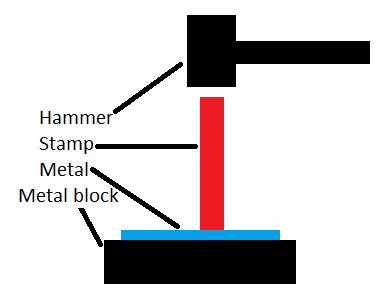
What sort of surface do we use to do the stamping on? Well, the best surface is some sort of smooth metal, usually a metal block or an anvil. You want to have the full force of the hammer transfer to the stamp and then into the metal sheet. Having the metal that you are stamping backed up by a smooth block of metal means that the force from the hammer is focused into the metal sheet and creates a crisp image. Equally important,   the metal is not marred by an uneven surface. The graphic shows the basic arrangement of tools for stamping.

Stamping ProcessThis picture shows some of my favorite tools for doing stamping.

Stamping Kit

I hope that this information makes both your purchases and your research more interesting and productive.

Next time: Chasing and Repousse!