What Size Were Brooches in the Middle Ages – Part 3 – Hooks – Sharp and Blunt

The pre-1600 hooks that are different from our modern hooks and eyes can be broken down into two main classes, sharp and blunt. The blunt hooks were designed to either be used with a large eye hook, or with some other kind of loop or hole. Any of these hooks can either be cast, or cut from metal sheet or wire. They can be plain or decorated with stampings, engraving, glass gems, enamel, rivets, or any combination of these techniques. These hooks can be made of tin, lead, bronze, or silver (or a gazillion other in-between alloys). They were sometimes tinned, silver plated, or gilded to make them appear to be more valuable. We usually only see solid gold items used in jewelry.

Blunt hooks were frequently used in jewelry to close necklaces, bracelets, and torques. A blunt hook could also be used to hold a belt closed (we may think of them as buckles, but technically a flat plate with a hook on the underside or the end, is a hook). They could also be used to close pouches and bags. They were often very decorative, and we have an example of a surviving jacket with large versions of these all the way down the front. Most of these hooks only have one hook. The wrist clasps that were used by both Anglo Saxons and Vikings are a form of blunt hook and eye. Some of the Anglo Saxon wrist clasps were riveted onto a leather band, but most wrist clasps were probably sewn in place.
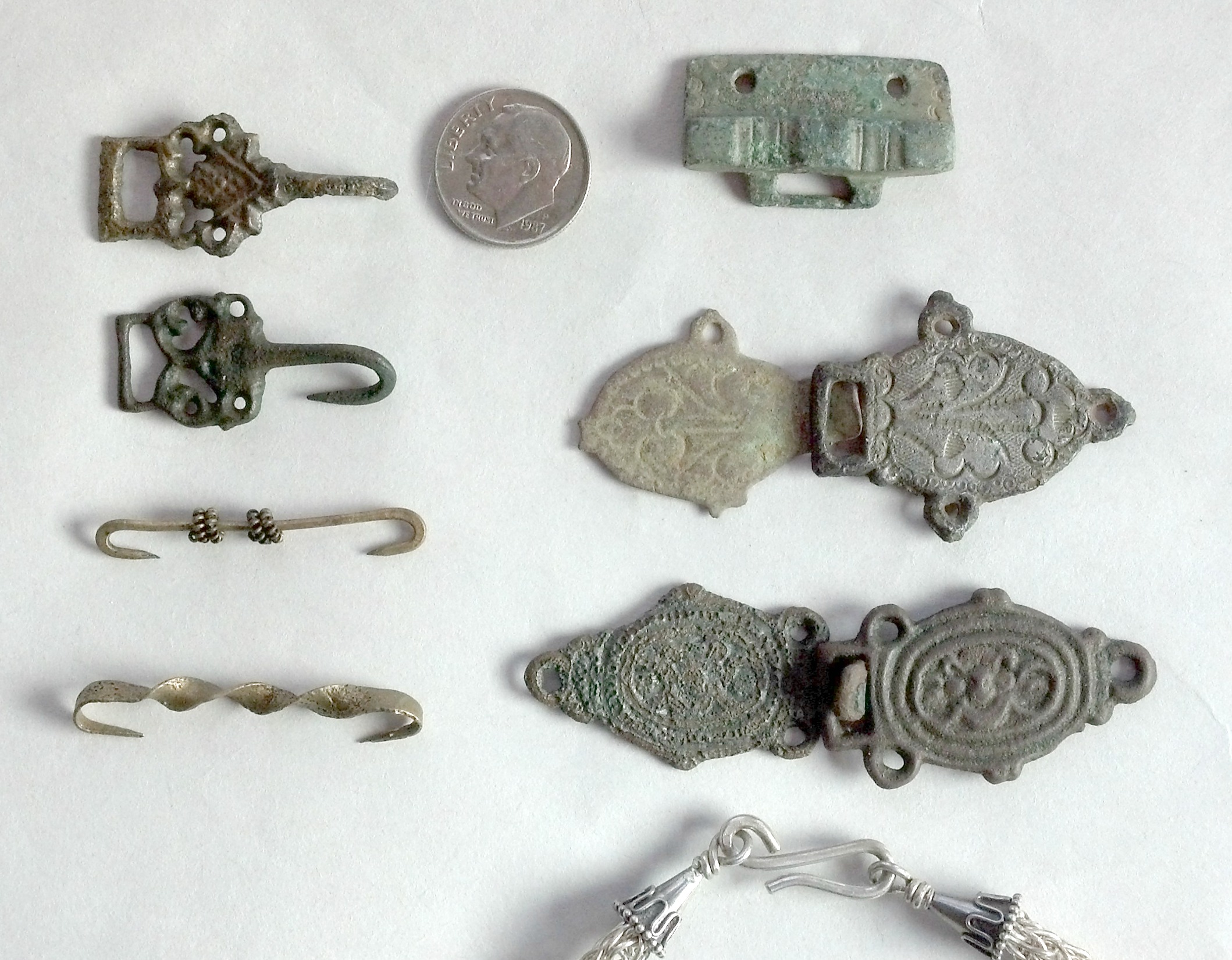
types of real hooksA selection of hooks. All of the hooks in the picture, with exception of the jewelry hook, are real artifacts. The hooks in the left column are all sharp. The top two are dress hooks from England (the hook on the bottom one is squashed sideways, but the top hook is just as sharp), and the two hooks at the bottom are from Germany. The right column is all blunt hooks. The blunt hooks start at the top with the eye side of a wrist clasp, then two dress hook and eye sets, and then at the bottom a simple jewelry clasp.

The sharp hooks come in many configurations. I am aware of hooks with one hook, two hooks, three hooks (evenly spaced in a circle), and four hooks (two on each end). To be honest, we are uncertain of all of the uses for these hooks. They are usually found as “occasional finds” by metal detectorists. That means they were probably lost while in use, or the fabric or other organic material that they were attached to has disintegrated and they are found in a context that would determine or explain their use.

How were sharp hooks attached? Some were probably sewn in place, and others, especially those attached to leather, were often riveted in place. A single point hook could be used to close leg wraps, clothing, and purses. Two pronged hooks (one on each end – see picture above) could be used to close the neck of a lightweight cape or cloak, and so can a four pronged hook with two hooks on each end. These were not sewn in place – they relied on the hooks to keep them in place. A three pronged hook could also be used to support the back of a ladies skirts to keep them clean.
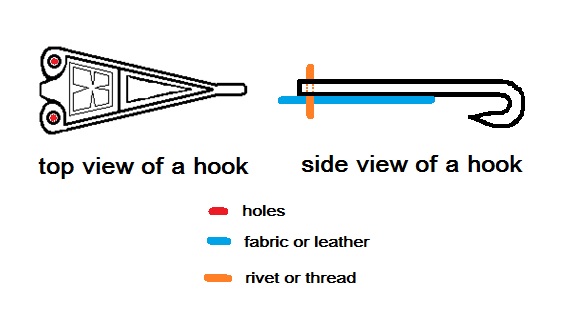
Anatomy of a hookHow big are these hooks? The ones that I have seen range from an inch long (not counting the portion of the hook that is underneath the hook), to about an inch and 3/4 long. The really large hook and eye sets (either cast or sheet work) can be as large as four inches from end to end. They all suffer from the same problems – they can open if they are not kept under at least a minimum amount of tension. The really large blunt hooks often have enough length to the hook that they are unlikely to unhook, but they are also several inches long, as a set. The large blunt hook sets can also be fairly bulky, and are usually only used on the outside of a garment.

Next time: Buttons and Toggles

What Size Were Brooches in the Middle Ages Part 2 – Bronze Brooches and Other Tiny Things

Last time I mentioned the fact that a lot of pre-1600 items are actually quite a bit smaller than we might modernly assume. In addition I mentioned the easy manufacturing techniques involved in lead and tin items.

Bronze requires dramatically more heat – nearly four times the heat! Temperatures near 2000° F require a furnace, with some sort of blower system, like a bellows. Bronze items would therefore have been a more specialized and expensive production. Not as elite as silver or gold, but not the bottom rung of lead and tin either. And even more important, bronze is much stronger than tin or lead.

Getting back to tiny things, let’s talk a little more about tiny brooches. Tiny brooches can’t be used on thick fabrics. This does NOT mean that they can only be used on linen, cotton, or other plant fiber fabrics. It just means that the fabric needs to be relatively thin.

Brooches like the little one that I bought have a big advantage over penannular brooches. A penannular brooch, if tugged and shaken enough can eventually open. But an annular brooch has to break, bend a lot, or have the fabric that it is attached to tear in order to let go. This gives it a couple of big advantages over the other forms of simple closures that were available pre-1600. It won’t open and it can lay super flat.

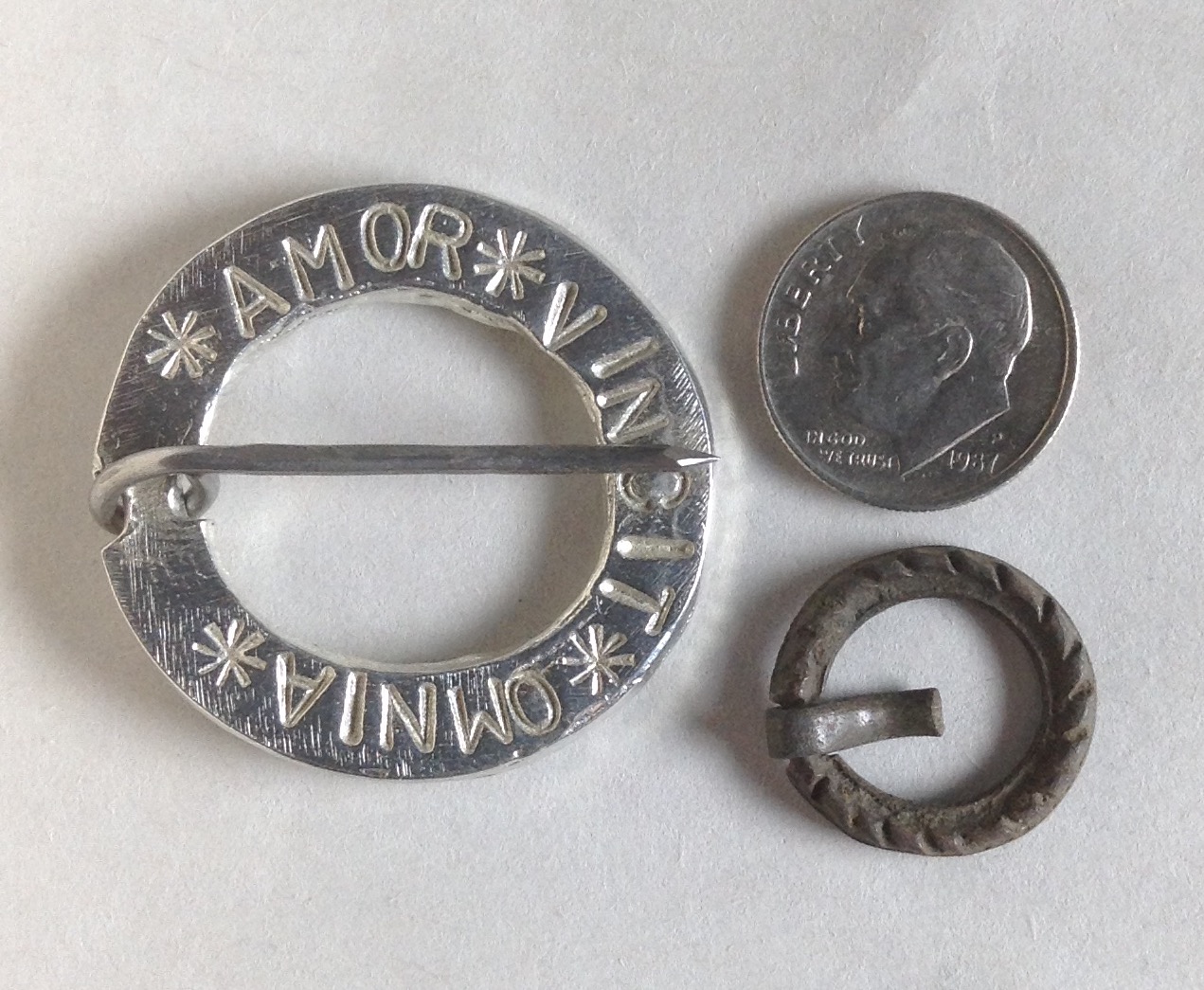
ringandbrokenringbroochesThe brooch on the left is an annular brooch and the one on the right is a penannular brooch, with a dime for scale (18mm). I chose a heart shaped annular brooch because I wanted to make a point about annular brooches. They must form a closed ring, but that ring can be just about any shape.

What forms of closures were available pre-1600? Laces or ties, hooks, hooks and eyes, buttons and toggles, penannular brooches, annular brooches, fibulas, dress pins, and other miscellaneous brooches. We already discussed penannular and annular brooches, so let’s look at the other options – remember we are looking at tiny things here, preferably things under half an inch, because that was the size of my little brooch. And there must have been a reason for that size, right?

Laces and ties. Easy to make, inexpensive and widely used. They can be made by the average person with commonly available supplies. They can be made to lie extremely flat, but they can break or untie, and it is very difficult to make them really tiny and still have sufficient structural integrity.

Hooks, and hooks and eyes. Exactly what is the difference? Modernly hooks and eyes are small metal sewing accessories that are available at any sewing supply store. Pre-1600 folks did have small hooks and eyes that were made out of metal wire, and they were definitely used extensively in the 1500’s, but there were also many other types of hooks used, and even some large cast hooks and eyes. Earlier cultures, like the Celts and Anglo Saxons sometimes used what I call “hooks and eyes on steroids” – sets where the individual pieces are each an inch or more long.

hooks and eyesThis picture shows a modern selection of hooks and eyes in various sizes on the right (the numbers are the sizes) and a 1500’s collection of hooks and eyes, from the Netherlands on the left. The size 3 modern hook is about 7/16th inch tall (12 mm).

So, if size is an issue the large hooks are out. The tiny hooks and eyes can lay fairly flat, and they meet the size criteria, but unlike many of their modern versions they did not have a little “bump” on the inside of the hook that make the hook and eye set “lock”. This means that the older hook and eyes would have to rely on tension pulling on them and keeping them in place. Without the tension, they open.

Next time: Hooks – Sharp and Blunt, and Buttons and Toggles

What Size Were Brooches in the Middle Ages?

I could just as easily have asked this question about any sort of common item, and because of my training I often do. I realized a couple of years ago that many people have a total misconception of the size of a lot of things that people used. Despite years of education and extensive training I am NOT completely immune to this problem. I sometimes buy small metal detector finds, and have been caught in this trap.

A little while ago I purchased a very nice annular brooch (ring brooch). It was a good looking bronze piece which had a sort of twisted rope look. There were no dimensions given for the piece and I assumed that it was at least twice the size that it actually was. I was shocked when I saw how tiny the brooch actually was. This made me wonder how common an issue this really was. So, I looked at the given dimensions for many other items that were on sale. Then I went to a couple of the museum sites and looked at the actual sizes of the finds in the museum. And yes, there were a few really magnificent huge pieces, but in general the brooches and everyday pieces were rather small – at least by modern standards.

Researching the size of the people who wore these items in England shows that women during the Middle Ages were generally about 5 foot 2 inches tall and men about 5 foot 6 inches. The article that I read said that this meant that Medieval Women were only an inch taller than modern women. I am 5 foot 9 inches tall. My grandmother, who was born in about 1890, was 5 foot 2 inches, but most of my female friends are at least 5 foot six. Now I consider myself to be a little taller than average, but not dramatically so. Is it possible that these brooches were sized smaller because the people were smaller, or were they sized smaller because of the value of the metal?

I don’t think that we can give a definitive answer to this question, but I would love to hear people’s opinions on this topic. Metal really was a valuable commodity.

Inexpensive metals like tin and lead were commonly used to make lower end pilgrim’s badges and decorative pieces. These metals both have a very low melting temperature, which means that they can be cast using a simple hearth. Pilgrim’s badges give us other important clues as well. Some tears ago I had the good fortune to meet with the curator of medieval artifacts for the Museum of London. Besides the sheer exhilaration of spending time with John in the bowels of the Museum storage looking at pilgrim’s badges, I also noticed the casual finishing of these ubiquitous items. Many of the badges had flashing left over from the manufacturing process. Modernly, we would expect those “manufacturing defects” to be removed. Casting and finishing of tin and lead are easy, so the condition of the pilgrim’s badges indicates the acceptance of a rough finish for some pieces.

Next time: Bronze brooches and other tiny things

One of my pewter brooches, a dime, and the tiny brooch that I bought.

One of my pewter brooches, a dime, and the tiny brooch that I bought.