Choosing Which Metal To Use

I often hear conflicting complaints from historic re-enactors and SCA folks alike:  “the problem with my group is too many authenticity Nazis” and “why can’t people at least make a more accurate attempt at their clothes?”

As a professional jeweler and merchant at SCA events, I frequently wrestle with the disparity of these sentiments. Some of the choices are difficult, but some are easy from my perspective. I make many of my items using a copper alloy known as bronze. Some merchants choose any old copper alloy without regard to what would have been used historically. But using true bronze gives my pieces the look and feel of the originals that they are patterned after.

Bronze was used to make weapons, armor, knives, brooches, hooks, crosses, and many, many, other items. It’s a ubiquitous material throughout Medieval history, and much earlier. Bronze is a remarkable alloy with multiple formulations. The first bronze included copper and arsenic (yes arsenic). Fortunately for real sticklers for accuracy, arsenic bronze was largely replaced by a tin and copper formulation that we recognize today as true bronze. A bit of good news for authenticity fans – true bronze became the primary bronze from the 3rd millennium BC.

There are very few places on the earth where copper and tin are found together (one site each in Thailand and Iran), so true bronze is reliant on trade. Great Britain was the major source of tin in Europe, which can explain some of the unusual trade goods found in Britain.

Copper alloys are truly remarkable. They can be harder than wrought iron, be sharpened for cutting edges, and the alloying process is comparatively easy. Depending on the alloy (tin, zinc, lead, silver and other additives) the metal can take on many different hues. Each formulation has unique characteristics, and in our modern society they have very specific names – brass, yellow brass, and nickel silver, to name a few. Some alloys are malleable, others are hard and brittle, and still others have differing degrees of chemical resistance.

Are there any other practical reasons for me to want to use true bronze instead of some other bronze alloy? Yes. True bronze can be enameled. Now some of the other alloys can be enameled, too. But the problems with enamels changing color because of the zinc in brass, for example, can be difficult to overcome. True enamel is a form of ground glass that is melted and fused to the metal. If you are interested in more detail about enamel and enameling, just visit my enamel blog.

Handled ewer. Copper alloy with champlevé enam...

Handled ewer. Copper alloy with champlevé enamel, Late Roman work. (Photo credit: Wikipedia)


Today we know that iron replaced bronze for knives, weapons, and many other larger items, as iron working skills matured. Iron could maintain a sharp edge longer, withstand greater bending forces, and eventually could be made into steel. The transition to iron seems to have been encouraged along by a tin shortage. Around 1200 BC the shipment of tin around the Mediterranean plummeted – coincident with population migration. There’s no definitive proof of the link between migration and the tin shortage, but some archaeologists believe that there is a causal relationship between the two.

But are there any other metal choices that we need to make for period reproductions? We’ll talk about that next time.
My Casting Process Up Close – No It Is Not Instant! Part 3

Last time we ran through some of the basic techniques that I use to process my lost wax cast pieces. And we asked the question : Are We Done Yet?

Well, almost. I use essentially the same process for both bronze and silver. The biggest differences in the way pieces are processed depends on the shape of the piece. Flat pieces, like regalia medals, often require a lot less sanding and polishing than three dimensional pieces, like buttons, or pendants. The Raven Viking Pendant, for instance, has more than one sprue connection that needs to be cut and polished off for each piece (three to be exact).

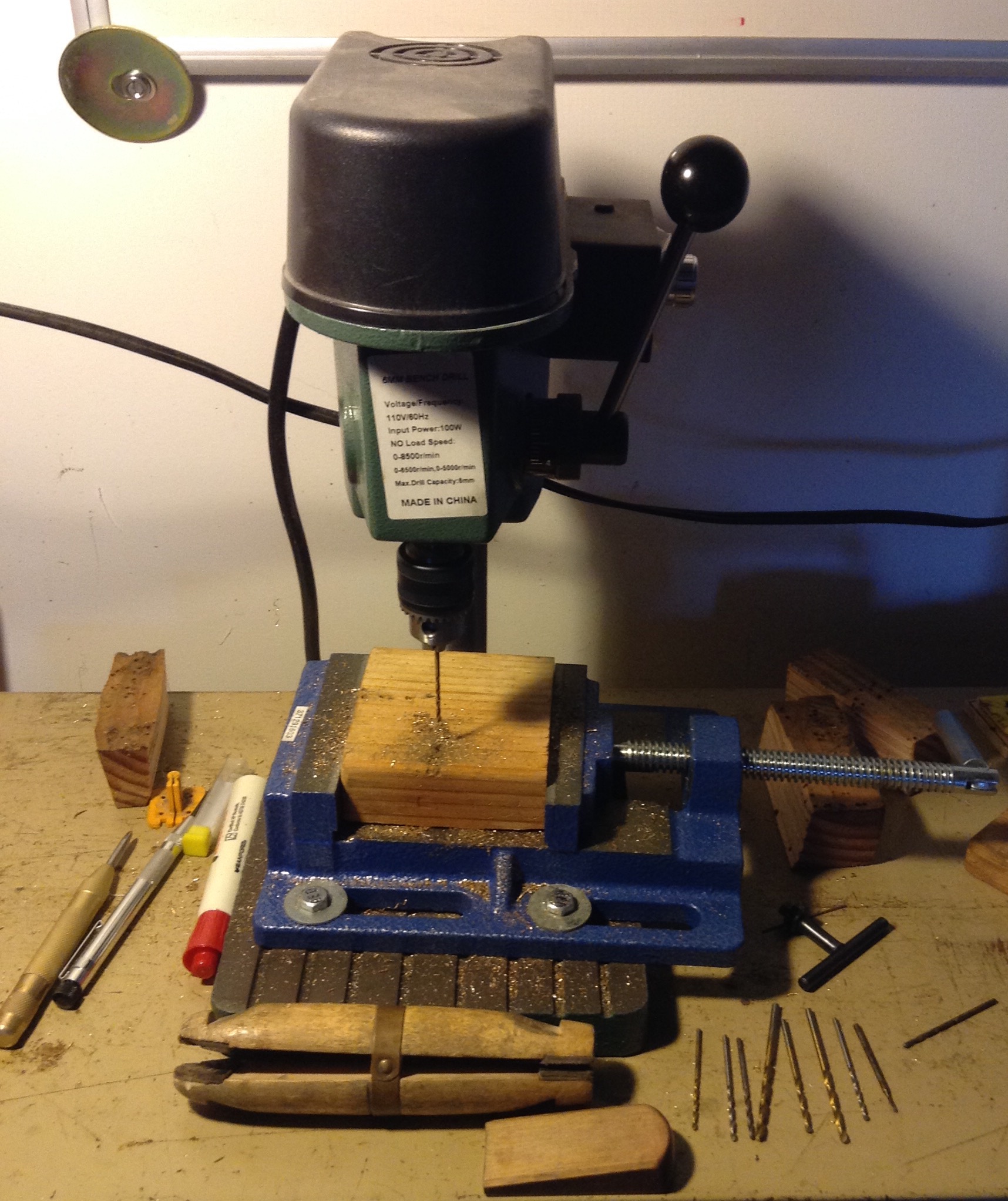
If the piece needs to be drilled, this is when it happens. I use my little drill press to drill holes in the regalia medals and make sure that any other holes, whether they are in dress hooks, pendants, or anything else, are the size that they are supposed to be.

drill press

This is also when any pieces that do not have carved maker’s marks can acquire stamped marks, if appropriate.

makers mark

I then use the Cratex wheels to remove any rough spots from pieces that were drilled.  Assuming that everything has gone well up to this point, the pieces go into a rotary tumbler with stainless steel shot to burnish.

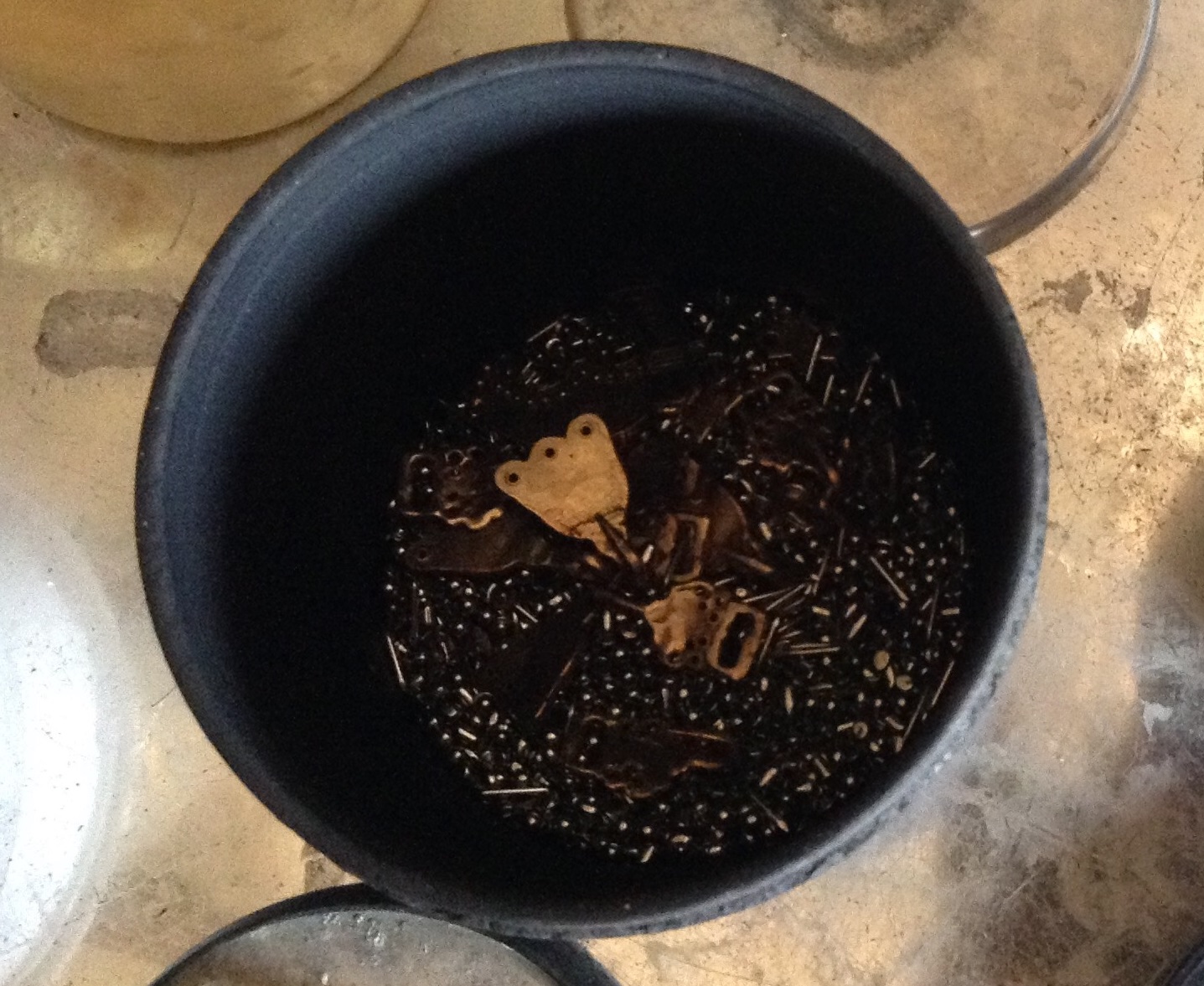
Jewlery in TUmbler

Here is a picture of the rotary tumbler barrel, with stainless steel shot and a collection of dress hooks. You can see how much cleaner the castings are. The stainless shot will make the pieces a lot shinier. After they have tumbled for about 20 minutes, a quick check will reveal if they need more cleaning or not. Some pieces just need a little more help. And that help usually comes from the magnetic tumbler.

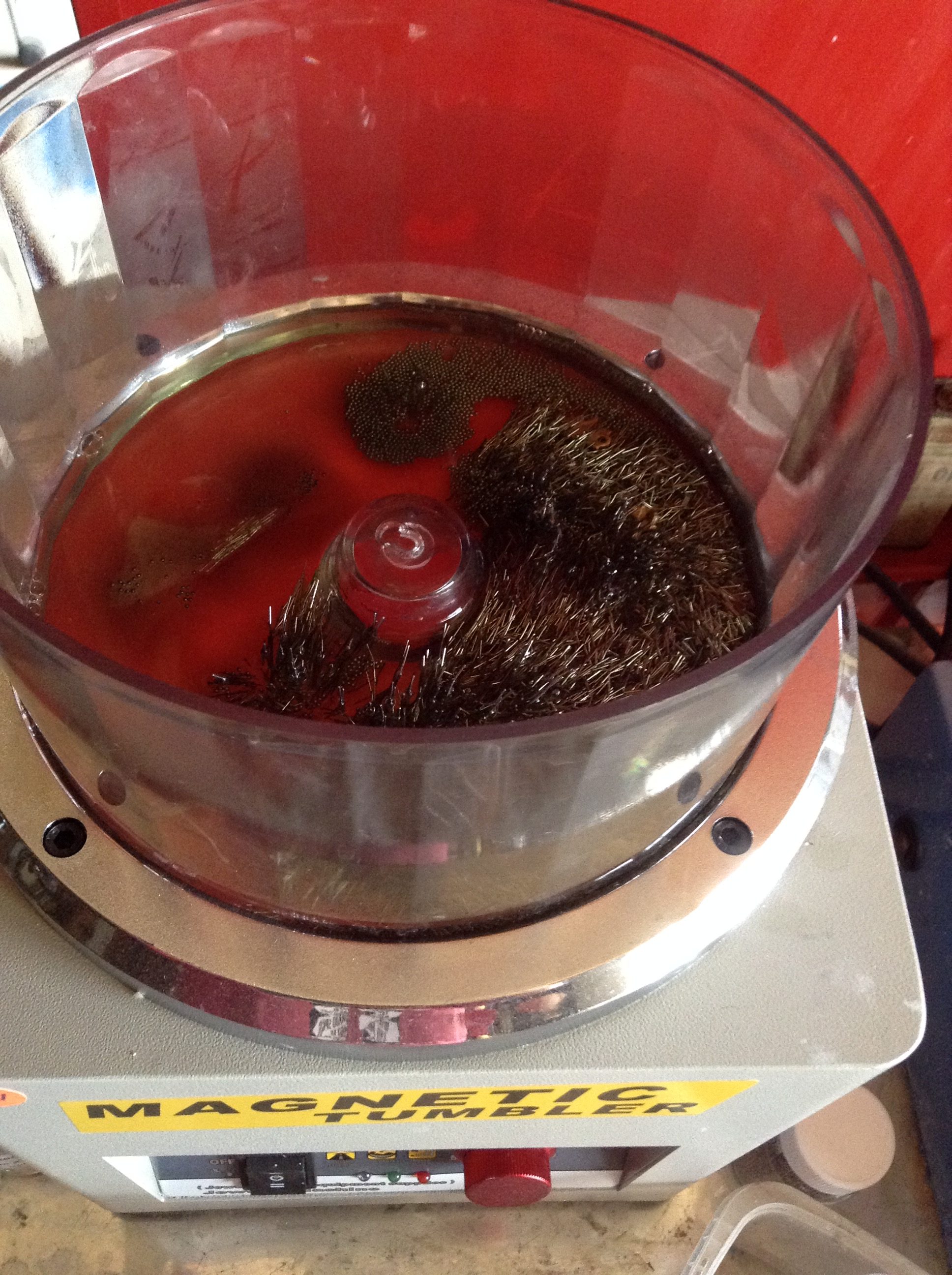
Magnetic Tumbler

And this is a view inside of the magnetic tumbler. Those tiny little hairy things are pieces of stainless steel which are about 1.5 mm in diameter and 5 mm long. The machine uses magnetism to fling the tiny pieces of steel in a vortex at about a gazillion miles an hour. It is great for getting into nooks and crannies and cleaning them out.

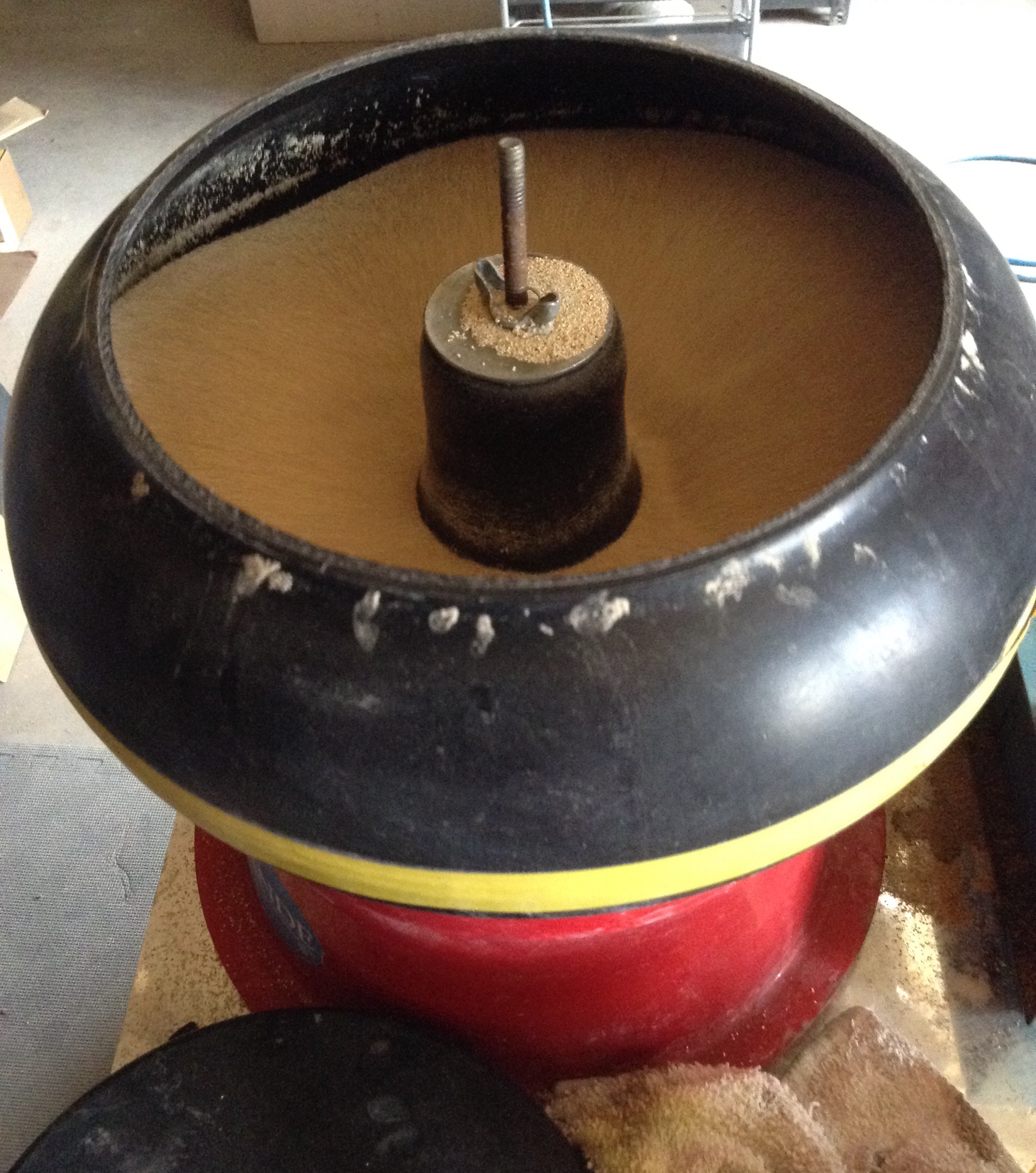
Once the piece is clean and polished enough, it is rinsed and then put in the dryer. The dryer? Yes. I have a vibratory tumbler filled with ground corn cob. The cob absorbs all of the moisture and prevents the piece from developing water spots.

vib tumbler dryer

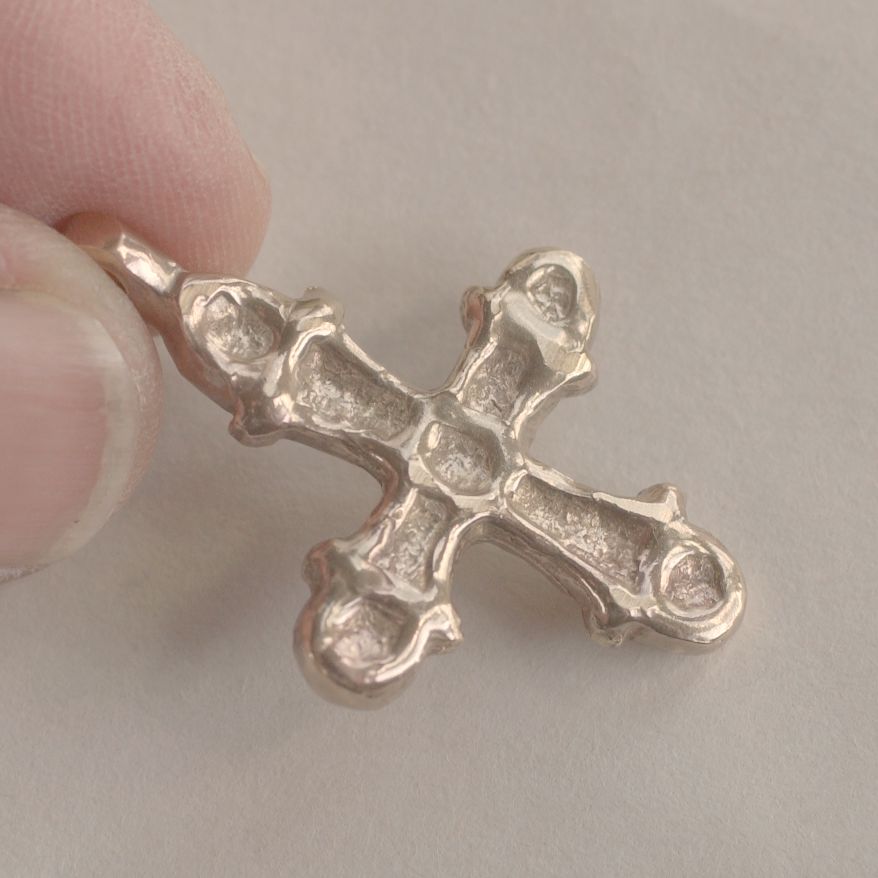
And this is what a piece looks like after it comes out of the dryer.

Etsy 61 hand held

Shiny! Of course at this point the pieces are once again examined in a bright light and checked for imperfections.  Scuffs or dirty spots will send them back into the process for touch-up.

I hope that this picture-rich blog gives you at least an idea of the process that every single piece of cast metal goes through in my shop. There are lots of other systems and techniques that can be used to accomplish the same end results, but no matter what system is used, there is nothing instant about the process!


My Casting Process Up Close – No It Is Not Instant! Part 2

So last time we talked about casting pewter. Even though it is a fairly simple process it is definitely not instant. But what about casting bronze?

Casting pewter involves a simple mold, either soapstone or a modern material like silicone. But casting bronze is often done as a lost wax process. If you want to see more detail about the lost wax process itself I suggest that you read my six part blog series The Way That I Cast – Lost Wax.

But this blog is not about the casting process, it is about what happens when a cast piece comes out of the flask. This picture shows the beginning of the process.

Button Process

On the left we see a freshly cast set of buttons, still covered with investment (the white layer). The next piece has the investment cleaned off, by scrubbing it with a brush in water. And then a fan of individual buttons has been cut off of the sprue button with the hacksaw (shown at the bottom of the picture). Then the individual buttons are cut off of the fan with the sprue cutters (at the top of the picture). What is left is a pile of buttons and a pile of sprue pieces.

The buttons have been cut from the small branches of the fan, and now they need to have the spot where they were cut off rounded and smoothed out.

wet sander

And this is what I use to do that job, a wet sander. The sanding belts are made of wet-dry sandpaper. Water drips down onto the belts and cools the piece that is being sanded, while controlling the dust. Once the button sprue area has been shaped it is time to smooth it a bit more.

Cratex Wheel

This set of Cratex wheels does a more delicate job of smoothing the area and removing scratches. There is a small pile of bodkins, crosses, Thor’s hammers, and dress hooks in process on the bench.

And once the general smoothing has been accomplished, the pieces are put into the vibratory tumblers to remove the oxides and further smooth the surfaces.

wet vibratory tumblers

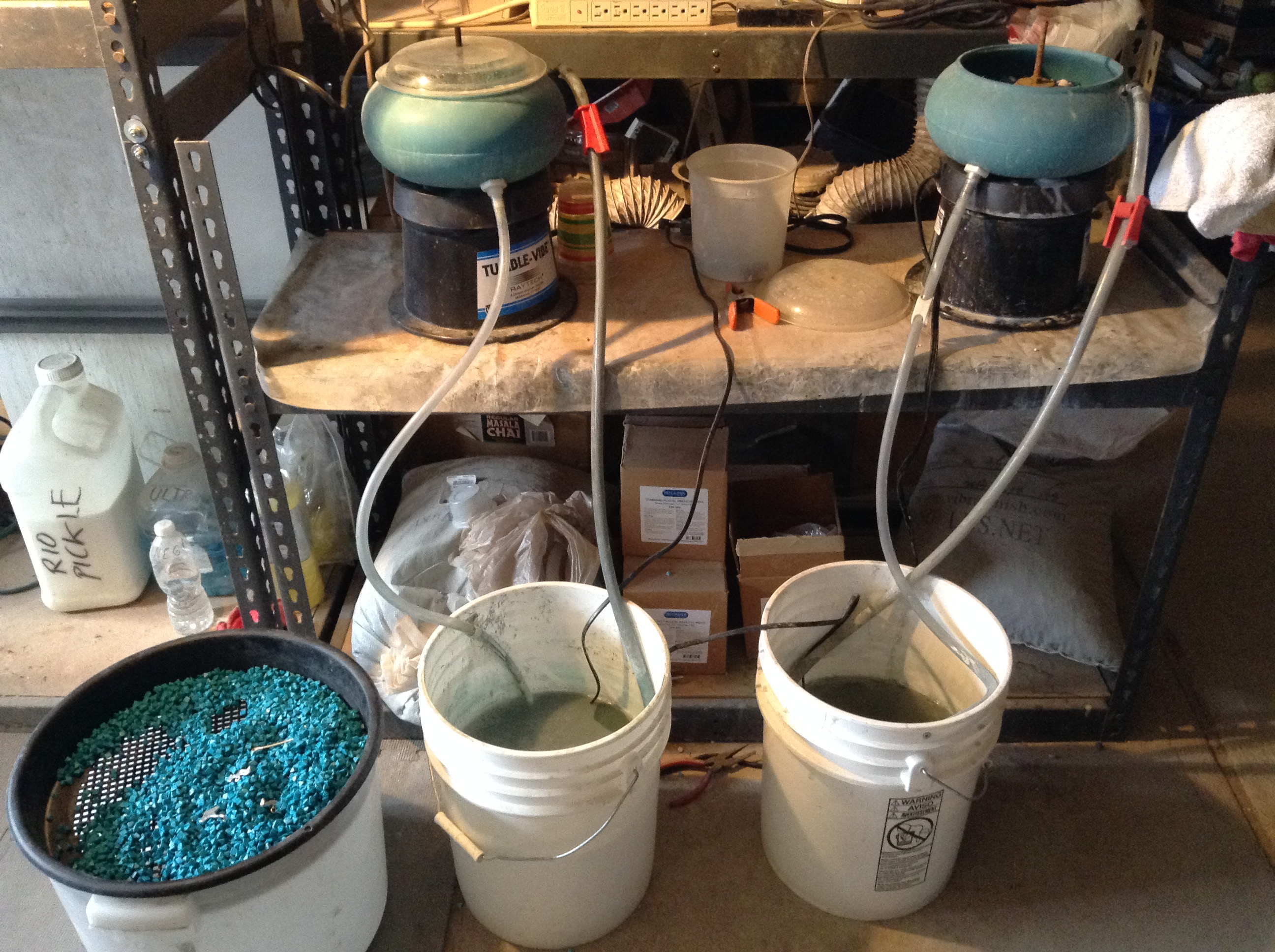
And this is what the vibratory tumbler bench looks like. There are two tumblers, each with their own source of circulating water. Each tumbler is filled with a different polishing material. The one on the right is the courser material and the one on the left is the finer material. The white bucket with the sieve on top shows the contents of the left tumbler being sorted to remove the pieces of cast metal. The cast pieces spend at least three hours in each of the tumblers, with a rinse in between to avoid transferring grit from one process to another.

And now what? Well, at this point I turn on a bright light, and check each piece to see how it is progressing. If it looks good I will set it aside for the next step in the process. If there are any issues, it will either be rejected if there are “fatal flaws” that can’t be cleaned up, or get a trip back to the Cratex wheels for some additional polishing.

Next Time: Are we done yet?