Purses Part 8: Where Do We Go From Here?

I realized after I posted the last blog that some folks might not have a clue about the process of riveting. Riveting was one of the most common methods for joining base metals together prior to the advent of modern soldering techniques and fancy gas torches. If you are interested in reading about modern soldering techniques. I wrote a blog on the technique a while ago.

But back to riveting. I made a quick, and not particularly artistic, picture of the basic riveting process. How is that for a fancy hammer?! But hopefully this gives you the basic idea. The metal of the rivet, or the end of the purse frame bar or pivot is simply moved by hammering.

Riveting

But back to my process! I also spent a ton of time looking at examples in museums. I found several at the Museum of London that had a similarly shaped purse bar and pivot. This purse frame was photographed upside down, but you can see that it is very similar. And this purse frame is not only similar, but also has a surviving purse frame ring. Excellent! Now I even have a potential model for the ring on my purse frame!

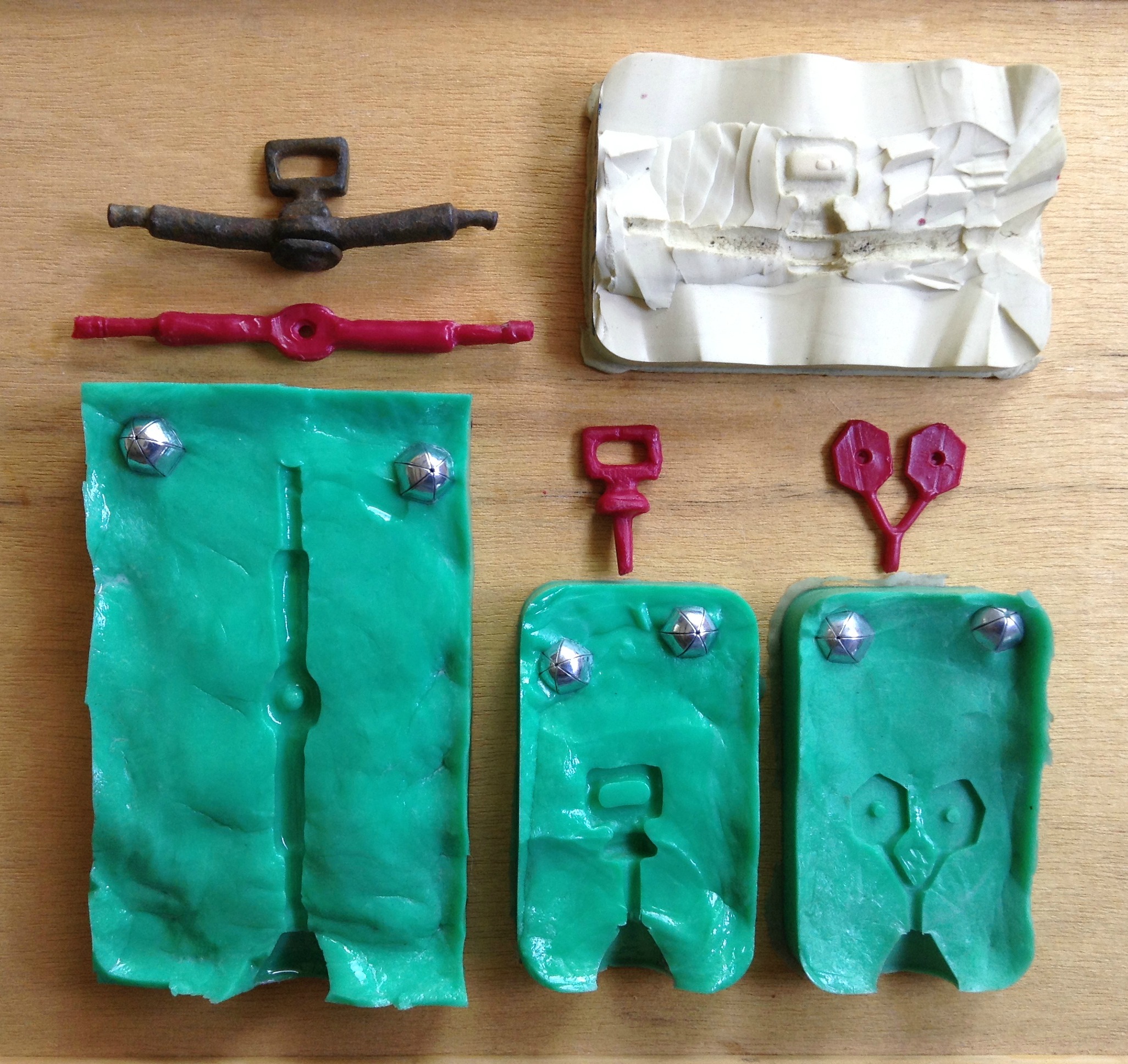
Next it was time to actually make a mold of the frame that I have. I used modern materials to make my molds. Because the actual artifact is metal I was able to use silicone mold sheets to make the initial mold. This material requires heating, in a special press known as a Vulcanizer, to create a rubber-like mold. Once this mold was created I was able to remove the original artifact and inject molten casting wax into the cavity of the mold. This wax creates an exact replica of the original artifact. I made several copies of the original purse frame in wax, and then began cutting the wax apart into the individual pieces that make up the purse. At this point it was possible for me to repair any flaws in the original purse frame pieces, like corrosion or other pitting. Once the individual pieces of the purse looked the way I wanted them to, I was able to use another modern silicone mold material, called Room Temperature Vulcanizing Silicone (RTV), that allowed me to easily create a mold of the individual wax replicas of the purse pieces.
Purse mold and waxes

Here is a picture of the original artifact and half of the Silicone mold that I made from it. At the bottom of the picture are the three RTV molds that were made of the individual repaired waxes. The new waxes that can be cast from these molds are the red objects above the RTV molds. You can see that I extended the worn and peaned ends of the original purse bar so that they would be long enough to hold new purse bar rings and still have room to be peaned over. I also extended the central pin on the pivot of the purse so that it will be long enough to go through the purse bar, put on the washer (shown on the right) and still have room to be peaned over.

Next Time: Time For Metal!
 

Purses Part 5: What Other Forms of Purse Frames Do We Find?

I often wonder if they asked each other “How many rings does YOUR purse have?” That may have not been the exact approach that Medieval people took, but purses were definitely an important display item.

The “typical” purse frame that I have shown you is definitely common, but it is by no means the only form that we find. One frame ring, two frame rings, three frame rings and simple wire rings are all found. The majority of the frames are made by casting, and are composed of some sort of bronze alloy or iron.

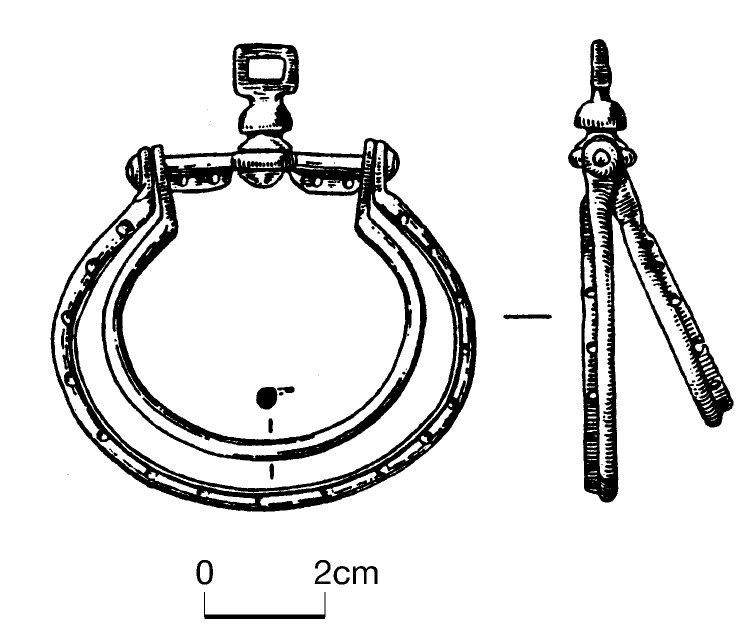
Let’s take a look at a two ring frame. This is a drawing of a purse that belongs to the British Museum. A quick glance will show that this is a small purse, probably used for coins. It is only about 5 cm (a little less than 2 inches) across at the support bar. The much larger, roundish purse frame rings allow a person to at least put their fingers into the purse to grab a coin, probably while pushing up the purse from the bottom with the other hand.

British Museum purse 1985,1101.92This is a particularly excellent example of a nicely built purse frame, Because amount of detail that they included in the drawing we can really see how the frame works. The drawing shows the lip that was cast on the purse frame ring to attach the bag of the purse.

The Museum of London has a purse frame of similar form that has had a modern velvet bag sewn onto it. If you go to the link you can see how the larger purse frame ring forms the cover for the purse, and the smaller ring, along with the two support tabs on the purse bar actually support the bag portion of the purse. This particular purse bag shows the purse frame loops almost completely covered by the fabric of the purse. There is no way to determine exactly the form of the original purse rings, because you can’t see them. The frame rings may not have had the pierced lip that allows the metal frame ring to support the purse bag while still showing off the metal of the frame. There is both a front and back version of the purse picture, which is great because it allows you to actually see all of the details of the frame, the velvet purse bag, and the way it was attached.

There are a considerable number of other types of metal purse frames, including some that are truly odd, and some that are totally over the top.

Next time: The Tip of the Ice Berg

Purses Part 4 What the Clues tell us and More about purse forms!

So last time we looked at the most common form for a large purse. And I mentioned that the picture of the purse held a very important clue.

Purse Frame Collage

Take a look at this composite picture. The left most picture shows the typical purse frame, and the right two pictures are of the piece of purse frame that I own. The picture on the top right shows the fragment of purse frame in the same position as the intact purse frame is in on the left hand picture. You can see that this purse frame fragment also has Niello decorations, this time in the form of floral swirls that act as spacers between words. DEO and H are the only visible letters on the frame fragment. The original inscription was probably “DEO HONOR ET GLORIA” – Honor and Glory to God. The use of standard inscriptions was very formulaic in Medieval times, but that is another blog.

The picture on the right bottom shows the cross section of the purse frame. As you can see, the frame is NOT flat, but rather L shaped. The back of the L, which doesn’t really show from the outside of the purse unless the frame is bent, is pierced to allow the bag portion of the purse to be attached. The two red arrows show two locations where the purse frame is pierced. I am certain that there are others, but these holes show because the frame is bent. The fragment of purse frame that I own has two holes in the back section of the frame that are 1 3/8 inches apart. Both of these holes are elongated from extreme wear and stress. Most purse frame pieces that we see show extreme wear. The main support bar is often bent and the holes in the frame that were used to support the fabric or leather bag usually show signs of wear. I have seen at least some examples where the top of the fabric bag was actually sewed to, and supported by, a heavy wire, which was then attached to the purse frame with wire loops. These wire loops would have put a considerable amount of point stress on the purse frame, causing both wear and stretching or bending of the purse frame. I would also suspect that purse frames, being an expensive item, were reused until they were totally worn out. It seems as if putting a new cloth or leather bag on a metal purse frame would have been a way to relatively inexpensively update an important accessory.

Before we go any further I should give a set of standard terms that I am going to use to describe purses. I have looked at a lot of purse frames in person and in online collections and my terminology aligns with what I see most of the museums using. Here is a graphic showing the basic purse frame with terms. It really isn’t that complicated, but having a set of standard terms will make it simpler when we are discussing the basic construction techniques that are used in the more complex purses later.

typical purse frame Parts

Next Time: What other forms of purse frames do we find?