Staying in Touch With Your Phone

Cell phones help us maintain contact with friends and family throughout most of the continental US and much of Europe. But some of the areas that hold large-scale camping events have marginal cellular service.

A5406CA (cellular phone) open

A5406CA (cellular phone) open (Photo credit: Wikipedia)

These miniature marvels have limitations on the distance over which reliable communications can happen. Some sites have spotty service. Others have weak or marginal service. Still others are only served by one of the major cellular providers.

Cell phones provide essentially “line of sight” communications between your cell phone device and the cell phone tower. Many things can impact your ability to make or receive a call. The most obvious way to impact your cell service is to control the distance to the cell tower. If you are closer to a cell tower, reception will be improved. Being further away from a cell tower decreases reception. Generally speaking, cell phone reception will work within 12 miles of a tower site, providing the tower is “line of sight.” You may also be able to make calls from as far away as 22 miles from a cell tower.

Line of sight doesn’t strictly mean that you have a clear view of the cell tower. But some obstructions are deceptively opaque to the radio signals. Leaves of trees and bushes fall into this category. More obstructions mean less signal. Less signal means its harder to

English: The Faraday Cage is in the High volta...

English: The Faraday Cage is in the High voltage Lab of the University of canterbury Engineerig School. In the photo it was running at 110 000 volts, and the spark can be seen on the left where the technician is pointing a probe at the cage. (Photo credit: Wikipedia)

make and receive calls. Metal is the ultimate obstruction – if it is connected to the ground. Scientists use this fact to make Faraday cages to keep radio waves (that also make up cell phone signals) out of an area.

Signals can also be received even though a ridge is between you and the cell tower. And, sometimes you can see the cell tower very close to you, but you can’t get a signal. Both of these facts depend on how the cell tower signals are aimed by the antennas on the tower. What would be nice is a way to amplify the cell signals so that you can make a call when you are in a marginal area.

Your ability to connect to the cell service can be improved in many circumstances by using a cellular phone booster.
Wilson Electronics dB Pro Installation

Wilson Electronics dB Pro Installation (Photo credit: nan palmero)


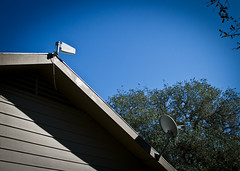
Cell phone boosters can use simple whip antennas (like a car radio antenna) or a jogh gain antenna like that shown to the left.

Lower cost cell phone repeaters can be purchased for $200-$300. These boosters come with a simple whip antenna – AND your phone must be placed on a special pad to boost the signal. These boosters are powered from your car’s 12V system and work well. But, be aware that you can drain your car battery if you leave the booster on continuously for a long while.

More capable boosters are also available but they involve more and larger equipment. The equipment includes an external antenna – most often a directional antenna as shown below.
Wilson Electronics dB Pro Installation

Wilson Electronics dB Pro Installation (Photo credit: nan palmero)

Establishing cell phone service using signal boosting equipment is fairly easy but it does take some technical skill. Simple boosters with one antenna and a contact antenna for the cell phone are the easiest to install. Follow the simple directions. Establishing a link to distant cell towers is more complex and requires some knowledge of transmission systems – and takes some trial and error. All of these boosters include protection to prevent accidentally damaging the cell tower.  If you lack adequate skill to set up the more complex boosters, a local distributor may be able to provide you with training.

Enhanced by Zemanta

Camp Beds: Part 3 –Getting off of the Ground – Homemade & Crafted Solutions: Part 3 – Bolted Together Bed

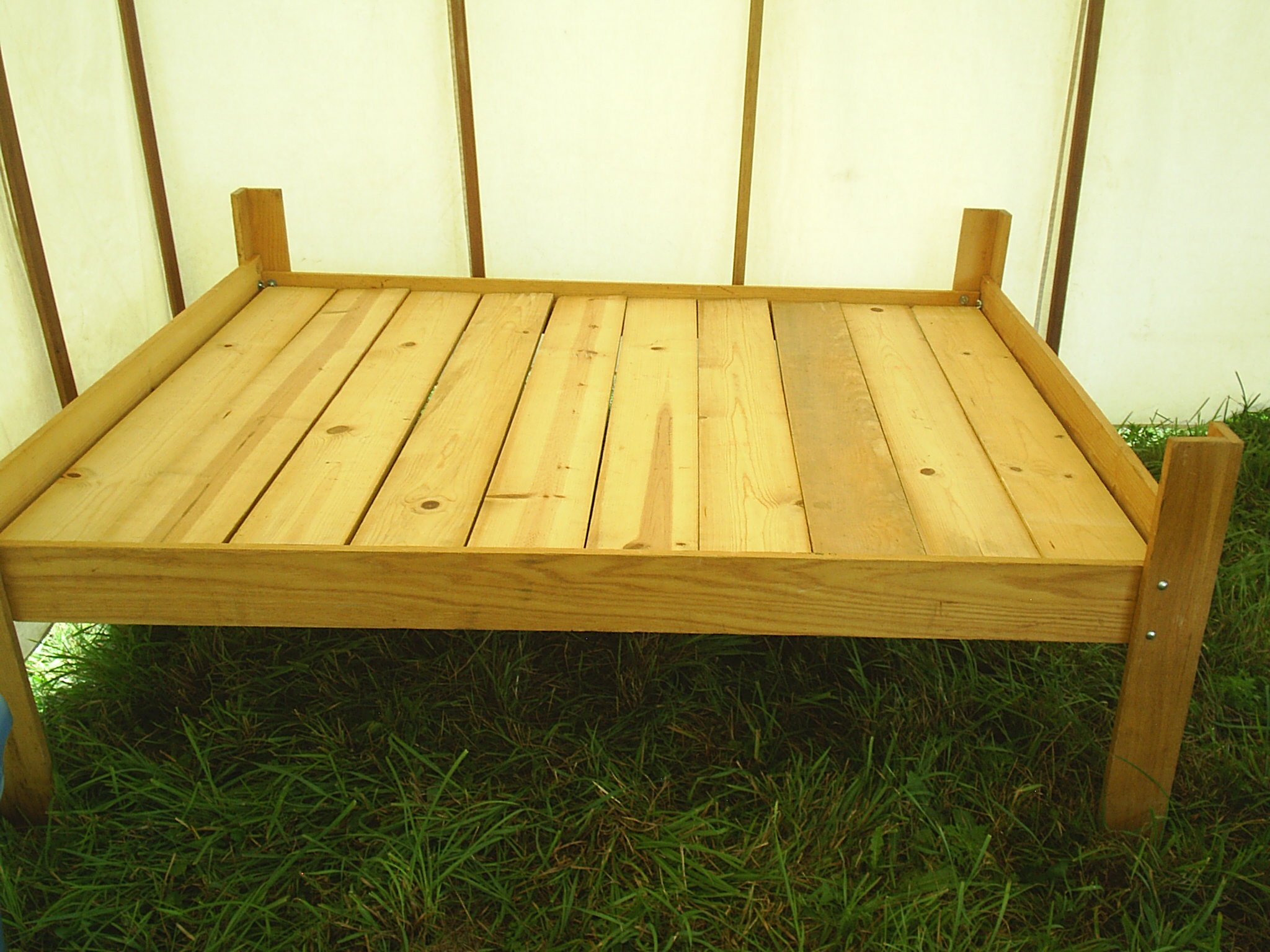
When we started camping in period pavilions we asked our friends what sort of beds they were sleeping on. And this is the bed that we settled on. It is not period, but it is comfortable, sturdy and easy to break down and set up quickly.

M3361S-3034

When it is “dressed” it can look as plain or fancy as you want it to. It would also be simple to extend the top of the legs up to create a four poster bed. We always cover our pillows completely during the day to keep them clean.

M3361S-3034

So how do we start?

First decide how large a bed you are going to make. Measure the mattress and make the bed at least 1 inch larger in both directions. This gives you room for your covers to be tucked in around the mattress.

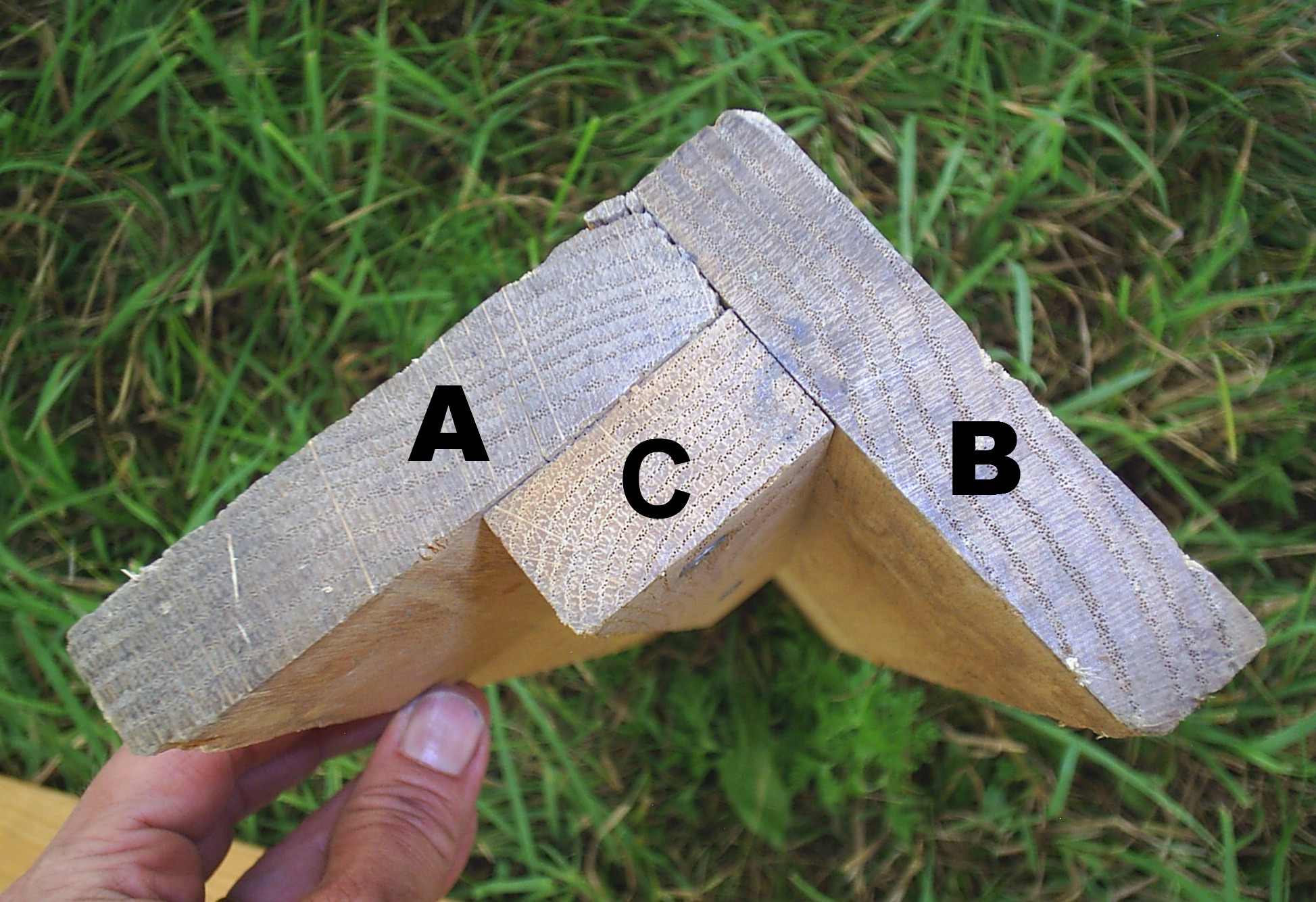
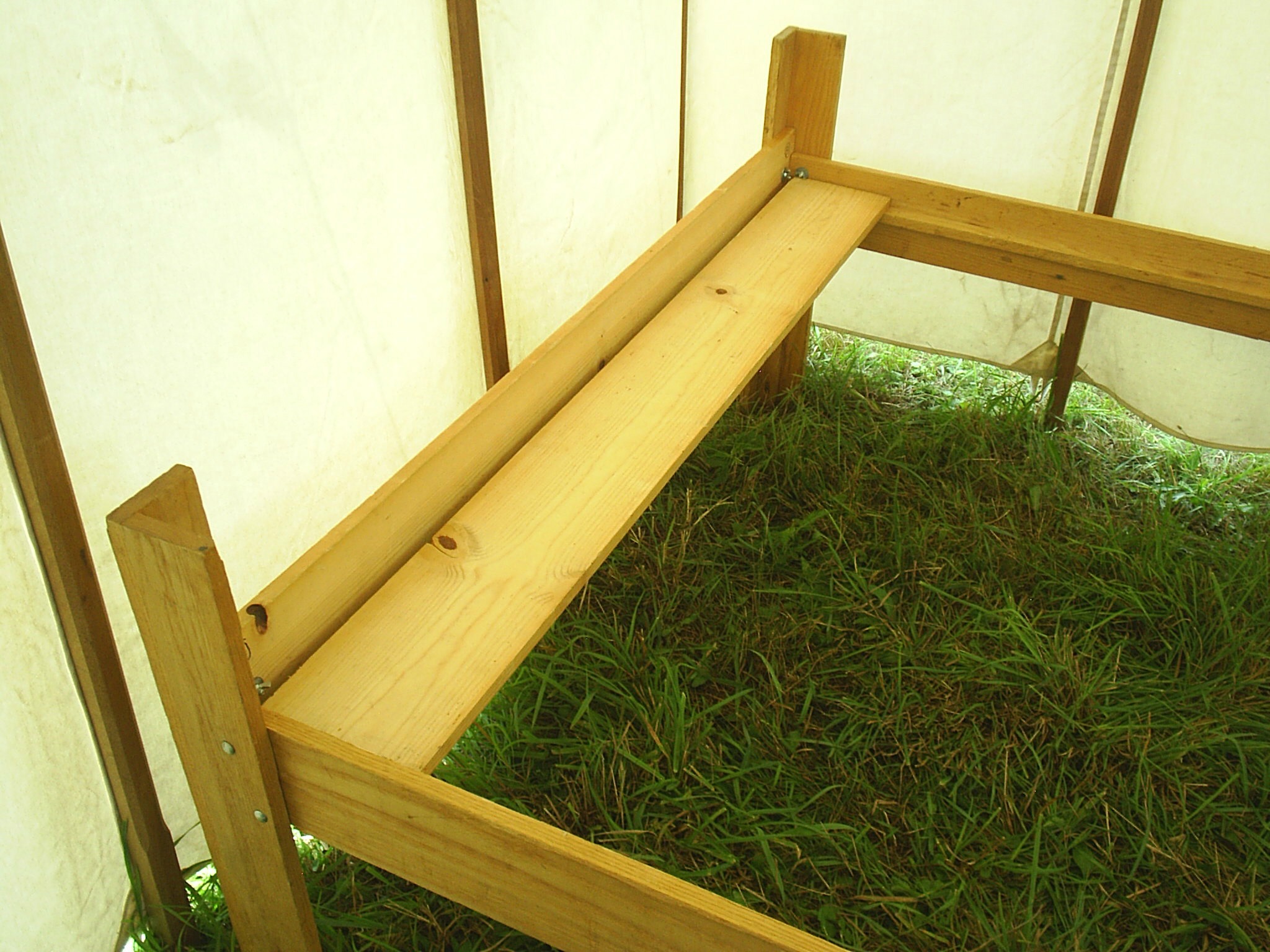
Here is a picture of the leg construction, from the bottom. The leg is made of two pieces of wood with a third piece acting as a stabilizer. All three pieces are glued and screwed together. A and B are the same height and C only goes up to the level of the side rails. The rails will actually rest on C when they are bolted in place. You need to decide how tall you want the legs to be. Ours are tall enough to allow us slide our storage tubs under the bed.

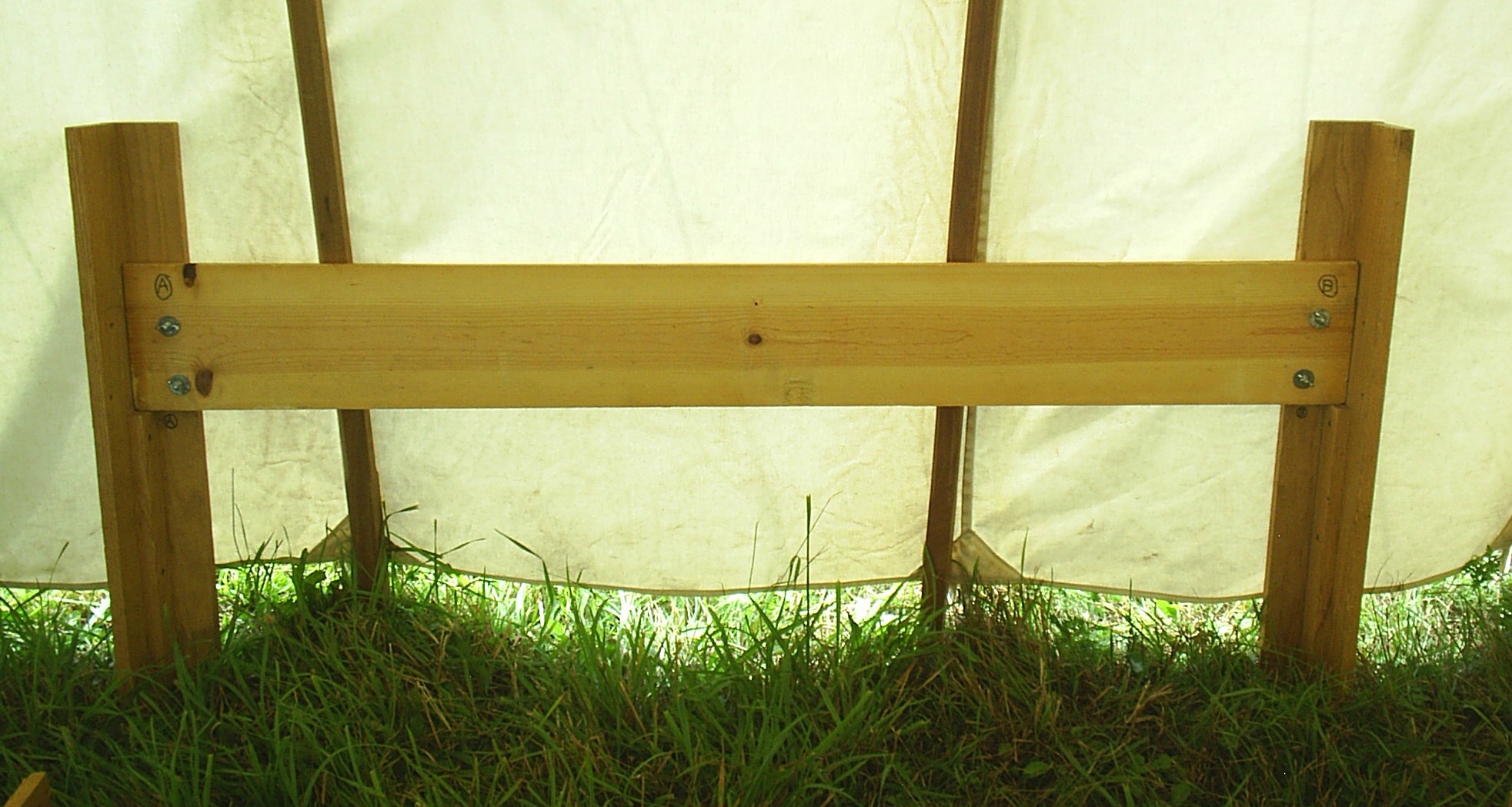
M3361S-3034This is the way the headboard and foot board of the bed are assembled.

M3361S-3034

Four bolts, with washers and wing nuts hold the legs to the headboard.

The side rails of the bed are also made of several pieces of wood. C is the actual side rail, B is the shelf that the bed boards rest on, and A is a stabilizer for the bed board shelf and also stiffens the bed rail. When the side rail is in use board C is vertical.

M3361S-3034

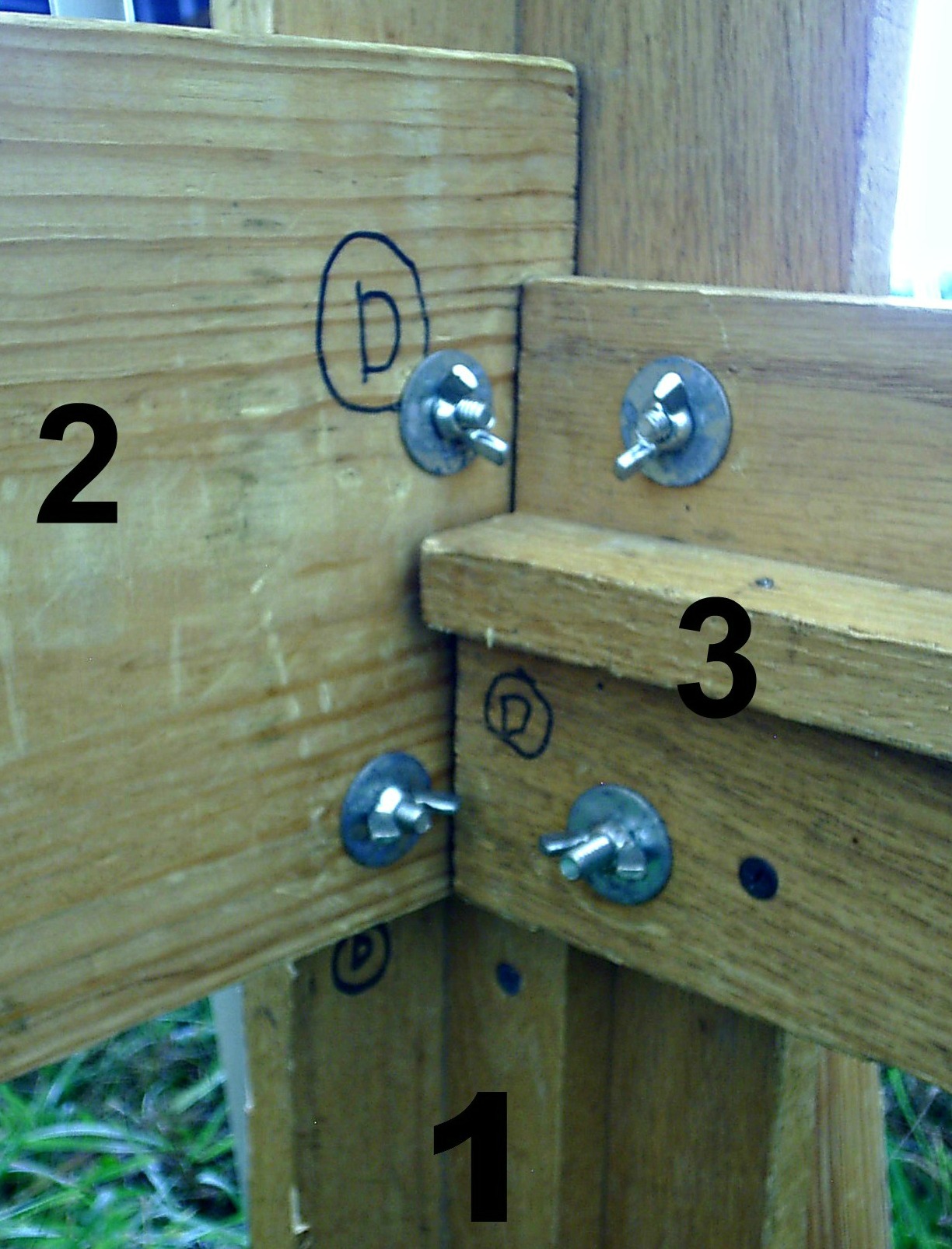
This next picture shows the side rail in place. You will notice that each one of the pieces is marked with the letter D. That makes it easy to find all of the pieces and assemble them quickly. No matter how careful you are about drilling your holes, each corner of the bed will be slightly different. Any system that allows you to keep the correct pieces together will work.

M3361S-3034

The distance from the bottom of boards 2 and 3 to the ground determines the height of the items that you can easily slide under the bed.

The next picture shows the bed frame with a single bed board in place. The mattress will rest on top of the boards when they are all in place. If you are using an air mattress I recommend that you put an old blanket or canvas tarp on top of the bed boards before you put the mattress in place. You will need to protect the air mattress from splinters and the bolts in the corner of the bed frame. If you are camping in cold weather placing a survival blanket under the mattress will help keep you warmer.

M3361S-3034

Once you have put all of the boards into the frame you can put the mattress in place. The mattress actually sits down into the frame, so that it does not slide off.

M3361S-3034

Now that you have seen the basic process, you or some other handy person can easily make one of these beds. There is another very important hint that you may be able to spot in the picture above.

M3361S-3034

The bed, if properly constructed, will be square and will work perfectly on level ground. But when was the last time that you camped on perfectly level ground? Save the cut off pieces of boards from your projects and always carry some with you. Whether you are on a slight hill, or you have a hole under a single leg, the boards will make your bed a much more comfortable place.

I hope this blog series has given you some good ideas about what you would like to do with your own camping bed arrangements.


Camp Beds – Part 3: – Getting off of the Ground – Homemade and Crafted Solutions: Part 2 – Springs and Assembly

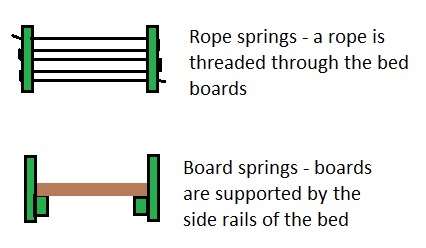
One of the major goals when creating your camp bed is comfort. Your bed at home generally has a box spring, but what can you use in a home-made camp bed? The most common camp bed solutions are rope springs and boards. Both are historically accurate and functional. The boards are heavier, but the ropes need to be re-tensioned every few days, take longer to assemble and are more likely to break.  This graphic shows how both of these techniques work. The rope can actually be used as part of the structure of the bed – keeping the boards under tension, but this also means that a broken rope can mean a broken bed. If you maintain your ropes, watching for worn spots and making sure that the ropes are sturdy (no clothes line!) this should NOT be a problem. The boards are simply laid on supports on the side rails of the bed. Be sure that the boards fit fairly snugly between the side rails so that when they bend they do not slide off of the side rail supports.

Bed springs

So how do we put the wooden pieces of the bed together?

I have seen some amazingly complex and beautiful wooden beds – pegs, mortise and tenons, all sorts of creative and historically inspired furniture designs. I have to admit that when we made our bed it was put together with ¼ inch nuts and bolts. Why bolts? Simplicity, strength, and ease of construction. But more on that later… I should explain some of your options before I tell you how we do our beds.

Mortise and Tenon Joint

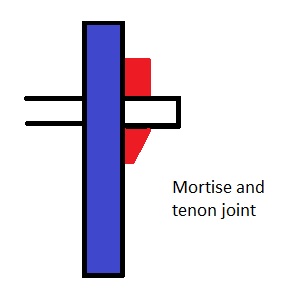
So what is a mortise and tenon? The blue represents the upright that has a hole, called a mortise, cut through it. The white piece that sticks through the mortise is called a tenon and the red piece is a peg which keeps the two pieces anchored firmly together.

If properly constructed this is a very sturdy joint and was a major technique for joining wood together for centuries. It has the advantage of being able to be taken apart easily for transportation.

This next version of the graphic shows the details of the upright and the beam as they would appear in a bed. If you think about the fact that you are cutting a hole through a vertical piece of wood and putting another piece of wood through the hole, you should be able to see some of the issues. The quality of both pieces of wood must be good. The most critical piece is actually the tenon since that beam is greatly reduced in size in order to fit through the mortise AND a hole is cut through the beam to accept the peg. If the quality of this piece of wood is not good, it will break. The upright, while important, can easily be made heavier – and that piece of wood is in compression – which makes it much less likely to break.

Mortise and tenon 2


Lots to think about and figure out! Next time we will discuss the bed design that we have used for the past 15 years.