What Size Were Brooches in the Middle Ages – Part 13 – What other things were little?

Well, this is back to where this series originally started out – looking at tiny brooches and buckles and other things. Ideally I would have planned out the entire series, written all the installments and then just published them, one at a time. The reality is that I wrote one installment and then started reacting to questions and comments that I received from readers. So it may have not been a literary gem, but my goal was to answer questions. And I think that I have been doing that. Perhaps I have encouraged people to pay more attention to the historical facts, at least as we know them, instead of just accepting modern mythology. We have fashion, availability of materials, and the size of the people to thank for some of the size issues. But functionality is also a consideration.

I learned to do tablet weaving quite a number of years ago, and my original cards were a solid four inches square. Huge cardboard squares the size of bar drink coasters, with 1/4 inch holes in all four corners. Years later, my cards are 2 1/2 inches square and they are still larger than many of the real pre-1600’s weaving cards that I have seen.

To me, learning to tablet weave was a very cool thing. An opportunity to be creative and make something the same way it was made hundreds, or even thousands of years ago. And then I saw these videos – videos of women had learned to do the same sort of crafts that I was learning. Except that they had been doing it for decades – not as a fun hobby thing, but because they actually needed to make things for everyday use. There are a bunch of these movies out there, on You Tube, under the search term “Norsk Stumfilm”. They show women and men, filmed in the 1940s, doing some of the crafts that I do for fun. This one, called bandvev, shows several techniques for weaving bands and cords. They are black and white, and have no sound, but they were designed to show the actual hand movements of the women. They actually slow down the film for us so that we can see the hand movements.

Some of the equipment is small and some larger. The last woman does what I was taught to do as a Viking Cord. I learned to do it using two people. By using four very large weighted bobbins, she can do it by herself. Yes, I will be looking into this. While the technique that I was taught is a great project for children, or for forcing adults to cooperate with each other on a productive task, I always had a hard time believing that they would actually have made the cord that way.

And then there is this lady. This is a new color video that was made in Sweden to show an old technique for weaving bands quickly on an Inkle style loom. Again her hand movements are slowed down in order for us to be able to see what she is doing. Her bobbin is just large enough to hold the weft thread and the weaving knife that she uses is of a modest size.

And the point of all of this? Do not assume that just because we use something in a specific size modernly, that it was the same size before 1600. Do not assume that all things before 1600 were large, or small, or standardized in size in any way (they may vary greatly in size from time to time and place to place). And whatever you do, do NOT assume that because it is “traditional”, or because you saw it at a Renn Faire, it is correct for the timeframe before 1600. Go forth and do research!

frühmittelalterliches Webbrettchen (Augsburg, ...

frühmittelalterliches Webbrettchen (Augsburg, Inneres Pfaffengässchen) (Photo credit: Wikipedia)

What Size Were Brooches in the Middle Ages – Part 12 – Figuring out Earlier Cultures

So last time we asked the question – but what about earlier time frames? What can we do to understand cultures like the Romans and the Vikings?

To be blunt, the less figurative art that we have (art with actual life-like representations), the harder it is to be completely confident of our interpretations. Cultures like Rome, Greece, and Egypt, despite having existed a very long time ago, actually left an amazing collection of sculpture, frescoes, paintings, and mosaics.

An excellent example of using this sort of information to help us understand a culture, is the Camomile Street Soldier. I found a single line reference in a book about this being a source of information on the use of buttons in Roman Great Britain. So I Googled it. I quickly discovered that it was a carving that is believed to have been part of a frieze on a tomb. This sculpture clearly shows the clothing of a soldier. I found a small collection of pictures of the carving. You can see the buttons on the front of his tunic, as well as how he wore his sword and how his belt was decorated. In addition, through the generosity of the internet, you can read J.E. Price’s original report on the discovery.

And you can read a follow-up report that reevaluates the frieze in modern terms.

All from one search based on a single reference in a book. Now obviously this was a lucky find.

But sometimes we make our own luck.

The Egyptian tombs had wonderful paintings in them. The Roman frescoes in Pompeii and Herculaneum are legendary for their details. If the culture that you are interested in does not have any surviving carvings or paintings with that level of detail, look at archaeological reports. Join academia.edu (FREE) and start reading the articles that are posted there. You can even set up your preferences so that every time an article is posted in one of your areas of interest, you are notified. Many theses and dissertations will do all of the extensive research that is necessary to interpret the archaeology that is available. Don’t be afraid to let someone else help you do your research – just always approach any research with at least a little healthy skepticism.

Many of the earliest large burials were very poorly excavated by treasure hunting antiquarians, but occasionally we find someone, like Johann Karl Bähr, whose original training was as an artist. He recorded every inhumation grave that he excavated in extreme detail. Unfortunately, his records were for Livian graves, not Vikings, but records like these can provide us with insights into cultures that did not leave good pictures of their members.

Professor Bӓhr’s work is also a good example of a problematical area of study – Vikings vs. Scandinavians vs. Finno-Ugaric cultures. Now this could be a blog series all by itself, but my point is that the Vikings were not a unified culture. They were a generalized group of people who started out in Norway, Denmark, Sweden, and northern Germany and spoke the same language – Old Norse. Each area had different influences – the Hanseatic League, the Finno-Ugaric cultures, the Slavs…and different levels of access to imported goods. I would expect the different groups to have dressed and looked differently, with different dress accessories and styles.

But going back to our original theme – what other things are little? More next time!

Territories and voyages of the Vikings

Territories and voyages of the Vikings (Photo credit: Wikipedia)

What Size Were Brooches in the Middle Ages – Part 11- Theories About Misconceptions

So last time I promised to talk about my theories on where many of our historical  misconceptions came from, and what else besides brooches is not as big as we might think it is.

I was chatting with a friend about some of the common misconceptions that I find in the general public about the size and quantity of jewelry in pre-1600’s Europe. She blamed a lot of it on the Victorians, and I agree. The upsurge in nationalistic pride combined with the romanticization of historical and mythological events in literature. Then you add some extremely talented artists who published romantic photographs and paintings of these events, and you have a perfect storm. There is something about seeing a picture that reinforces the reality of a theory, even if the theory is wrong. All of these things served to make people believe that these fantasies were fact. This article is an excellent example of the type of romantic photography that reinforced these beliefs.

And this article, about the infamous forgers, Billy and Charlie, gives us another peek into the world of the Victorians and how gullible they could be. I have personally seen some of the work that Billy and Charlie did. The Victoria and Albert Museum in London, England, has a case of Billy and Charlie originals in their “Fakes and Forgeries” Gallery. Their work really was awful: crudely made, overly large, cast pieces, that bear very little resemblance to real historical artifacts.

One of the problems for modern reenactors is that some of this Victorian gullibility has been retained in modern culture. Less than authentic costuming is used in movies, TV programs, and literature and many modern people’s first introduction to anything “historical” is a local Renn Faire. And every time we see a picture it reinforces the “reality” of the costumes, even if they are really incorrect.

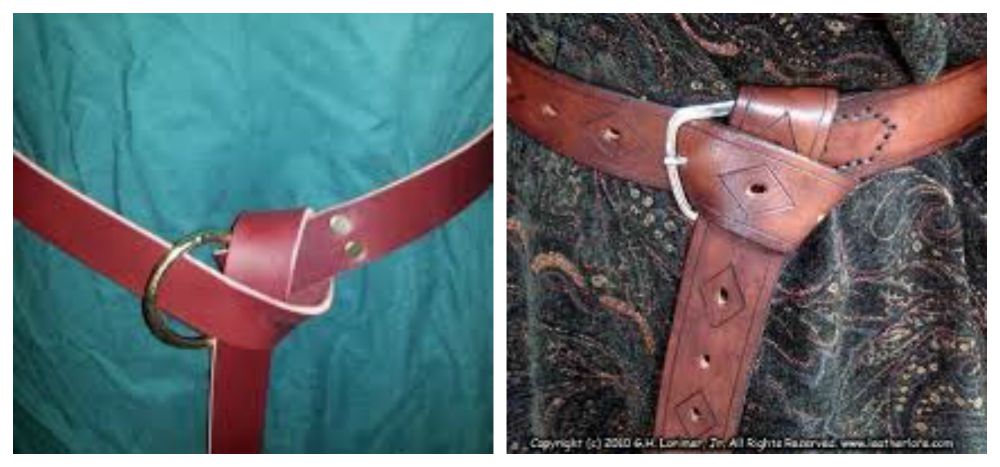
Another friend noted that one of the MOST annoying things that she sees all the time among historical reenactors is the use of a simple ring as a belt buckle. She felt that this was a Renn Faire affectation. I agree with her assessment. Pre-1600 people definitely did sometimes tie a knot in a belt, but I have never found an example of a simple ring buckle in any historical drawing or painting. These pictures show the Renn Faire Version on the left and a modern interpretation of the correct historical technique on the right.

Medieval Tied Belts

We have science and research capabilities that are very far beyond the abilities of the Victorians, but yet we sometimes choose to believe their words instead of doing our own work.

So exactly how do we fill some of our knowledge gaps? Well, honestly the easiest thing is to just look at the real facts. We have thousands of illuminations and paintings that were created during the Medieval timeframe that show Medieval people at work and play. We have thousands of surviving artifacts from graveyards and other archaeological excavations that can be precisely dated and give us an accurate image of what people actually owned and used. With more and more museums digitizing their artifact collections it is no longer necessary to have large numbers of expensive research books, we can now go online and see up-close pictures of accurately photographed artifacts and art work.

But what about earlier time frames? What can we do to understand cultures like the Romans and the Vikings? We’ll talk about that next time along with a  few other things…