Designing Displays for a Craft Show – Display Boards Part 1

Last time we talked about some of the challenges that we can face running a craft booth at an outdoor event. One of the very important issues outside, is how to build display boards that will not blow over in a gusty breeze. Clumsy or careless customers knocking over displays can be an issue at indoor events, too. One of the things that I learned quickly was that if one display board falls over most customers will run for the hills, whether it was their fault or not.

When I started selling jewelry at outdoor craft fairs, I used the small necklace display boards that are often used in mall jewelry shops. But it didn’t take long for me to realize that I needed to make better use of vertical space. “Going up” lets you show more items in the space. From that first outdoor event I learned that my display boards needed to be very sturdy to withstand whatever the weather could throw at me.

Before you build your display boards you need to consider what size they should be, how you will hang your items on the boards, and whether you want to always hang the same things on the same boards. Alternately, you could have more flexibility in terms of board layout. Once you think you understand these facts, then you need to choose the display board materials and what it will be covered with.

Whenever I think of display design, I remember a very wise teacher that I had once in a class on booth design. He basically said “Ladies, don’t ask a male friend to build your displays. We will build it. We will use two by fours and 1″ plywood, it will weigh a ton, and require a large team of sturdy men to set it up.” He then recounted a story where he and some friends used recycled solid antique doors to create a display space for a friend’s paintings. It looked awesome and worked very well. BUT, with each door weighing 80 to 100 pounds and eight doors in the display, it took a small army of sturdy men to set it up and a truck to haul all of pieces.

Consider whether you’ll set up the display by yourself, how far you may need to transport it, and what sort of vehicle you will need to hold all of the pieces and any tools needed to set it up. Most convention center environments have strict regulations about what you are allowed to bring in yourself and what you have to pay someone to haul for you. These contractors are often hired by the convention center and can be quite expensive. Make sure that you investigate what the rules are about you bringing in displays. How far away will you have to park? Will you be allowed to use a dolly or wagon to bring in your displays and products? Most, but not all, outside venues allow you to drive to your booth to do set-up. When you are considering applying for a show, READ the rules first. Most will tell you when you are allowed to set up, and how you can do it. If you have questions, contact someone at the show to make sure that you understand the rules. Violating the terms for set up, especially at large convention centers (even if it’s a small show) can delay your setup significantly.

Next time: More on building display boards and other display issues.
DROID3 TRY3 046

Thinking it Out – So you want to do a Craft Show Outside…

I recently read a jewelry hint newsletter that started something like this, ” I had planned out how to make my booth pretty, but I never realized what can happen if there is a nasty gusty wind.” When I mentioned this to a couple of my friends that I merchant with on a regular basis their response was “What planet does this person live on? Do they sell only at indoor events?” And that made me think that it might be time to write a blog about this topic. Most of the events that I do are outside.

If all you are going to do is sell at indoor events, your product problems are mostly limited to issues of appearance (make it look good), security (keep thieves from taking your stuff), and efficiency (fit as much into a small space while still making it functional). But if you are going to be selling at any kind of outdoor event you MUST consider what you will do if there is weather. And most of the time there will be weather, if not this time, then next time!

Here are the sorts of questions that you need to ask yourself in order to have a successful, weatherproof event.

Rain. If it rains can you protect your product and still be able to sell it? Is your product ruined if it gets wet? If your product is water sensitive, can you package it to make it safe and still have it be attractive to your customers? If your product is placed into a waterproof or water-resistant package, is it removable so that the customer can view it closely, or do you need to have a sample available. Is a sample enough. For instance, a handmade card, where the front of the card is the selling point is easily encased in plastic. A hand painted scarf, where each portion of the scarf is unique has to be in packaging that allows the entire scarf to be easily viewed and then put away again.

Dust. Yes, it does feel like the opposite of rain, but sometimes it can appear, even with rain. It can also turn into mud if there is a source of moisture. If the ground that you are on is covered with grass the amount of dust will be less, but road and foot traffic can sill stir up a surprising amount of dust. The longer an event is, the more likely dust is to be a problem. The grass can be trampled and the sprinklers can`t be run with vendors’ booths in the way. I have a friend who sells handmade soap and lotion bars who has lost product because it became coated with dust at an event. She now wraps her product in plastic for outdoor events. Also be aware of how difficult it will be to remove the dust from your packaging. Some packaging is more difficult to clean than others.

Wind. If the wind starts to blow will it damage your product? Will your product blow away? Will your display fall over?

Heat. Is your product heat sensitive? Will it melt or bend or slump or blurr?

Cold. Will cold make your product freeze, and if it does will it be ruined or break?

Light. Is your product subject to fading from exposure to light?

I hope that these thoughts will help you avoid some of the things that can go wrong in an outside vending environment, and better prepare to deal with the challenges that you may encounter. Planning can eliminate a lot of the drama. Next time we will discuss some display techniques that work well either inside or outside.

Storm then wind then dust then rain.

Storm then wind then dust then rain. (Photo credit: Wikipedia)

Garden Defenses: Making Large Covers for Your Garden – Part 1

I have always loved the pictures of English Country gardens, complete with the occasional cute little bunny, nibbling contentedly on some random grass or weed. A lovely vision, but unfortunately nothing like where I live. With drought even worse than usual this year the rabbits have become voracious predators, eating everything that they can get their self-sharpening teeth on.

I have considered building enclosures for my beds for several years. I loved the pictures of neatly constructed cedar or redwood frames, with hinges for easy access and latches to keep the covers from blowing open. But have you priced quality wood lately? I have, and it just wasn’t going to happen. So I took my old standby PVC pipe, and went to work. My larger enclosures use 10 foot sticks of 1 inch PVC and my smaller ones use 3/4 inch PVC. I do not recommend using anything smaller than 3/4 inch PVC – it just won’t have the structural stability that you need.

In previous years I have used these PVC pipe arches to support row covers over my garden beds. The row covers allowed me to set my vegetable seedlings out before all danger of frost was gone, protected them from bugs, protected them from hail storms, and allowed me to extend the summer season solidly into the edge of winter.

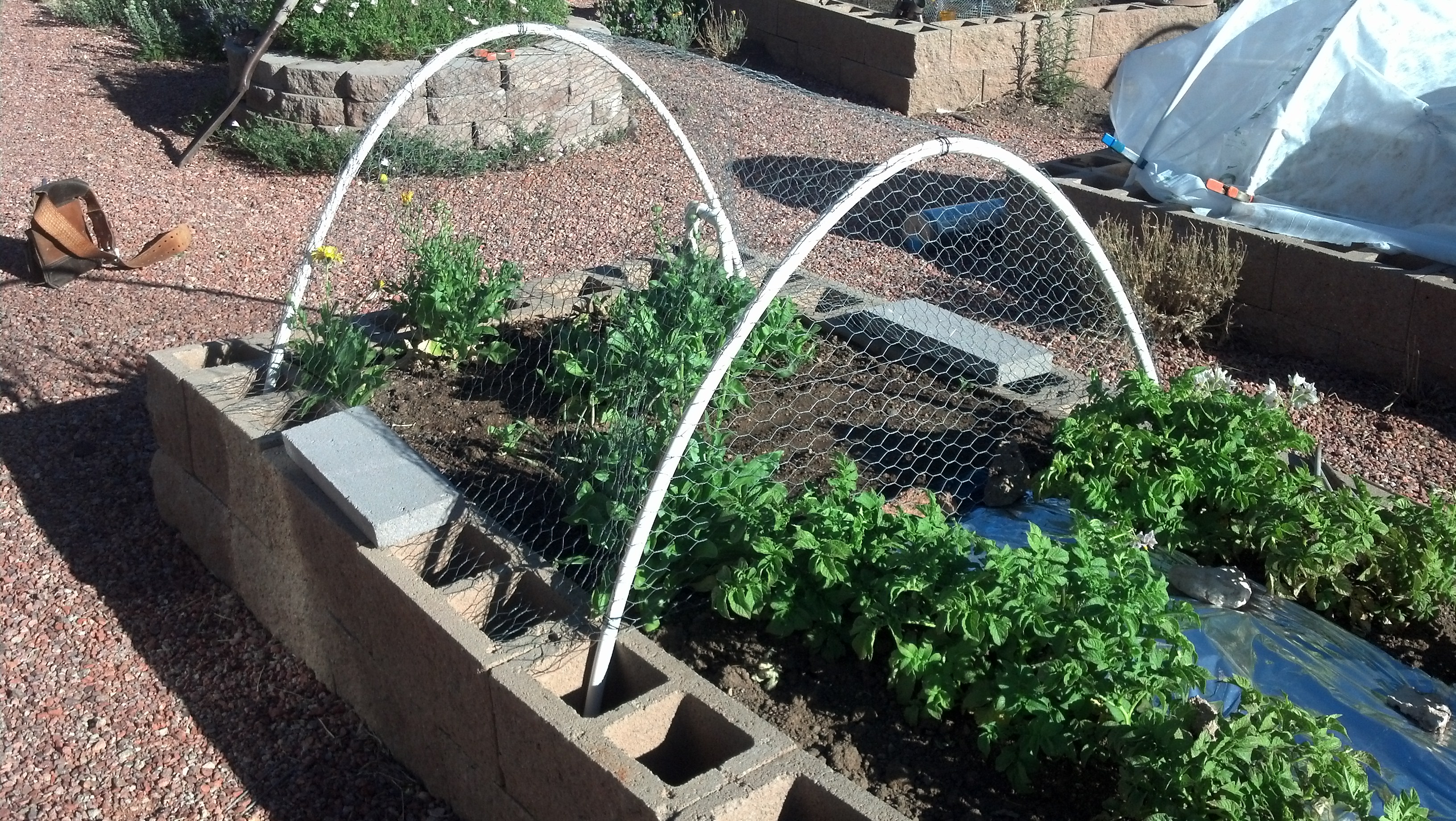
So first let’s take a look at my garden beds. Because the quality of the soil where I live is very poor, and water is something that rarely arrives from the sky, I used raised beds that are made of dry laid cement blocks. Adding the PVC arches is very simple. I just buy 10 foot sticks of PVC pipe, bend it and stick the ends in the concrete blocks that make up my raised beds.

garden bedsThis picture shows some of the beds in my garden. The closest bed has a small chicken wire cage on one end and the bed to the right has a row cover on the PVC hoops.

If you do not have raised beds, or you have raised beds that are made from boards, railroad ties, or dry laid stone, you will need to put something into the ground to hold the ends of the PVC pipe. The most efficient, sturdy, and available “something” is a piece of rebar. Large home stores sell rebar precut to different lengths. They are not cheap, but they will last a lifetime and more. I would not buy anything shorter than a foot. You want to have several inches to drive into the ground and about six above ground. If your ground is particularly friable (not structurally stable) you may need to buy 18 inch pieces in order to have sturdy supports for your “cage”. The stakes and/or PVC pipes are placed so that they line up with the middle or the edge of a piece of wire. For instance, if I was using five foot tall chicken wire, which does not have much structural stability, I would plan to use a PVC hoop at each end and one in the middle to support the wire and keep it from crushing easily. On the other hand, if I was using two foot tall 1/2 inch hardware cloth I would place one hoop on each edge of the hardware cloth, and that would be more than enough support.

But how do I keep my wire on the hoops? Simple – cut pieces of baling wire that are long enough to wrap around the PVC pipe, stick through the wire, and wrap into a twist to hold everything together. I usually just cut my wire, form a U shape, push the wire U through the wire fencing and twist the ends together the same way that that you would twist a twist tie. I often use a pair of pliers to do the actual twisting – saves the fingers a bit and makes for a tighter twist.

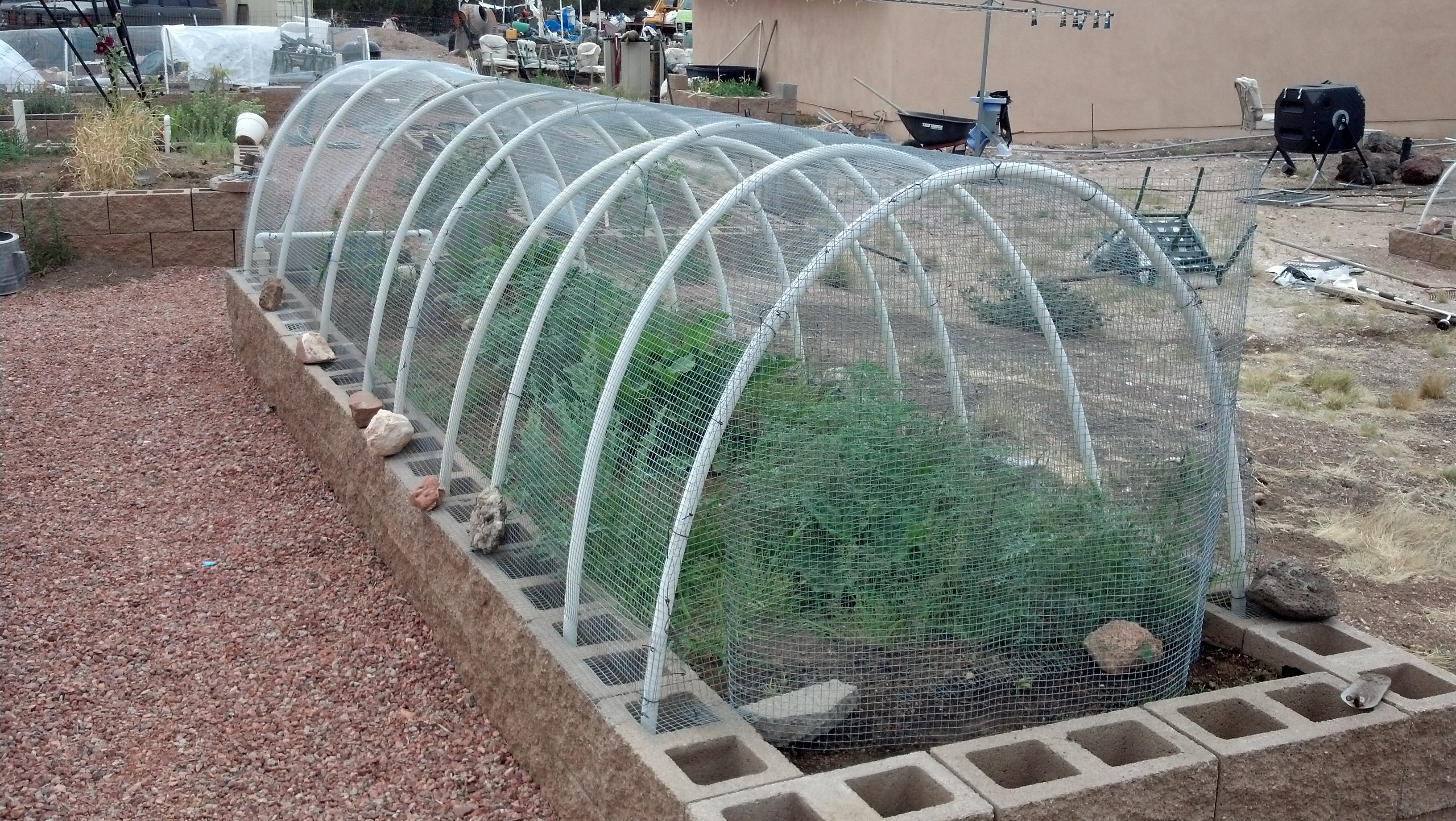
And this is what you wind up when you are done – a complete cage over and around the vegetable bed. This particular bed also has a “c shaped” piece of hardware cloth attached to the end to protect the pole beans from rabbits and crows (they sometimes pull newly sprouted beans). I did not put the pole beans inside the cage because I want to allow the beans to climb on the top of the cage.

Rhubarb bed

But, you say, how do I get to my veggies to harvest them and pull weeds? We will discuss creating access next time.