Planning Your Garden – Garbage in Garbage out! Part 2: Picking our seed varieties

So this week we are going to talk about picking our seed varieties. Before we get into those details though, I would like to make a point about seeds.

Do I save seeds? Yes, from heirloom plants that breed true with very little variation. My Violas, Hollyhocks, California Poppies, Calendulas, Coreopsis, Marigolds, and Bachelor Buttons are all from saved seeds. I carefully harvest, or distribute, these seeds after every growing season, and store the harvested seeds in well marked plastic prescription bottles.

In addition to my flowers I also have a selection of perennial herbs that come back by themselves every year, and occasionally need to be beat into submission so that they do not take over the world.

I am not currently saving vegetable seeds, with the exception of teppary beans, peas, beets and parsnips. Why? It takes more effort than I currently have time for. I know how, but right now purchasing quality seeds is just easier for me.

So back to choosing seeds. I recommend purchasing your seeds from a reputable seed company. While I have occasionally had good luck buying no-name brand seeds at a home improvement store (that is where my California Poppies came from) most of my seeds come from just a couple of major seed suppliers – Johnny’s Selected Seeds and Totally Tomatoes. Why? Excellent quality seeds with very high rates of propagation. That means that if I plant 20 seeds I will usually get 18 plants (and sometimes 20!). I start most of my seedlings on a rather tight timetable because of my regular business events, so having to replant can be a problem for me.

These two companies are obviously not the only seed companies out there. There are lots of reputable companies, many of which specialize in seeds designed for specific areas of the country. When I lived in Massachusetts I also bought seeds from Shephard’s Seeds (which no longer exists), Burpee, and others. I had a very fertile garden there, full of humus and very productive with very little help. When I moved to northern Arizona I found that I needed to be much pickier about my seeds and what varieties I planted. I live at 5270 feet above sea level and our weather and soil conditions are extreme.

Before I go any further I should mention that I have a garden diary. Every year, for over twenty years, I have kept a record of what was happening in my garden. I record the seed varieties that I am using, what company they came from, when I started them, how they were started (flats, plug flats, biodegradable pots, plastic pots, or in the garden), what sort of results I got, how and when the plants were posted, what amendments were added to the soil, any unusual extremes of weather, insect pests or diseases, and what sort of production I got from the plants. Having this information allows me to remember exactly what worked well, and what didn’t. I don’t have to guess which seeds worked for me, I know what varieties were the best.

Next week: Part 3 Deciphering the seed catalogs

Embed from Getty Images

Planning Your Garden – Garbage in Garbage out! Part 1

No, this blog post is not about compost! I became aware of the phrase many, many years ago in reference to computer code. The idea was that if your code was garbage, your results would be garbage too. Well, like it or not, the same thing often goes for our gardens. Now that the main garden season is over, it is time to plan what we are going to do next year to make our garden better. We can’t necessarily control what Mother Nature throws at us, but we can try to moderate the effects enough so that we can feel good about our gardens.

DROID3Try2 203

I live in northern Arizona, in one of the most difficult locations that I have ever gardened. Our soil is an interesting collection of ash falls from various volcanic eruptions, along with rock dust and almost no organic material. The soil is so alkaline that a natural, mostly impermeable layer of calcium carbonate forms below the surface of the soil (caliche), usually one to two feet down – sometimes as much as 6 inches thick. The alkalinity of the soil prevents the plants from absorbing calcium (ironic huh?) so we have to supplement our tomatoes or they will have poor crop yield because of blossom end rot.

So what can we do about these issues? Well, one of the most important steps that we can take is to be extremely careful in our seed choices. I have several friends who insist on using random seeds that they save from store bought vegetables and fruit. That’s an admirable approach in many parts of the country, but here my friends are often not happy with the results. Why are the store bought vegetables or fruit so yummy and the next year’s result so disappointing? Simple, there is an excellent chance that the plant used to produce the vegetables was a hybrid.

So what exactly is a hybrid? It is when the breeder takes two or more plant varieties and purposefully combines the pollen from one with the flower from another to create a genetic combination of the two plants. Mankind has been manipulating plants in this manner for a very long time, and there is nothing dangerous about it. This does not involve any genetic manipulation other than what Mother Nature sometimes does herself. Ancient man chose and kept the seeds from the best plant and in that way gradually improved the quality of the plants that he could grow. Modern traditional hybrids (non-GMO) are created for many reasons, including flower colors and forms, flavor profiles in fruits and vegetables, disease resistance, plant height and form, and fruit longevity (how fast does it rot), just to name a few.

So how do we learn about the seeds that we are using and locate quality seeds to buy? Read. Read everything that you can find about seed varieties and their characteristics. If a company won’t tell you if the seeds are hybrids, or not, you need to consider whether you want to do business with them. I also strictly avoid all GMO seeds and deal only with companies that provide a non-GMO promise.

So how do we pick our seed varieties? We’ll talk about that next time!

Garden Defenses: Making Large Covers for your Garden – Part 2

Last time we ran through the basics of building a cage for your veggie bed using PVC pipe and chicken wire or hardware cloth. The bed cages that I built this year fell into two categories – beds that would essentially be left alone until next year and beds that would be harvested within a few weeks.

This year I wanted to add some more perennials to the garden, and I chose asparagus and rhubarb. I decided to create a new bed for the asparagus and convert an existing bed into a rhubarb patch. The asparagus bed would not require anything except occasional weeding until next year, and the rhubarb bed, which was actually rhubarb at one end and Swiss chard, onions and herbs at the other, would require weeding and the ability to harvest vegetables and herbs when needed.

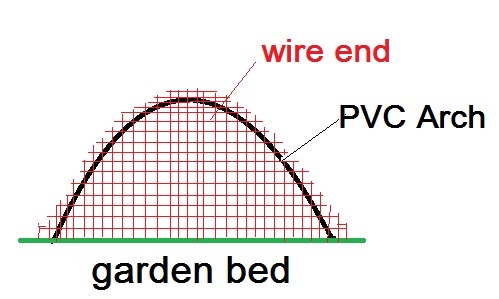
Initially both beds were treated the same. A PVC frame was put in place and hardware cloth was wired into place on the frames. The irrigation for these beds was carefully put into place before the wire was closed up. In the case of the asparagus bed I used drip irrigation and the rhubarb bed is a wicking bed (think self watering planter with the reservoir underneath). Once the “arch” frame of the bed is completed you will need to close up both ends of the “cage”. I usually just measure a length of wire fencing that is about 6 inches longer than the widest portion of the “arch” and about 3 to 4 inches taller than the arch. The “end” of the cage is then trimmed to match the arch of the PVC pipe.

cage end


The “extra” wire is bent down to meet the wire fencing on the arch and then wired in place.

corner of cage

When you put the ends on the cage I recommend leaving extra wire at the bottom so that you can anchor it, either on the surface of the soil, or on the edge of the bed.

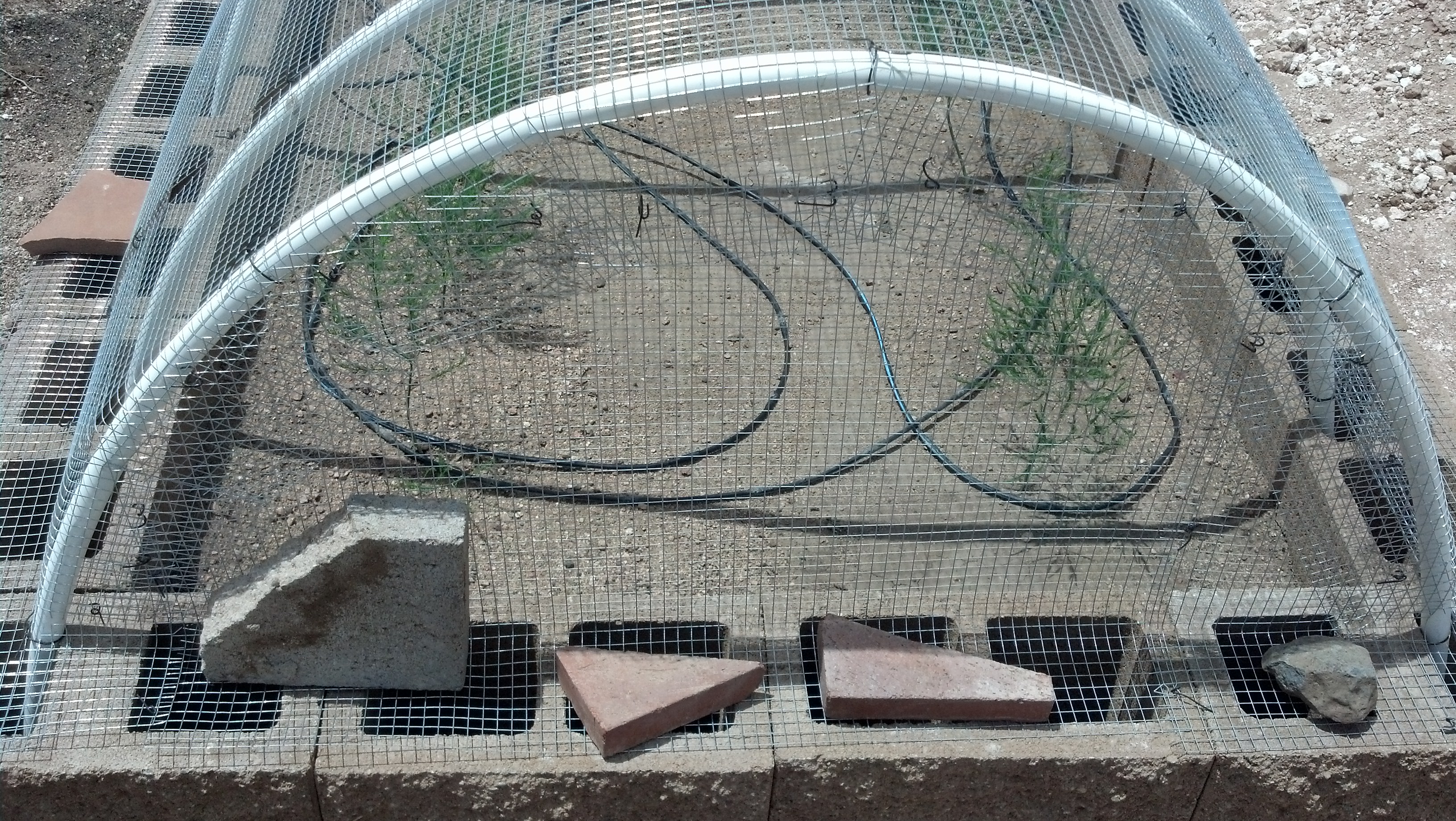
asparagus bed with bricks

This picture shows how I bend the hardware cloth or chicken wire down and weigh it down on the top of the cement blocks that make up my beds. I leave at least an extra 4 to six inches of wire on all pieces of the wire, all around the bed.

OK, so now we have a closed cage. How do we get back in to weed and harvest? Doors! It is possible to open the actual pieces of wire fencing by unwiring them from the PVC pipes, and I have done that before for weeding, but for easy everyday access, you need to make doors.

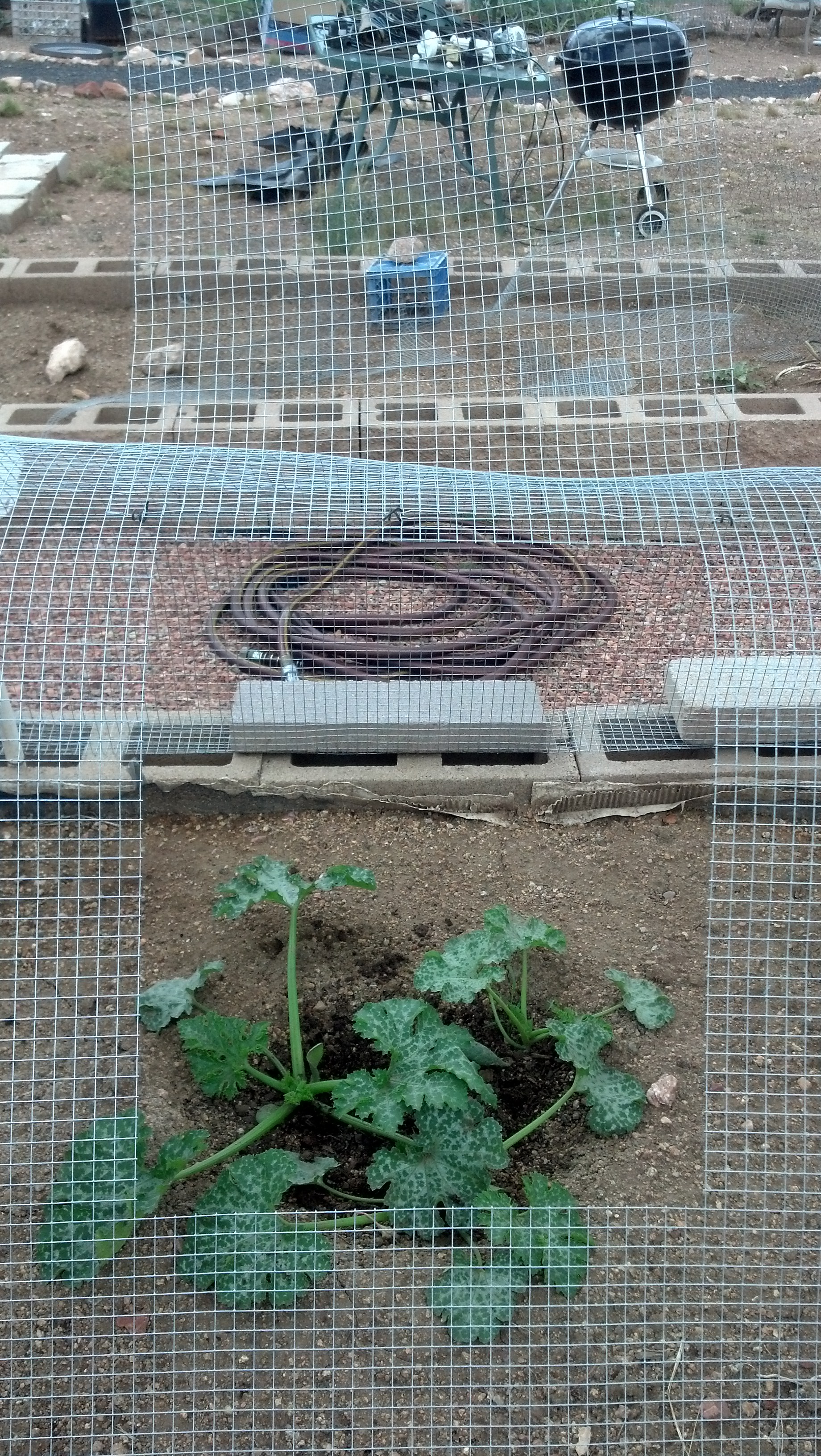
cage with door open

This picture shows the simple doors that I cut into the cages. I choose locations that will allow me to reach the most important areas easily. I cut the wire so that there are as few sharp points sticking out as possible. The hole must be big enough for good access. I cut a piece of wire, in this case hardware cloth, that is at least two inches larger, on each side, than the hole. The hinges are simple loops of wire at the top of the hole that allow the wire door to open and close. To keep the door closed when you are not using it, you can use binding wire or twist ties. Simple!

I hope that this series of blogs inspires you to develop your own custom cages to protect your plants.