
The Care and Feeding of Your Metal Jewelry & Accessories

What sort of finish do you like on your jewelry? And once you have chosen it, do you know how to take care of it?

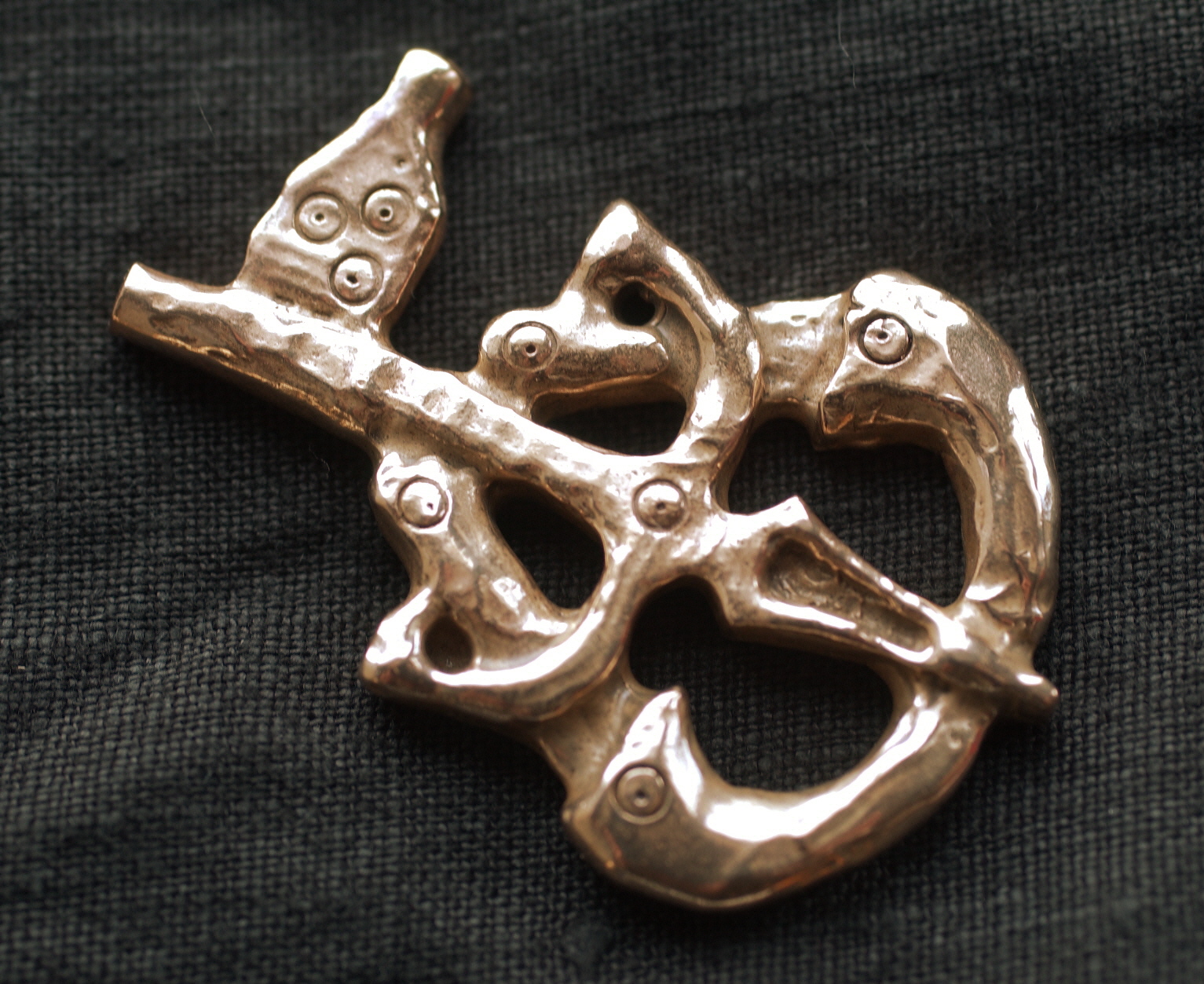
Whether we are talking about a historical piece, or a modern piece, the way that you prefer jewelry to look is very much a personal choice. It is important to realize that some pieces of jewelry, or other metal accessories like crowns, coronets, and buckles, are designed to be maintained in very specific ways. For example, the Viking Keys that I offer are sold with a bright finish. But bronze can attain a patina over time that you may prefer. The nice thing is that if you decide that a brown or blur-green patina is not to your liking, you can always polish it to like-new condition.
Etsy 28When you buy a piece, ask the person who sells it to you what is the best way to take care of it. Generally they will know. I say generally because I have heard some very bad advice given at shows before, so I always try to make sure that my customers know what to do with my pieces. And I have helped other people’s customers on several occasions. If the advice that you receive doesn’t sound right, it is up to you to figure out what the correct process is. Most jewelers are happy to provide an explanation of why they recommend specific cleaning and care.

I highly recommend that people understand what they are willing to do before they buy a piece. Someone who purchases a piece with bright, smooth surfaces, but refuses to polish the piece regularly, may not be happy with the way that their piece looks, unless they pay to have it cleaned professionally.

For some pieces that are not damaged by liquids, buying something like a small home ultrasonic cleaner may be just the trick. Just follow the instructions and your piece will be as good as new.

The easiest, and probably the safest, solution for dirty or tarnished jewelry, is a Sunshine Cloth. They are a chemically impregnated cloth, manufactured in Japan, that is safe for all metals. The cloth is non-abrasive, so it will not damage plated metals or leave scratches. I sell them in my store, and include them whenever anyone purchases a coronet.

You can use the Sunshine Cloth to remove all of the tarnish on a smooth piece, or just polish portions of the piece to produce highlights. Gentle, but firm pressure is all that it takes to clean an amazing amount of build-up and tarnish from your pieces. Be sure to store it in a little ziplock to keep it fresh, and NEVER wash it – washing removes the chemicals that do the cleaning. The cloth will eventually become amazingly dirty, but it will continue cleaning even when it’s all black!

If your piece is really dirty, you might try something like Flitz. This is a liquid cleaning compound generally found in motorcycle shops and automotive parts stores. When we received the Baronial Coronets that we planned to use during our tenure as Baron and Baroness, they were just plain grubby. They were tarnished and also had a layer of general grime. A good scrubbing with Flitz, following the instructions of course, and the coronets were clean and shiny. Both Flitz and Sunshine Cloths will leave an invisible coating to help protect the metal. We wore our coronets a LOT. I would clean them up a tiny bit before every use with a Sunshine cloth, and about every eight months I would do a “deep cleaning” with Flitz.

And beware of lotions and perfumes! The chemicals in these concoctions can stain or tarnish your pieces.

Lastly, if you prefer the shine and patina of a new item, ask your jeweler if they offer a clear transparent coating option to help keep your item looking like the day that you bought it. There are a number of coatings that can be used to retard tarnishing, ranging from polyurethane to clear nanoceramic plating. All of these coatings will eventually wear off depending on how you use the piece. Some, like the nanoceramic coating, have been reported to last a year or more in daily use.

Metal objects can be a “living” thing – the care and feeding is up to you.

Camping: Making Your Bed and Sleeping Warm

Our weather at camping events this past year was a challenge; anywhere between 30 and 75 degrees at night. One of the events that I did, by myself, was extremely cold and windy every single night. Camping in a medieval canvas pavilion, with no one else to help provide body heat, can make staying comfortable at night something of a challenge. I had checked the weather forecast before I went, and I knew that the temperature was going to be a concern. My solution? Something that I call the camping burrito.

When you are sleeping on a cot you lose heat in all directions, up and down and sideways. I use a futon mat on my cot, which makes it considerably more comfortable (I have a bad back), and provides some insulation from the cold under the cot. When I know that it is going to be cold I start by placing my cot as far away from the canvas wall as I can. Then, on top of the futon I start layering the sleeping bags, quilts, blankets and sheets that I plan to use. I actually place the sheet on the TOP of the pile, because I am going to fold the entire mass of bedding over the top, like a giant burrito.

Burito BedThis diagram shows exactly what I am talking about. All of my quilts, blankets and sheets are queen sized. The closed side of the covers is towards the canvas wall. This dramatically reduces the amount of air infiltration – no drafts. The fact that the covers are all queen sized means that there is plenty of extra covers on the open sides of the bed – again, no drafts. You can always pull the covers up over your head to complete the “package”.

And what should the camper be wearing? Well my favorite “extreme cold” outfit is wool socks, long johns with heavy flannel PJs over the top, a stocking cap, and a hooded sweatshirt. Everything about this “fashionable” outfit has a purpose. Warm, dry feet are a must – hence the socks. The layers on the body are pretty obvious, dry warmth. The hat helps to cut heat loss from the head and the hooded sweatshirt provides more warmth to the torso, covers the head with an additional layer and eliminates any drafts around the back of the neck (particularly important for those who do not like to sleep with their heads under the covers). In addition, we have discovered that many cell phones do not do well in cold weather – the cold literally kills their batteries, so in seriously chilly weather I put my cell phone in my sweat shirt pocket to keep the battery from going dead. I’m, not going to win a beauty contest, but I am going to get a good night’s sleep.

One of the things that I really like about this “burrito system” is that if the weather warms up you can easily pull back the top layer(s) or open up the side of the burrito for ventilation.

I hope that this “burrito system” will make your camping experience much more comfortable. I know that it has done a great job for me.

Researching on the Cheap, Part 11: Where do I go for more information?

So, you have exhausted the online museums and libraries, your local library (if you have one) is a bad joke, and you have no access to a university library (if you have a local university library see if they have some sort of “friends of the library ” membership that will give you access to their information and inter-library loan). Now what… Facebook and Yahoo interest groups, and Blogs.

Just a few years ago all of my “special interest groups” were located on Yahoo, and some still are. But my most active study groups are now on Facebook. For both of these online service you must be a member, but once you are a member you can search their groups and ask to join. Generally most of the special interest groups require membership in order to post, and if you want to ask questions, you need to be able to post.

Now, I am NOT in love with Facebook. I hate the ads, and I have actively started blocking people who consistently annoy me. But to be able to go onto a group, post a question, and have people from all over the world reply, is amazing.

Are there drawbacks? Definitely. Modern Mythology abounds on some of the groups. What do I mean by that? Well, someone who believes that just because something is this way now, or that people believe something now and therefore it was true in the Middle Ages, may post really bad information. Again, just as with using the internet, you need to educate yourself and maintain a good amount of skepticism in your thought process.

Be certain that you read the descriptions of the groups carefully. One of the Yahoo groups that I am on is very academically oriented. Blatant trolling or posting of bad information will initiate a message from the moderators. If the bad behavior continues the individual in question will be removed from the list.

Often the questions that are posed on these groups are practical. Things like – I need help with a pattern for a specific type of pants – which one do you recommend? I am trying to locate a good source for this type of fabric, where should I go? I am trying to find an Italian Renaissance portrait that shows a specific type of hairstyle, do you know where I can find it? These groups are positively amazing, when it comes to answering these sorts of questions. Instead of spending hundreds of hours in a futile search, or experimenting randomly with retail sources, you can get help from other people who have already used a company.

Aside from groups, there are individuals who post some very good information on their Facebook pages. Some of these people live in countries other than the USA and will post pictures that they have taken in local museums. You can often find these people through the special interest group pages.

And then there are the blogs. Blogs can be anything that the person who writes them wants to publish. Some are awesome, and some are totally full of bad information or totally skewed philosophically. Blogs will come up in regular search engine searches. You are the only one who can decide if the writer is a real authority or a crackpot. But there are some truly excellent blogs on the web. Full of well-taken photographs and facts. Sometimes you can locate the good ones through comments on a special interest group. If you have questions about a blog post a question about it on the special interest group and see what the response is.

I hope that this blog post helps you locate even more helpful information on the internet!

English: A panorama of a research room taken a...

English: A panorama of a research room taken at the New York Public Library with a Canon 5D and 24-105mm f/4L IS. (Photo credit: Wikipedia)