
Camping, Batteries and CPAPs

Over the past year or so we have written several blogs about camping and dealing with electrical needs. From charging your cell phone or iPad to running a CPAP machine, we have discussed the use of various sorts of batteries and inverters, and how to figure out how much power your machine needs. Make sure that ANY system that you use for medical purposes is tested before you plan to use it camping. If you don’t have the skills to evaluate a design yourself, find a competent person to aid you. Make sure that you discuss your medical needs with your doctor.

At a recent week-long camping event I was approached by a camper. She thanked us for all of the articles…she had read them all, but now she had a new problem. The temperature. Now I know personally that I have to sleep with my current cell phone in my pocket in order to protect it from the cold. The battery in the new model is very cold sensitive, whereas the older version of the same model was barely affected by even the coldest nights (How is THIS new and improved?)

I know that some folks only camp during warm weather, but there are several events a year that I camp at which can be quite chilly. What exactly do I mean by chilly? The forties (Fahrenheit) and down as the very low 30’s. Yes, I have seen the water in the dishpan freeze overnight. It actually made me feel good – I thought I was getting soft in my old age!

I was aware of the effects of cold on batteries because I do a lot of nature photography, and when photographing outside in the snow I knew to keep my spare batteries in the inside pocket of my parka to keep them warm. If you are going to be camping outside in cold weather, you need to check your batteries ahead of time to make sure that they can take the cold. For easily transported electrical sources, generally alkaline batteries perform poorly in very cold weather, and lithium batteries are only a little better choice. According to the experts your best bet is the NiCad battery. But just as we recommended that you test your battery set-up before you used it while camping, you need to see how your batteries will respond to cold temperatures, too.

In addition to the problem of battery failure from low temperatures, the camper who stopped by to talk to me had another issue – the air from her CPAP was sooo cold that she couldn’t tolerate using it. So we talked about it for a while. The only thing that both of us could think of, that would be non-toxic, and not require additional electricity, was hand warmers. Her plan was to create a box around her air intake and put a hand warmer or two in the space to preheat the air. Larger “body warmers” were also available. For people who may not be familiar with these little camping gems, there are several types. I am aware of two different forms that do not involve any sort of combustion (we were concerned about toxic fumes). The most common form is a disposable pack, containing cellulose, iron, water, activated carbon, salt, and vermiculite. You unwrap the pack, shake it up, and it produces heat for one to ten hours. Another self-contained, and reusable form of the hand warmer uses a super-saturated salt solution, but it is usually only good for a maximum of two hours.

I have been thinking about using a small cooler with a hand warmer to keep our phones warm for a while. I would be interested in hearing about other people’s experiences with cold, batteries, and CPAP machines!

A pair of air-activated disposable hand warmer...

A pair of air-activated disposable hand warmers, US quarter to scale (Photo credit: Wikipedia)
Casting Metal: Soapstone Molds – Part 5 – My Piece is Not Casting Well – What do I do next?

Diagnosing why a pewter piece is not casting correctly, without looking at the mold, is not easy. But there are a series of things that I always go through when I am having trouble with a mold. It is a process of elimination. Eliminate all of the potential problems and the piece should cast properly.

First, let’s look at the metal. Every metal alloy has a specific temperature at which it pours properly. Are you getting your metal hot enough? Does it flow well? Are you transferring the metal quickly from the melting pot to the mold? Are you getting your metal too hot? Metal that is too hot will put off a lot of fumes, which means that you are actually cooking off some the metal. This is not good for you or the metal.

Next let’s look at the general form of the mold. Do the two sides of the mold fit together properly? Does the metal leak out? If the metal is leaking out somewhere, and you are clamping it properly, then the faces of the mold – the two surfaces that are supposed to fit together – are not surfaced properly. You will need to resurface the mold to make the surfaces fit properly.

Is the funnel and the sprue large enough to allow the pewter to flow properly into the mold cavity? If the two sides of the sprue are not symmetrical or the sprue channel is not smooth enough the roughness of the mold may cause turbulence in the metal flow that will prevent the mold from filling completely. The inside of the funnel and sprue should be as smooth as you can make them and uniform. Be sure that the sprue does not narrow towards the cavity of the piece and that the transition between the sprue and the mold cavity is smooth.

Is air being trapped in the mold and preventing the metal from getting into the details of the mold? Before you consider making any permanent modifications to the mold try dusting the inside of the mold with caster’s talc or graphite dust. Simply use a small brush and lightly brush the entire inside of the mold with the powder. Sometimes that is all it takes to make a mold cast properly.

If this does not work it may be necessary to carve very shallow lines, about the diameter of two hairs away from the edge of the mold cavity to allow the air to escape from the mold. in some cases a larger channel, called a riser may be necessary if large quantities of air are trapped.

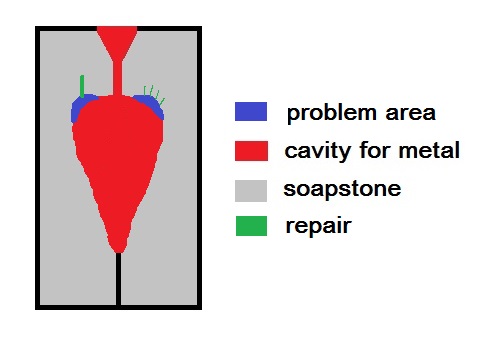
This graphic shows a couple of examples of air being trapped because of the design of the piece. The use of either shallow cut lines, or a riser should fix the problem.

soapstonemoldproblemsIf you have run through all of these points, and the mold is warmed up, and the piece is still not casting, it may be time to enlarge the size of the sprue or the funnel area. Begin by enlarging the funnel area, and then if the problem is not fixed, enlarge the diameter of the sprue.

I hope that you find this information useful in helping you to improve your pewter casting. This series was not intended to be a comprehensive reference to pewter casting, but rather an aid to understanding the process.

Casting Metal: Soapstone Molds – Part 4: Pouring the Metal and Perfecting the Mold

OK, so you have your mold ready, you are wearing safety equipment, and you have your metal melted. Now what? I highly recommend clamping the mold closed with something that will not burst into flame if you pour molten pewter on it. You do not need to use a lot of pressure, but the mold pieces do need to be properly aligned and held together. My most common arrangement is a couple of spring clamps that hold everything neatly in place. You can use C clamps, but be careful not to apply too much pressure to the mold, you do not want to crack it. Experienced pewterers will often simply hold the mold closed with a heat resistant glove on and pour the metal. I have done it many times myself, but one of the problems is that the mold will become progressively hotter as you pour each piece. If you are pouring a lot of molds at once, the molds will have some time to cool down, but it you are only pouring one or two molds the molds will quickly become too hot to hold and you will be at risk of dropping the mold, which could break the soapstone.

These are the types of clamps that I use.

Why clamp the mold? It allows you to keep your hands completely out of the way of the molten metal. Most people will use a small metal ladle with a spout to scoop up and pour the metal from the melting pot into the mold. Whether you are doing that, or simply pouring from the container in which you melted the metal into the mold it is inevitable that at some point you will spill some molten metal outside of the mold. That is why the surface on which the mold rests while you fill it needs to be non flammable, and you need to have your hands out of the way.

Pour molten pewter into the mold until it is full. Wait for the metal to cool down and re-solidify. If you jiggle the mold a lot at this stage you risk creating a grainy unusable product. Leave the mold alone. If you watch the metal cool you will see it go from shiny to dull. Give it several more minutes, and then open the mold. Both the mold and the casting will be HOT.

The chance that your piece will pour perfectly the first time that you try it is slim. If it does, and continues to pour well, congratulations! You have completed your first soapstone mold.

If the piece does not cast well, try again. Make careful observations. Does the casting improve as the mold warms up? Does it seem as if there is enough metal? The sprue and funnel area should be completely filled with metal. If they are not, are you pouring the metal directly into the funnel portion of the sprue? Is the metal hot enough? If the metal is too cool it will be more viscous and not flow as well.

Next Time: My Piece is Not Casting Well – What do I do next?