My Casting Process Up Close – No It Is Not Instant! Part 2

So last time we talked about casting pewter. Even though it is a fairly simple process it is definitely not instant. But what about casting bronze?

Casting pewter involves a simple mold, either soapstone or a modern material like silicone. But casting bronze is often done as a lost wax process. If you want to see more detail about the lost wax process itself I suggest that you read my six part blog series The Way That I Cast – Lost Wax.

But this blog is not about the casting process, it is about what happens when a cast piece comes out of the flask. This picture shows the beginning of the process.

Button Process

On the left we see a freshly cast set of buttons, still covered with investment (the white layer). The next piece has the investment cleaned off, by scrubbing it with a brush in water. And then a fan of individual buttons has been cut off of the sprue button with the hacksaw (shown at the bottom of the picture). Then the individual buttons are cut off of the fan with the sprue cutters (at the top of the picture). What is left is a pile of buttons and a pile of sprue pieces.

The buttons have been cut from the small branches of the fan, and now they need to have the spot where they were cut off rounded and smoothed out.

wet sander

And this is what I use to do that job, a wet sander. The sanding belts are made of wet-dry sandpaper. Water drips down onto the belts and cools the piece that is being sanded, while controlling the dust. Once the button sprue area has been shaped it is time to smooth it a bit more.

Cratex Wheel

This set of Cratex wheels does a more delicate job of smoothing the area and removing scratches. There is a small pile of bodkins, crosses, Thor’s hammers, and dress hooks in process on the bench.

And once the general smoothing has been accomplished, the pieces are put into the vibratory tumblers to remove the oxides and further smooth the surfaces.
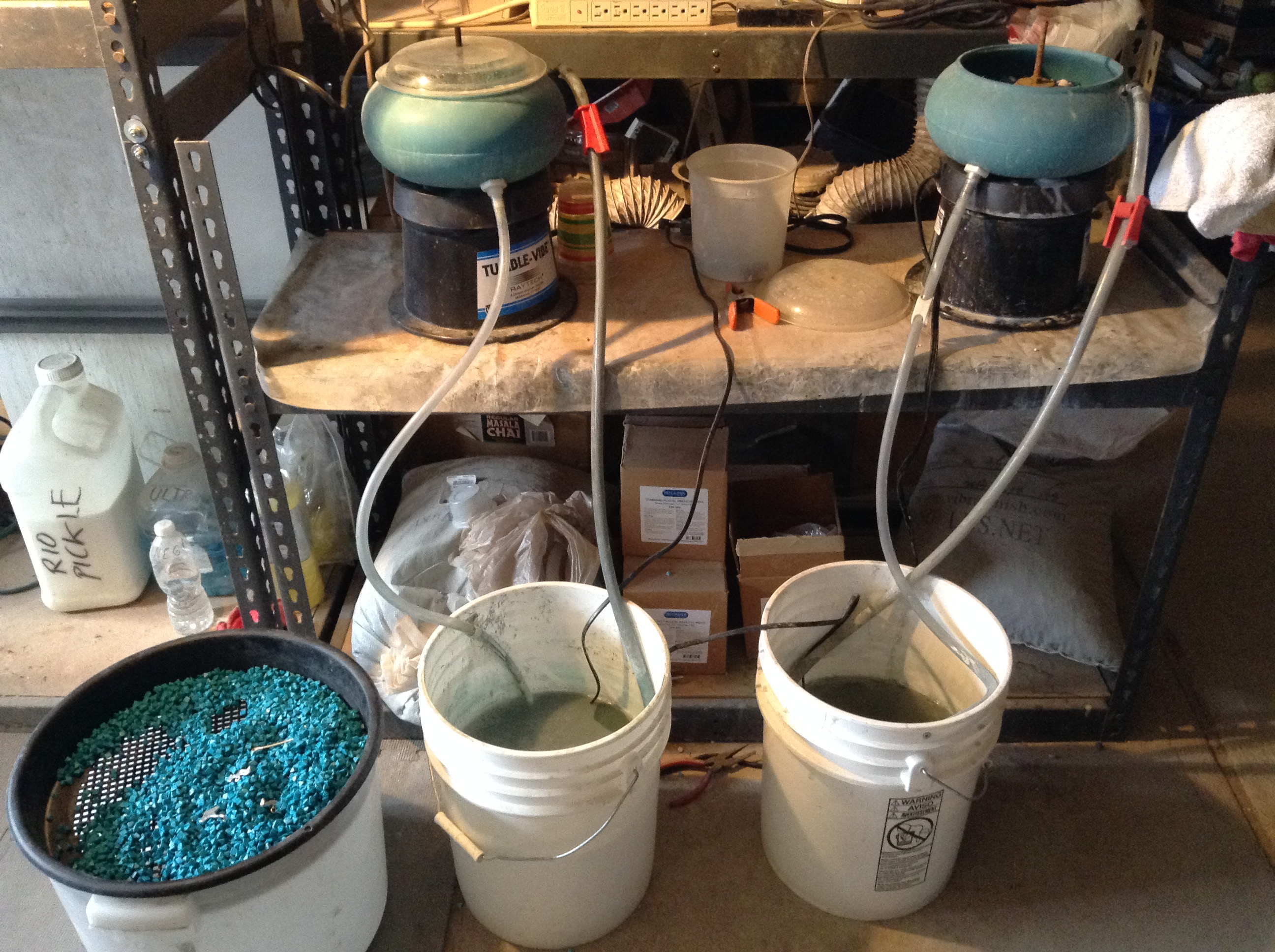
wet vibratory tumblers

And this is what the vibratory tumbler bench looks like. There are two tumblers, each with their own source of circulating water. Each tumbler is filled with a different polishing material. The one on the right is the courser material and the one on the left is the finer material. The white bucket with the sieve on top shows the contents of the left tumbler being sorted to remove the pieces of cast metal. The cast pieces spend at least three hours in each of the tumblers, with a rinse in between to avoid transferring grit from one process to another.

And now what? Well, at this point I turn on a bright light, and check each piece to see how it is progressing. If it looks good I will set it aside for the next step in the process. If there are any issues, it will either be rejected if there are “fatal flaws” that can’t be cleaned up, or get a trip back to the Cratex wheels for some additional polishing.

Next Time: Are we done yet?
My Casting Process Up Close – No It Is Not Instant!

I have been chatting with several customers lately at events, and it has become painfully obvious that some of them think that the casting process is almost instant, and that the cast pieces arrive looking as lovely as a shiny new penny.

Not really.

I was trying to figure out where they may have gotten this impression from. Maybe they watched an edition of “How It’s Made” where a giant machine spits out polished pieces, or maybe they have seen pewter casting.

So I thought about the Pewter Casting for a while. I do a little pewter casting for some of my reproduction spindle whorls. The originals were lead, and I am just NOT going to go there, so I use lead free pewter. I also make a few Pilgrim’s badges in pewter and bronze.

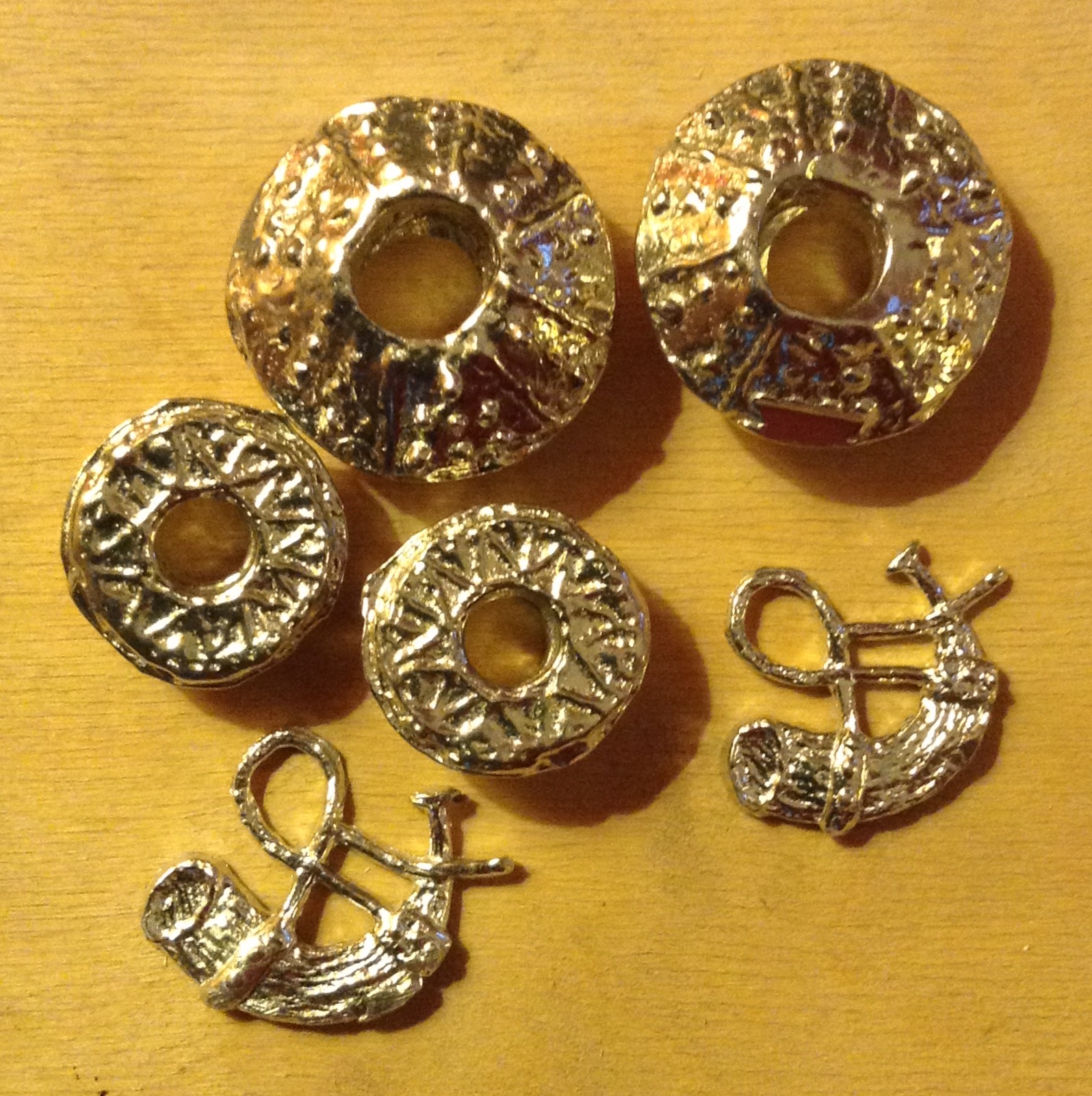
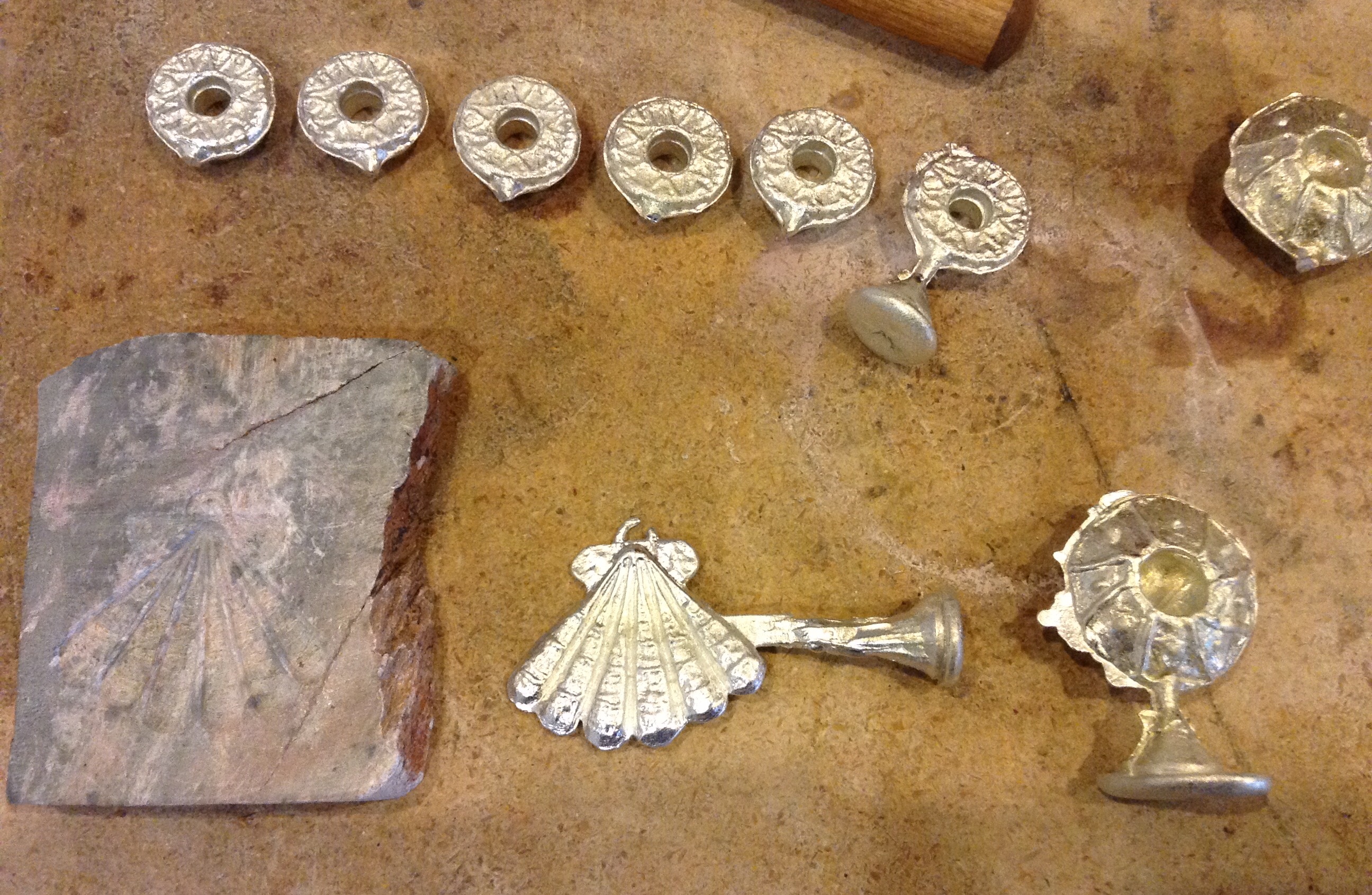
Cast Pewter pieces come close to looking like that new penny that we talked about, at least a lot closer than bronze or silver do when they are cast. This picture gives a nice perspective on casting simple pewter pieces. The original soapstone mold that I created for the scallop shell pilgrim’s badge (Santiago de Compostela in Spain), is on the far left. An “almost” cast ( the loop is incomplete and the “wings” on the top of the shell are not squared enough) shows what a fresh casting might look like. Above this is a row of six small spindle whorls, one of which still has it’s sprue intact. The larger spindle whorls on the right side show what flashing looks like (that wobbly bit sticking out on the edge of the spindle whorl).

pewter casting

OK, so let’s look at the process objectively. The mold is clamped, and the molten pewter is poured into the mold and allowed to cool. After three or four minutes the cast piece can be taken out of the mold. It will still be hot, especially if it has some bulk, like the spindle whorls do. Depending on the temperature of the room and workbench, a five minute wait is probably a good idea. Then I use a pair of sprue cutters to cut off the sprues. You can see where the sprues have been cut off on both the large and small spindle whorls. I then remove any flashing around the edges of the piece, either with a file, or a wet sanding machine. During this process the remains of the sprue are also removed. I then check any interior “holes”, like the interior of the loop on the scallop and the center hole on the spindle whorls for flashing, and remove it. Now the piece is ready for a quick polish. Twenty minutes in a tumbler with steel shot and burnishing compound will remove any oxides and give the pewter a nice sheen.

polished pewter

Shiny! This is what the polished pewter looks like. It is really not a complicated process, but even something as simple as pewter casting is definitely not instant.

Next Time: What Happens When We Cast Bronze

Event Strategies – Fun or Not: Part 4 – Keeping it Real and Being Honest With Yourself

No matter how much we try to plan for an event, stuff happens. Only you can decide if your mental and physical stamina is sufficient to be able to deal with an event, especially if it doesn’t really work out the way you had hoped that it would. Do you have an exit strategy? Are you heat sensitive or cold sensitive? Do temperatures over 90 degrees, especially if it is humid, send you into a physical downward spiral that can end at the ER? Is rough ground a problem? How long a distance can you walk? Only you can evaluate the facts and make that decision.

I have friends who no longer attend camping events, or if they do, they sleep at a hotel or cabin. Bad backs, CPAP machines, the inability to deal with temperature extremes, and a lack of physical mobility are just a few of the reasons that they made this decision. When the stress of camping takes away the fun of attending an event, you need to reconsider your options.

Switching to a camper trailer or small RV has allowed several of my friends to keep attending events. Using an RV at SCA events, can be good and bad, depending on the event site. If there are electrical hookups available it can create a rather luxurious situation, with most of the comforts of home. But the downside is that you may be camping a much longer distance from the center of the event. Camper trailers and RVs are often shunted off on an edge of a event, so check ahead of time with the autocrat. Many event sites do not have any sort of hook-ups, electrical or otherwise, so you will need to understand exactly what your camper is capable of doing. Our old RV could easily do a two 1/2 day “dry” camping trip without running our generator. Generators are prohibited at a lot of sites. You also need to check for additional fees. RV’s often have to pay an additional fee at some parks, especially if there are hookups.

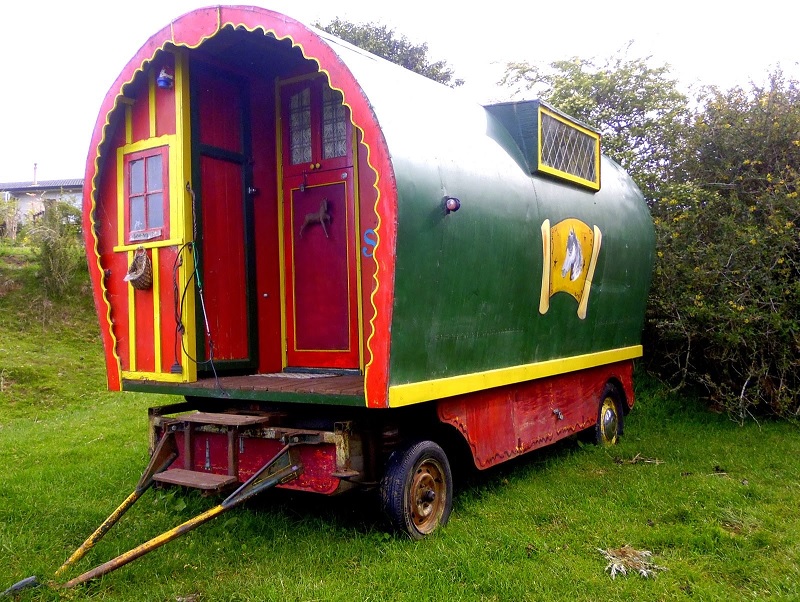
And then there is the Gypsy Wagon, or Vardo. They are towed like a trailer, but they are usually acceptable in camping areas and still provide a greater level of comfort than a tent.

Vardo 2

And sometimes things just get messed up even when you have done all the planning that you could possibly do.  A friend had been looking forward to a hands-on embroidery class. The teacher showed up to class without any supplies and announced that she would order in supplies and then teach the class again on a day that that my friend could not be at the event. Major disappointment.

Another teacher showed up for what was supposed to be a hands on nahlbinding class with no kits or notes, no class limit (she expected 6 and 30 showed up),and no note in the schedule about bringing your own supplies. In this last instance we have to question whether the teacher came from an area with low class attendance, was inexperienced, or was she suffering from a data entry error. Data entry error? Yes. I once had one of my Viking Knit Chain classes appear in the schedule as “Viking Knit Chairs”. Oh, and the class limit had magically disappeared, too. Fortunately I had enough supplies.

Assessing your ability to deal with an event is all about being honest with yourself. In 2015, when it looked like Pennsic was going to be a giant bowl of mud, several folks that use scooters decided not to attend because of the mud. Only you can decide if temperature, rain, terrain or other factors are going to make an event just too difficult. Plan it out, be prepared, and have a great time!