Eating Well When You Camp: Part 3: The Ultimate Cheat – Precooked Meals

Last time we asked the question “Why the BBQ on Friday?” And the answer? Raw meat. Raw meat spoils waaay faster than cooked meat. Properly cooked meal, which has been cooled down carefully and stored safely has a much longer “cooler life”. So on to a brief discussion of pre-cooked meals.

For people who are good cooks, have food allergies, or just want to be able to eat specific dishes, there are many excellent options for camping. Remember those vacuum bags that we mentioned last time, well those waterproof lovelies can be safely used to freeze pre-cooked meals from home and then used to reheat them in camp.

If your brain draws a blank when you think of precooked meals, let me mention just a few of the very successfully reheated meals that we have had in camp over the years.

Beef Stew, Chili, Chicken Pot Pie filling, or any thick soup. Simply freeze in a plastic container and once the food is solid, pop it out of the container, place it in a vacuum bag, vacuum the bag, label, and place back into the freezer until you are ready to use it. Pre-freezing the very wet contents make it easier to vacuum the food well and avoid freezer burn if you store the food for a while. We often do a big bunch of frozen dinners after Thanksgiving or a big roast and use them for both home and camping. I love to use the disposable plastic boxes that come with pre-packaged cold-cuts for freezing wet foods. The sides of the boxes slope outwards slightly, which makes it easy to pop out the solid blocks of food. The blocks will also melt more slowly than thinner flat packs of food. We know from experience that a full container, with lots of chunks of meat, is enough for two of us for dinner, so a dinner for four is two large blocks.

A nice beef stew for dinner.

A nice beef stew for dinner. (Photo credit: Wikipedia)

Turkey and gravy, or Pot Roast and gravy, or Roast Pork and gravy. Just put the pre-sliced meat into the bag and add gravy. The safest way to do this is to pre-freeze the gravy and put the block of gravy in with the meat right before you vacuum it. Be sure to label – sometimes it is NOT obvious what the food is. We have had a couple of “creative” meals at an event where someone forgot to read the labels on the bags and two things looked alike.

Lasagna! Lasagna is one of those things that really does freeze and reheat well. You can make your own from scratch or use pre-frozen lasagna (be sure that it is fully cooked). Lasagna reheats well in a boil and seal bag. The one drawback is that it takes a LOT longer to reheat than some other foods, but it is yummy.

Vegetables? We use frozen peas a lot when we camp. Just put half a bag of frozen peas, or other vegetables, into a vacuum bag, vacuum it, and label. You can even add a couple of tablespoons of butter or seasoning, so that the vegetable comes out “completely ready”.

Now we are not just eating the frozen dinners for supper – honestly that would NOT be enough food when I am camping. I get HUNGRY, and therefore next time we will discuss: Convenience Foods that are Worth Using.


Enhanced by Zemanta

Eating Well When You Camp: Part 2: Why the BBQ on Friday?

Last time we started talking about the rather delicious camping trip that I had just returned from and my theories of camp food. I asked the question “Why the BBQ on Friday?” And the answer? Raw meat. The weather was not particularly warm, and all of the food was being carefully kept on ice, but the item that needed to be cooked first was raw meat – in this case hamburger. The more a raw meat product has been processed the easier it spoils, so the hamburger needed to be cooked as quickly as possible.

Whenever we carry raw meat to an event, heavily processed items, like ground meat of any sort, are the first items to be cooked. If we need to delay their use at all, we bring them frozen solid, preferably from a zero degree freezer. Items like steak and whole chicken breast can easily be kept for a day or two more by making sure that they arrive on site very cold and are kept on ice until they are used. Since the vast majority of camping events are only a weekend long, that makes it simple to do fresh meat two nights in a row, or fresh meat followed by prepared meat the next night.

Aside from the issue of raw meat and food safety, another reason for the BBQ on Friday night was scheduling. None of us had any responsibilities on Friday night, so we knew that we could all just sit around and relax while the chef de jour did all of the grilling. The “sides” were super simple, buns, condiments, purchased potato salad and a birthday cake. The grill was set-up right on the edge of the shade structure that we were sitting under, so no one was stuck off somewhere cooking.

Pulled pork is a form of barbecue. It is a met...

Pulled pork is a form of barbecue. It is a method of preparation in which pork is cooked using a low-heat, long-cook method. The meat becomes tender enough that its weakened connective tissue allows the meat to be “pulled”, or easily broken into individual pieces. (Photo credit: Wikipedia)

And talking of scheduling, that was also the reason that we had pre-cooked pulled pork for dinner on Saturday night. We knew that all of us had responsibilities with a very uncertain end-time. So dinner had to be something very stable that could be heated and held without losing its quality. This is where the vacuum seal bag really shines. The meat was prepared at home and sealed in a boilable vacuum bag. Why a vacuum bag? Two really big reasons: water and water. The first water that we needed to worry about was the melted ice in the cooler. I have personally lost several meals over the years because they were stored in resealable bags and the bags allowed the ice water in the cooler to leak in. Resealable bags are NOT waterproof. The second water was the water that was used to reheat the meat. Reheating in boiling water is a very “gentle” way to reheat food. The food will not dry out or scorch and precooked meat will not overcook, even if held for an hour. Once the meat is thoroughly heated, the hot water in the pot is still clean and can be used for washing dishes. If we had used a waterproof plastic container to store the meat, the reheating process would have involved getting a pan dirty AND risking drying out or scorching the meat.

Next time: The ultimate cheat – precooked meals!

Enhanced by Zemanta

Eating Well When You Camp

About a dozen blogs ago I wrote an article on canning cookies. Well, having just returned from a weekend camping trip today, the issues of camp food, convenience, sanitation and comfort are all uppermost in my mind.

The trip was a success. A comfortable, convenient, yummy, success. We ate six meals on site, plus yummy snacks, and no one spent a huge amount of time in the kitchen. How? Planning! Let’s look at what we had and then discuss why we had it.

Friday lunch was chicken salad, cold cuts and cheese, homemade and store bought cookies, and plenty of drinks.

Friday dinner was a simple barbeque: burgers with all the fixings, an industrial sized container of purchased potato salad from a discount store and a big sheet cake (birthday) for one of our members. And of course lots of cookies and drinks.

Saturday Breakfast was pancakes, with syrup and butter, bacon, omelets, granola and yogurt, and of course birthday cake, and drinks.

Saturday lunch was more chicken salad, cookies, and drinks.

Saturday dinner was pulled pork BBQ in sauce, with rolls, cookies, and cake and drinks.

Sunday breakfast was pancakes, granola and yogurt, muffins, the last of the birthday cake, and drinks.

Now, I admit that I had absolutely nothing to do with the production of most this food. It was made by two other families, that volunteered to take care of me at the event so that I could do my job there. I supplemented what they provided with a few items of my own. But the techniques are ones that I use all the time when I am doing the cooking.

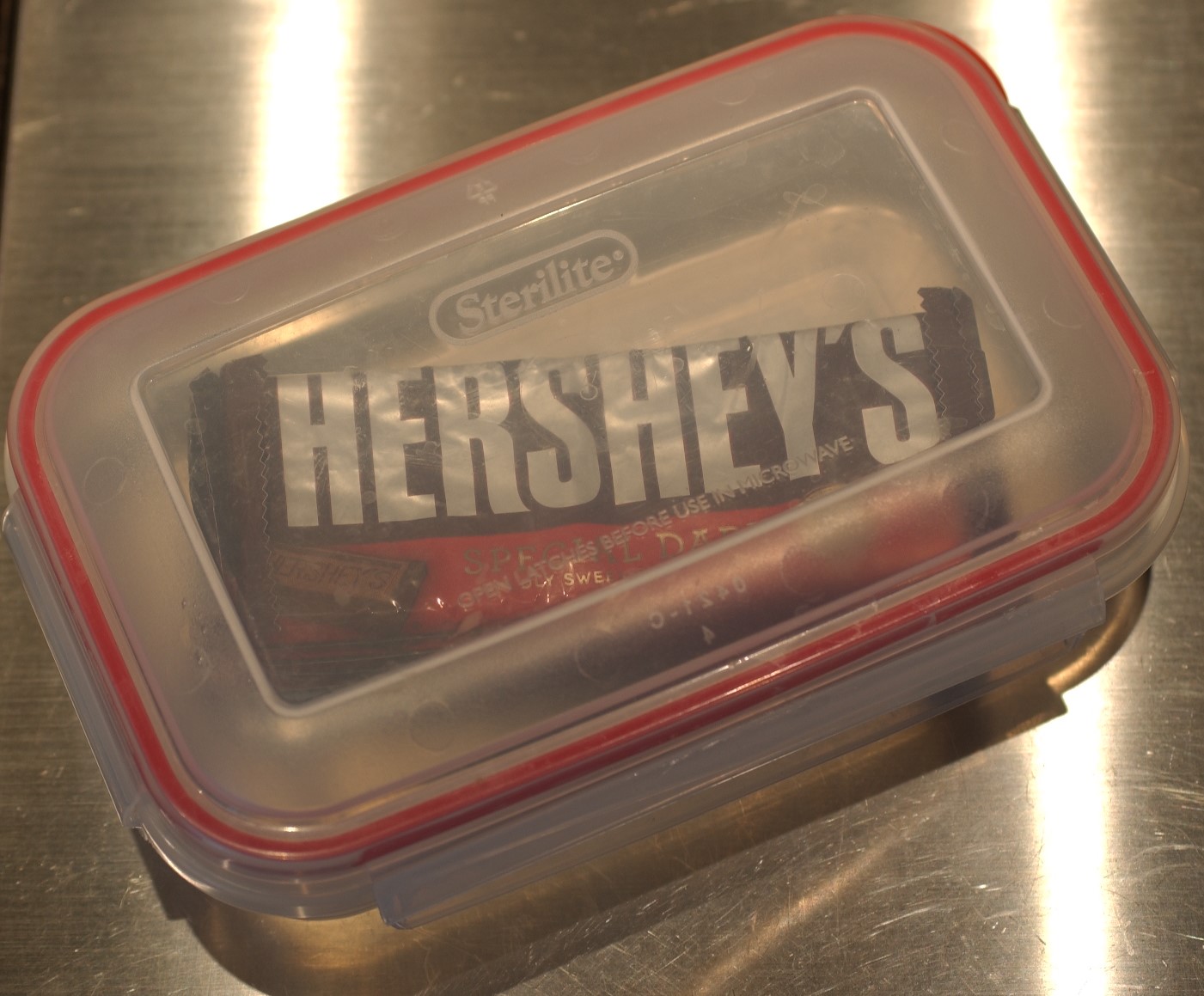
So, analyzing what we ate. The chicken salad was mine. I cooked the chicken, made the salad at home, boxed it up in waterproof containers and tossed it in the cooler with lots of ice. The salad is made with diced apples, walnuts, chopped Craisins, mayonnaise, sour cream, and chopped chicken. I always make sure that the chicken is handled VERY carefully, cooked well, chilled immediately and only made into salad once it is cold. The cold boxes of chicken salad go in a pile of ice. The waterproof containers ensure that it will be salad and not “soup”. Ice from a cooler is often NOT clean so it is very important to keep the melted ice water out of all food items. When you buy containers for use in your cooler make sure that they say “waterproof”. Most normal containers will leak. Sterilite makes a set of containers with snap top lids that ARE waterproof and come in a large number of sizes. Always be sure that your boxes are properly maintained – no cracks, damaged seals, etc.

Snap Top

Let’s talk about drinks for a minute. You will see me mention that over and over. I live in Arizona. Drinking lots of fluid is an important part of staying healthy. My most important drink is water. I will also carry lemonade, iced tea, V-8, fruit juice, and occasionally a soda. Yes, I carry alcoholic beverages, but I don’t even count them as part of my regular intake because some of them can actually help you become dehydrated. I almost never go any distance from camp without a bottle of water, and yes I do the same thing in Pennsylvania or Mississippi, too. Camping is thirsty work.

Next time: Why the BBQ on Friday Night?