Casting Metal: Soapstone Molds Part 1

One of the things that I specialize in, in my shop, is cast metal. I cast pewter, bronze, white bronze, and sterling silver into an assortment of pieces of jewelry and dress accessories. Customers often ask me questions about casting, so I am going to write a set of blogs to help folks understand the basics of casting.

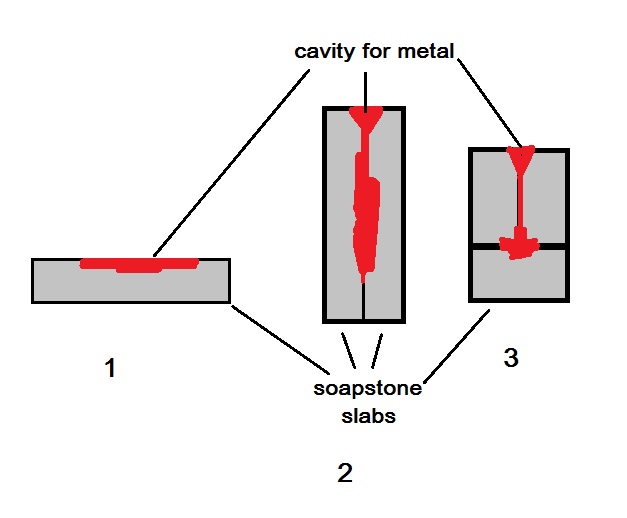
A common, and relatively simple form of casting, that was done before and during the Middle Ages, was soapstone casting. This is a relatively straight forward process where the artist carves soapstone to create cavities that molten metal can be poured into.

This graphic shows three basic mold forms with one, two and three slabs.
soapstone molds

I am going to assume that you have purchased good quality soapstone that is designed for carving. It should not have veins or cracks in it, and the texture should be uniform.

Let’s run through the basic process of making soapstone molds. It is possible to cast a simple object by carving into a single piece of stone, but most molds are made from two or more pieces of stone. One of the critical first steps when you are using two or more slabs of stone is to make sure that the slabs fit together tightly. The easiest way to do this is to choose two pieces of slab that are identical in size, flatten them as much as possible by rubbing them on a piece of fine wet/dry sand paper and then rubbing them together against each other. Using wet/dry sandpaper means that you can use it wet if you want to. Start with a coarse grade of sandpaper and work with finer and finer grades until the faces of the slabs are smooth. At this point I should mention that you should be wearing a good dust mask when you do this. Soapstone that is sourced from reputable companies is guaranteed not to contain asbestos, but stone dust is still not good for you.

So, back to the two piece mold. The two slabs of stone are now smooth and they fit together like a glove. It is now time to mark the outsides of the mold to make it easy to see when the mold is aligned correctly. I usually just line the two slabs up carefully and then draw lines across the side with an indelible magic marker. Mark each side with a different number of lines to make it super obvious which way the blocks need to be aligned.

Once the blocks are marked it is time to lay out the design on the blocks. The design should be sized and placed so that there is at least 1/2 inch of uncut stone around the outside of the design. Having a band of stone that is narrower around the outside edge means that the mold is much more likely to break. The same properties that make the soapstone a delight to carve, also make it fragile. Your mold will eventually break, but a carefully thought out layout will greatly improve its longevity.

Next time: Carving the Design
 

The Care and Feeding of Your Metal Jewelry & Accessories

What sort of finish do you like on your jewelry? And once you have chosen it, do you know how to take care of it?

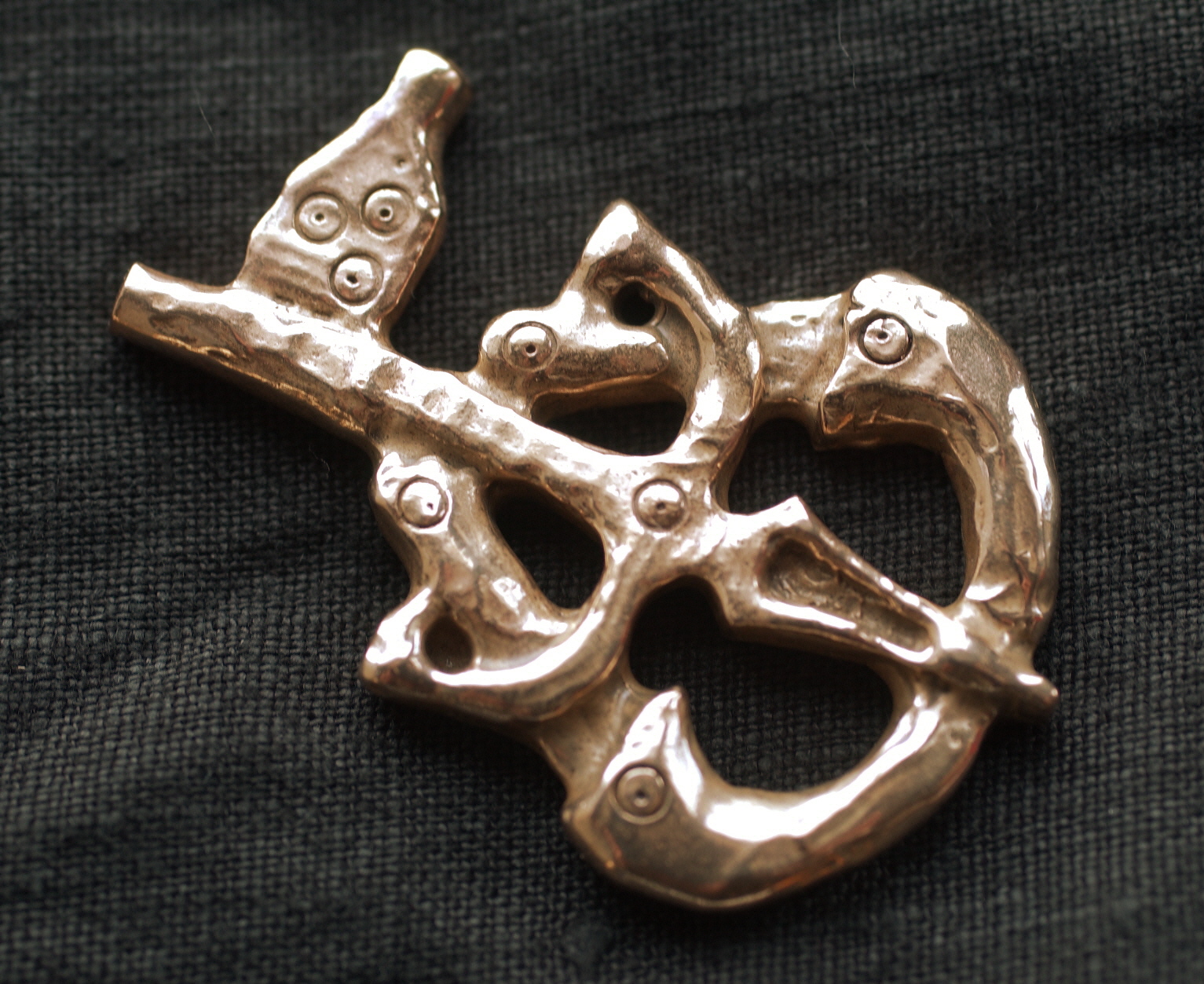
Whether we are talking about a historical piece, or a modern piece, the way that you prefer jewelry to look is very much a personal choice. It is important to realize that some pieces of jewelry, or other metal accessories like crowns, coronets, and buckles, are designed to be maintained in very specific ways. For example, the Viking Keys that I offer are sold with a bright finish. But bronze can attain a patina over time that you may prefer. The nice thing is that if you decide that a brown or blur-green patina is not to your liking, you can always polish it to like-new condition.

Etsy 28When you buy a piece, ask the person who sells it to you what is the best way to take care of it. Generally they will know. I say generally because I have heard some very bad advice given at shows before, so I always try to make sure that my customers know what to do with my pieces. And I have helped other people’s customers on several occasions. If the advice that you receive doesn’t sound right, it is up to you to figure out what the correct process is. Most jewelers are happy to provide an explanation of why they recommend specific cleaning and care.

I highly recommend that people understand what they are willing to do before they buy a piece. Someone who purchases a piece with bright, smooth surfaces, but refuses to polish the piece regularly, may not be happy with the way that their piece looks, unless they pay to have it cleaned professionally.

For some pieces that are not damaged by liquids, buying something like a small home ultrasonic cleaner may be just the trick. Just follow the instructions and your piece will be as good as new.

The easiest, and probably the safest, solution for dirty or tarnished jewelry, is a Sunshine Cloth. They are a chemically impregnated cloth, manufactured in Japan, that is safe for all metals. The cloth is non-abrasive, so it will not damage plated metals or leave scratches. I sell them in my store, and include them whenever anyone purchases a coronet.

You can use the Sunshine Cloth to remove all of the tarnish on a smooth piece, or just polish portions of the piece to produce highlights. Gentle, but firm pressure is all that it takes to clean an amazing amount of build-up and tarnish from your pieces. Be sure to store it in a little ziplock to keep it fresh, and NEVER wash it – washing removes the chemicals that do the cleaning. The cloth will eventually become amazingly dirty, but it will continue cleaning even when it’s all black!

If your piece is really dirty, you might try something like Flitz. This is a liquid cleaning compound generally found in motorcycle shops and automotive parts stores. When we received the Baronial Coronets that we planned to use during our tenure as Baron and Baroness, they were just plain grubby. They were tarnished and also had a layer of general grime. A good scrubbing with Flitz, following the instructions of course, and the coronets were clean and shiny. Both Flitz and Sunshine Cloths will leave an invisible coating to help protect the metal. We wore our coronets a LOT. I would clean them up a tiny bit before every use with a Sunshine cloth, and about every eight months I would do a “deep cleaning” with Flitz.

And beware of lotions and perfumes! The chemicals in these concoctions can stain or tarnish your pieces.

Lastly, if you prefer the shine and patina of a new item, ask your jeweler if they offer a clear transparent coating option to help keep your item looking like the day that you bought it. There are a number of coatings that can be used to retard tarnishing, ranging from polyurethane to clear nanoceramic plating. All of these coatings will eventually wear off depending on how you use the piece. Some, like the nanoceramic coating, have been reported to last a year or more in daily use.

Metal objects can be a “living” thing – the care and feeding is up to you.

Camping: Making Your Bed and Sleeping Warm

Our weather at camping events this past year was a challenge; anywhere between 30 and 75 degrees at night. One of the events that I did, by myself, was extremely cold and windy every single night. Camping in a medieval canvas pavilion, with no one else to help provide body heat, can make staying comfortable at night something of a challenge. I had checked the weather forecast before I went, and I knew that the temperature was going to be a concern. My solution? Something that I call the camping burrito.

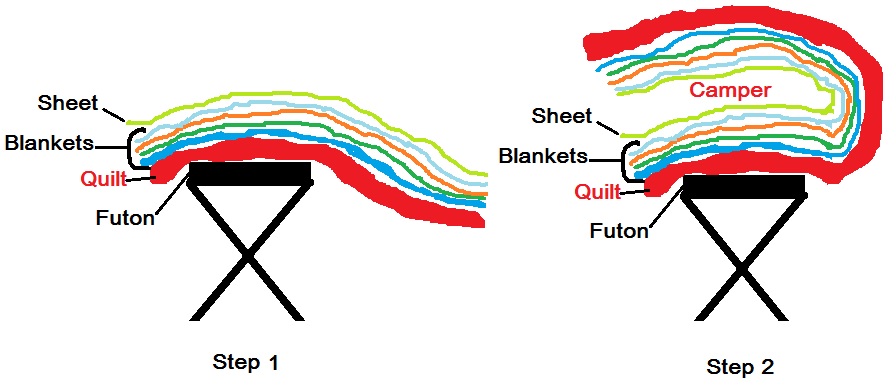
When you are sleeping on a cot you lose heat in all directions, up and down and sideways. I use a futon mat on my cot, which makes it considerably more comfortable (I have a bad back), and provides some insulation from the cold under the cot. When I know that it is going to be cold I start by placing my cot as far away from the canvas wall as I can. Then, on top of the futon I start layering the sleeping bags, quilts, blankets and sheets that I plan to use. I actually place the sheet on the TOP of the pile, because I am going to fold the entire mass of bedding over the top, like a giant burrito.

Burito BedThis diagram shows exactly what I am talking about. All of my quilts, blankets and sheets are queen sized. The closed side of the covers is towards the canvas wall. This dramatically reduces the amount of air infiltration – no drafts. The fact that the covers are all queen sized means that there is plenty of extra covers on the open sides of the bed – again, no drafts. You can always pull the covers up over your head to complete the “package”.

And what should the camper be wearing? Well my favorite “extreme cold” outfit is wool socks, long johns with heavy flannel PJs over the top, a stocking cap, and a hooded sweatshirt. Everything about this “fashionable” outfit has a purpose. Warm, dry feet are a must – hence the socks. The layers on the body are pretty obvious, dry warmth. The hat helps to cut heat loss from the head and the hooded sweatshirt provides more warmth to the torso, covers the head with an additional layer and eliminates any drafts around the back of the neck (particularly important for those who do not like to sleep with their heads under the covers). In addition, we have discovered that many cell phones do not do well in cold weather – the cold literally kills their batteries, so in seriously chilly weather I put my cell phone in my sweat shirt pocket to keep the battery from going dead. I’m, not going to win a beauty contest, but I am going to get a good night’s sleep.

One of the things that I really like about this “burrito system” is that if the weather warms up you can easily pull back the top layer(s) or open up the side of the burrito for ventilation.

I hope that this “burrito system” will make your camping experience much more comfortable. I know that it has done a great job for me.