Casting Metal: Soapstone Molds – Part 4: Pouring the Metal and Perfecting the Mold

OK, so you have your mold ready, you are wearing safety equipment, and you have your metal melted. Now what? I highly recommend clamping the mold closed with something that will not burst into flame if you pour molten pewter on it. You do not need to use a lot of pressure, but the mold pieces do need to be properly aligned and held together. My most common arrangement is a couple of spring clamps that hold everything neatly in place. You can use C clamps, but be careful not to apply too much pressure to the mold, you do not want to crack it. Experienced pewterers will often simply hold the mold closed with a heat resistant glove on and pour the metal. I have done it many times myself, but one of the problems is that the mold will become progressively hotter as you pour each piece. If you are pouring a lot of molds at once, the molds will have some time to cool down, but it you are only pouring one or two molds the molds will quickly become too hot to hold and you will be at risk of dropping the mold, which could break the soapstone.

These are the types of clamps that I use.

Why clamp the mold? It allows you to keep your hands completely out of the way of the molten metal. Most people will use a small metal ladle with a spout to scoop up and pour the metal from the melting pot into the mold. Whether you are doing that, or simply pouring from the container in which you melted the metal into the mold it is inevitable that at some point you will spill some molten metal outside of the mold. That is why the surface on which the mold rests while you fill it needs to be non flammable, and you need to have your hands out of the way.

Pour molten pewter into the mold until it is full. Wait for the metal to cool down and re-solidify. If you jiggle the mold a lot at this stage you risk creating a grainy unusable product. Leave the mold alone. If you watch the metal cool you will see it go from shiny to dull. Give it several more minutes, and then open the mold. Both the mold and the casting will be HOT.

The chance that your piece will pour perfectly the first time that you try it is slim. If it does, and continues to pour well, congratulations! You have completed your first soapstone mold.

If the piece does not cast well, try again. Make careful observations. Does the casting improve as the mold warms up? Does it seem as if there is enough metal? The sprue and funnel area should be completely filled with metal. If they are not, are you pouring the metal directly into the funnel portion of the sprue? Is the metal hot enough? If the metal is too cool it will be more viscous and not flow as well.

Next Time: My Piece is Not Casting Well – What do I do next?

Casting Metal: Soapstone Molds – Part 3 – Carving the Block and Getting Ready to Pour the Piece

Once you have worked out the details of placing your design within the blocks, and transferred the design, you need to start carving. Many people will actually do the carving of the designs for the molds under water. I don’t always do the carving completely underwater, but I do dip the stone in water regularly to reduce the amount of dust that gets into the air, and I always wear a dust mask.

Soap stone is soft enough to be carved with sharp items like dental tools or sharpened nails, or modern tools like diamond burs and dremel-style electric tools. I suggest experimenting on a scrap piece of soapstone before you actually work on your mold. Make sure that you understand how much pressure it takes to actually carve the stone. Different batches of stone can have different hardnesses. Figure out how your tool behaves, and how you can control the tool so that it does not slip. Be careful to be aware of your hand placement so that you can’t accidentally stab yourself if the tool does slip. You may find that a piece of the weird rubbery drawer liner that they sell will help to keep your block from sliding around as you carve it. Remember, carving soapstone is a skill that takes practice and patience.

One of the dangers of carving soapstone in water is the water itself. The soapstone must be 100% dry before you use it to cast in. Let me repeat that – 100% dry. If there is any water left in the mold you risk cracking the soapstone from thermal shock, or even worse, what I call a “volcano”. This is when molten metal and steam shoots straight up in the air. This is EXTREMELY dangerous and can result in some really nasty burns.

So now you have carved your soapstone mold. You have double checked it to make sure that there are NO undercuts in the mold, and that the mold is completely dry. If you have any doubt about the mold being dry you can lay the pieces, inside surface up, in a cookie try in a conventional oven at the lowest setting for an hour. It is your job to be safe.

English: Chunks of pewter from a pewter spoon

English: Chunks of pewter from a pewter spoon (Photo credit: Wikipedia)

I use a small electric furnace to melt my pewter. You can purchase small cast iron pots, shaped like small saucepans with a spout, for melting pewter. I only use lead free pewter. True pewter contains lead, which can be a serious health issue. If the pewter is overheated the lead will cook off as a vapor. This is dangerous. As a merchant who sells in multiple states around the US, I must conform to standards for lead in jewelry. Not having any lead makes it a LOT easier, and safer.

Now it is time to set up for your first pour. Heavy insulating gloves, like welding gloves, and eye protection are a good idea. I wear either a leather apron or a cotton welding apron and closed toed leather shoes. My hair, which is long, is pulled back out of the way and I usually wear cotton blue jeans. This may all seem excessive, but metal that is 500 to 600 degrees can leave a nasty burn.

Next time: Pouring the Metal and Perfecting the Mold

Casting Metal: Soapstone Molds – Part 2

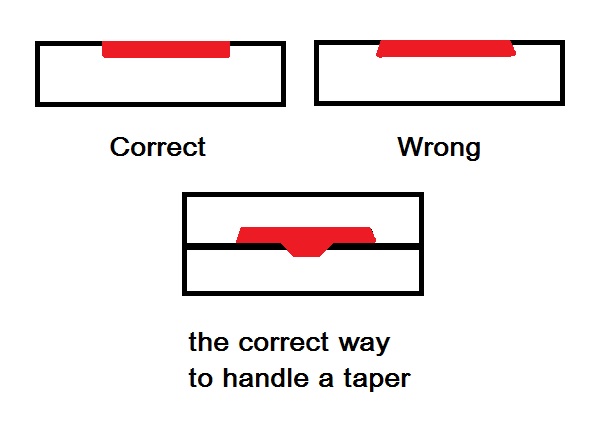
Once you have your design laid out on paper, it needs to be transferred to the block of soapstone. I am assuming that you are doing a relatively flat piece. More complex pieces are beyond the scope of this overview. Be sure that your design does not have any undercuts. Undercuts will act like a physical lock and prevent the hardened metal from coming out of the mold. The diagram below shows the basic principles of laying out a design. You need to create a cavity that will allow the metal to come out of the mold once it is cooled. The bottom diagram shows how to place a double tapered piece so that it uses the opposite block of stone to end the taper and does not create any undercuts.

how to handle a taperOne very important thing that you need to consider when you are doing the design layout is where the metal will be poured into the mold. Where is that not particularly attractive piece of metal, called a sprue, going to connect to your finished piece? It needs to be attached so that it can be cut off and filed flat without ruining your design. The sprue also needs to be large enough to act as a reservoir for extra metal. Metal shrinks as it cools, and having extra metal that your piece can pull from is a good thing. You may need to experiment with increasing the size of your sprue if your piece does not cast correctly, so try to allow for that in your planning.

soapstonemoldlayoutThis is the general layout for a basic soapstone mold design. The cavity for the metal is centered within the block of soapstone, except for the sprue, which goes to the edge of the block and ends in a funnel shape, to make it easier to pour in the metal. There are no undercuts that will trap the hardened metal and keep it from releasing from the mold.

The design that you have chosen needs to be transferred to your soapstone blocks. This can be a bit challenging the first time that you try it because you need to work three dimensionally. Transferring the design can be done by tracing around a cut-out copy of the design with a pen or pencil, if it is a simple shape. If this does not work well enough you may want to score the block using a sharp implement. This is also helpful if you need to add more detail. You can make small dots that act as reference points. You need to decide what will work for you. Some types of carbon paper will allow you to trace the entire design onto the block. Experiment. You may need to trace the design in stages, depending on its details. This is especially important because of the need to work in a three dimensional fashion. If you have designs on multiple levels of a piece, you may need to trace them on in stages as you carve down into the block.

Next Time: Carving the Block and Pouring the Piece