But What Do I Do With Those Dress Pins Part 2

So last time we discussed a little about dress pins and started looking at portraits that show pins in use as a dress accessory. One of the most important things that we have to look for when researching the use of pins is artists who do very precise and detailed portraits.

Rogier van der Weyden is definitely one of those artists. He painted a portrait known as Lady Wearing a Gauze Headdress (1445) that shows at least two pins being used for a complex headdress.

He also painted the Braque Family Triptych (1450). The right wing of the triptych shows Mary Magdalene, and it also clearly shows the use of a pin to hold a sleeve in place.

Another Rogier van der Weyden painting, also known as Portrait of a Lady (1455), shows several pins being used to anchor a fine veil to the top of a tall cap.

And this Portrait of a Lady by Rogier van der Weyden (1460) shows pins being used on both her headress to hold her veils in place and to anchor the sheer fabric of her neckline.

You may have noticed all of the paintings entitled “Portrait of a Lady” – all that means is that the name of the person in the painting has not been determined.

Ercole dé Roberti painted a portrait of Ginevra Bentivoglio (1480) that shows exactly one pin at the very top of her bun. You will definitely need to hit the “200%” button, but it is clearly there.

This portrait of Mary of Burgundy (1490), by Michael Pacher, shows a pin being used to attach a decorative pendant to her headdress.

Quentin Massy’s portrait, The Moneylender and His Wife (1514) shows a pin used to hold a veil in place under a hat.

Lucas Cranach the Younger painted a portrait of Katharina von Mecklenburg (1545), that shows a number of pendants or earrings hanging off the bottom of her hat. Unfortunately it is impossible to tell how these items are attached, but there are other portraits that show pins holding the pendants/earrings in place. My friends and I used to joke about the Italian women sending earrings to their cousins in Germany, but they didn’t have pierced ears, so they would just hang them on their hats. There is no way to know if this is true or not, but the lack of women in German portraits without earrings is notable.

A Portrait of Martha Thannstetter by Bernhard Strigel (1515) shows a pin being used to hold a wrapped veil.

And of course there are tons of portraits where we assume that there is a pin being used, but the artist has not painted them. Pieter Aertsen’s and Joachim Beuckelaer’s paintings of women working in the marketplace show several examples of what appears to be pins in use to hold on sleeves and partlets, but there are no actual pins showing in the paintings.

And then this post 1600’s painting by Louise Moillon shows two women in a marketplace. Both of them have pins holding their partlets in place.

We know that pins could also be used to pin the front plackets into women’s dresses. I could not find any portraits that show this, but records show that they were still doing this in Colonial America.

People used dress pins to close or decorate their clothing the same way that we would use safety pins, or velcro, or even a zipper.
But What Do I Do With Those Dress Pins?

For anyone who follows me on Facebook, my Etsy shop, or in my actual shop, you probably already know that one of my big selling items is dress pins. I have been getting enough questions about these pins lately that I decided it was time to write another blog about them. I originally wrote a basic blog about dress pins a couple of years ago, called Pins, Pins and More Pins, and another called Authentic Dress Pins about the fact that we make spiral headed dress pins.

Now I do make the early period dress pins that are three to five inches long – the kind that are usually used to clothes shawls and brats and such. But right now I am talking about the small wire spiral headed dress pins that appear in the archaeological record in the 1200’s and are made the same exact way solidly into the Victorian era.

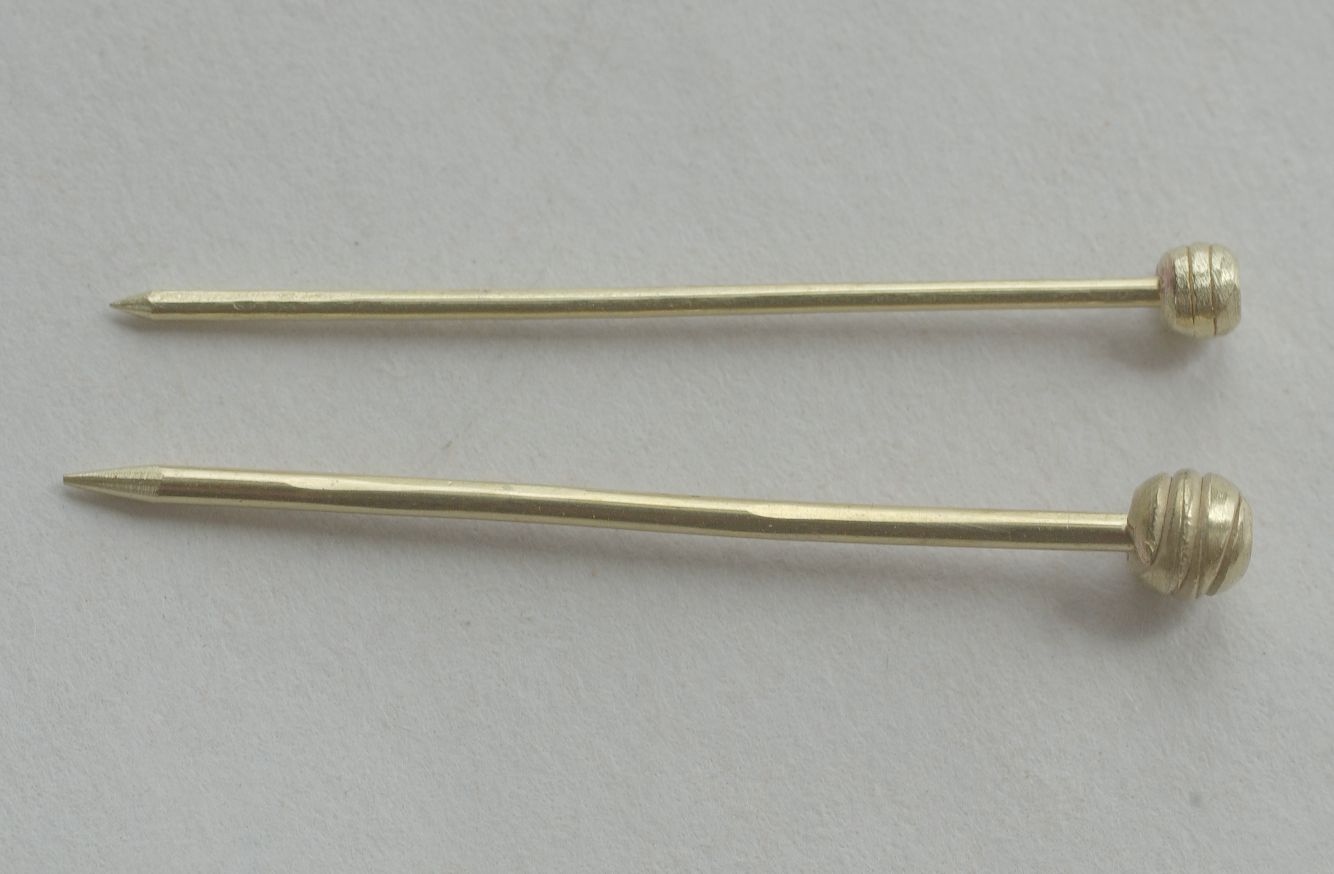
For those who may not be certain exactly what I am talking about, here is a picture of the two sizes of dress pins that I sell in my shop. In pre-1600 Europe they came in a virtually infinite selection of sizes, from really short (about 3/4 of an inch) to ridiculously long (three or four inches long), but these two sizes seem to work for most people.

two pinsAnd here is a link to some pre-1600 pins that were found in Great Britain. They find thousands of these all over Europe.

So the most common question that I am asked is, “what are they used for?” And my semi-wise-guy answer is: holding your clothes together. This is actually an understatement, since they are used for holding clothing, hats, veils, and just about any other dress accessory that you can think of in place.

How do we know what pins were actually used for? Well, they show up in inventories, but they also show up in a fair number of paintings and portraits. The earliest portrait that I could find is dated to about 1410 – A Portrait of a Lady. If you zoom in on her head coverings there is no attempt to disguise the use of pins to hold everything in place.

I should mention, that several people have told me that men also used these dress pins to hold their clothing in place. I have not spent a lot of time actually looking for pins in men’s portraits, but so far I have not found any. This does not, of course mean that they did not use pins, only that they did not either show, or that the artists did not paint the pins into the portraits.

The Portrait of Marie de Pacy (1425) also clearly shows the use of pins, a fancy one in the middle and many smaller pins on other parts of her headcovering.

The Master of Flémalle painted the Merode Alterpiece in 1427 and this detail of the left wing of the alterpiece shows a woman with several pins in her headpiece. A couple of years later he painted a Portrait of a Woman (1430) which shows several pins being used to hold a lady’s complex, multi-layered veil system in place.

Next time we will look at a couple of very prolific artists and some of the things that they showed pins being used for!

What Size Were Brooches in the Middle Ages – Part 13 – What other things were little?

Well, this is back to where this series originally started out – looking at tiny brooches and buckles and other things. Ideally I would have planned out the entire series, written all the installments and then just published them, one at a time. The reality is that I wrote one installment and then started reacting to questions and comments that I received from readers. So it may have not been a literary gem, but my goal was to answer questions. And I think that I have been doing that. Perhaps I have encouraged people to pay more attention to the historical facts, at least as we know them, instead of just accepting modern mythology. We have fashion, availability of materials, and the size of the people to thank for some of the size issues. But functionality is also a consideration.

I learned to do tablet weaving quite a number of years ago, and my original cards were a solid four inches square. Huge cardboard squares the size of bar drink coasters, with 1/4 inch holes in all four corners. Years later, my cards are 2 1/2 inches square and they are still larger than many of the real pre-1600’s weaving cards that I have seen.

To me, learning to tablet weave was a very cool thing. An opportunity to be creative and make something the same way it was made hundreds, or even thousands of years ago. And then I saw these videos – videos of women had learned to do the same sort of crafts that I was learning. Except that they had been doing it for decades – not as a fun hobby thing, but because they actually needed to make things for everyday use. There are a bunch of these movies out there, on You Tube, under the search term “Norsk Stumfilm”. They show women and men, filmed in the 1940s, doing some of the crafts that I do for fun. This one, called bandvev, shows several techniques for weaving bands and cords. They are black and white, and have no sound, but they were designed to show the actual hand movements of the women. They actually slow down the film for us so that we can see the hand movements.

Some of the equipment is small and some larger. The last woman does what I was taught to do as a Viking Cord. I learned to do it using two people. By using four very large weighted bobbins, she can do it by herself. Yes, I will be looking into this. While the technique that I was taught is a great project for children, or for forcing adults to cooperate with each other on a productive task, I always had a hard time believing that they would actually have made the cord that way.

And then there is this lady. This is a new color video that was made in Sweden to show an old technique for weaving bands quickly on an Inkle style loom. Again her hand movements are slowed down in order for us to be able to see what she is doing. Her bobbin is just large enough to hold the weft thread and the weaving knife that she uses is of a modest size.

And the point of all of this? Do not assume that just because we use something in a specific size modernly, that it was the same size before 1600. Do not assume that all things before 1600 were large, or small, or standardized in size in any way (they may vary greatly in size from time to time and place to place). And whatever you do, do NOT assume that because it is “traditional”, or because you saw it at a Renn Faire, it is correct for the timeframe before 1600. Go forth and do research!

frühmittelalterliches Webbrettchen (Augsburg, ...

frühmittelalterliches Webbrettchen (Augsburg, Inneres Pfaffengässchen) (Photo credit: Wikipedia)