Lies My Docent Told Me

I have to admit it, I snatched the name for this blog from a book that helped my daughter get through high school history – Lies My Teacher Told Me. The original book was about the most common incorrect information that is found in history text books. And it was important enough to earn a Wikipedia entry and is well worth the read.

My point is really not that far from the original book. Some of the information that I have heard or seen in museums has been really awesome, and some of it has been patently wrong. Do not hesitate to question the accuracy of information that you see in museums.

My first really glaring experience occurred in the Victoria and Albert Museum, probably about 15 years ago. I was in the Medieval gallery, a general collection of Medieval artifacts ranging from monstrances, to mirror cases, and enameled spoons to reliquaries. I was examining the designs on a reliquary when I heard an authoritative woman’s voice behind me. She was obviously giving a tour of some sort, so of course, I listened, and glanced over my shoulder. The speaker was a distinguished looking matron. Her guests were a young couple, probably in their early 30’s, and obviously upper crust – my instant thought was “donors”. And their eyes were wide with delight at all the marvelous things that they were seeing. I love enthusiasm for historical things, so I continued to listen. And then the words came, “They made these bowls out of bronze because gold would melt if they tried to enamel it”. I never heard another word. My brain was racing. This information was totally wrong. Should I speak up? No. I decided that these folks were probably not even going to remember that casual comment, and if I spoke up I would just be an “obnoxious Yank” and even more important I might affect the long term donor status of the young couple. Donors are the life blood of most museums. It just wouldn’t accomplish anything positive.

So, one of the basic rules that we always have to remember is that science – chemistry, physics, metallurgy, and all the other branches of science, operated according to the same rules in ancient times as they do now. What I knew was that most enamel, especially the often heavily leaded enamels that were used before the 1990’s, melt at between 1100 and 1400 degrees Fahrenheit. Bronze, which is what the bowls were made of, melts at about 1980 degrees Fahrenheit, and Gold, depending on the alloy, melts at about 1948 degrees. Hence, the docent’s statement was really, really, wrong. The bowls were made of bronze to save money. After they were made they could easily be gilded, to make them look as if they were made of gold, without having to pay for the additional cost of solid gold. Sigh. And just for fun, here is one of the reliquaries from the V&A.

VandA Reliquary


What other sorts of things should we be watching for when we go to museums? Generalizations are always a “red flag”. Statements like “The Romans always…” There are very few absolutes when it comes to people.

Next time: Other Hints to Help us Navigate Museum Exhibits.

Carrying Coals to Newcastle!

“Carrying Coals to Newcastle.” Exactly what do I mean by that? Well, it may be a slightly obscure reference for many, but Newcastle was a major coal producing area of England. Therefore trying to import and sell coal there would have been a futile effort. But back to that in a moment.

For those who have known me for a while, my interest in the accurate reproduction of pieces of period jewelry and accessories comes as no great surprise. I have always been interested in history, and with a Masters in Anthropology with a specialization in Archaeology, accuracy seemed like a natural thing. I know that my art teachers were often confounded by my unusual questions and projects. Fortunately for me they were mostly concerned with me learning specific techniques and not with what I actually made. And many years later I am still working on adding new, and very interesting, items to my shop collection.

Since I actually make my living making historically accurate items that people want, I obviously listen to my customers about what they would like to see in my shop. Sometimes that feedback is very direct, emails, and people who actually walk into my shop and make requests. Other times people “vote” with their wallets, and I have to admit some of those “votes” over the years have really made me smile.

And some of that “voting with their wallets” is why hubby and I have discussed “Carrying Coals to Newcastle”. It would never have occurred to either of us that the items that I sell might not be available in the countries in which they were originally made. One of the first of those sales was the lady from Sweden who purchased my reproduction of a key from the Swedish National Museum. As a reenactor she wanted a key that was as close as possible to the original one in the museum. All she could find in Sweden was “charm” sized keys. Mine is within a millimeter of the size of the original.

Etsy 29

And then there was the gentleman from Norway who bought one of my plain cast silver Thor’s hammers. He wanted a plain, solid silver Thor’s hammer, and had not been able to find one.

And the lady from Greece who purchased a batch of my brass fibulae and was totally delighted when she received them – Carrying Fibulae to Athens?

And the dozens of batches of dress pins that I have shipped all over Europe, including to a British TV production studio. Really? No one there makes these?

At Potrero War, a gentleman that I see at several events every year informed me that he loves my stuff, but that he is always amazed at how little stock I have in my shop. Really? I will admit, it is not your typical crowded and cluttered shop, but that made me wonder. Just how many separate items do I usually have in my shop (not counting backstock)? And because it was a new shop layout, and I had taken good pictures, I was able to count! Over 523 separate items, with a pair counted as one, and ranging in size from individual bronze buttons to knights chains, and Viking swags to Medieval spindle whorls, and with absolutely no attempt made to count the hundreds of glass topped veil pins. That will just have to be good enough…for now.

West Kingdom Golden Beltane Part 3

Noise and Quiet Moments

Isn’t that really the best part of an event, the contrasts? I tend to be a relatively early riser at events. It is a rare morning that I am not out of bed and dressed by 7:30 AM. Being up at a relatively decent hour (that is late for me at home) gives me plenty of time to take Jack for a nice long walk, and make and eat a leisurely breakfast, before it is time to sweep and dust the shop and open the doors. It also gives me time to take advantage of early morning light for photographs, but more about that later.

The first day that we were completely set up at Golden Beltane we all jumped…a lot. The folks next to us had a very special piece of equipment set up – a drop hammer. Our next door neighbor was Master Emmerich of Vakkerfjell, and if you haven’t seen his work yet, you have really missed out. He has a lovely website where he explains the process that he uses to create period reproductions of real coins, and well as household tokens and special event tokens. His work is really amazing, and I am now the proud owner of a limited edition silver Golden Beltane Commemorative Coin. Truly awesome.

I was fortunate enough to catch Master Emmerich while he was setting up his display case one morning, and he generously gave me a tour of his masterworks. The gallery  on his website contains a considerable percentage of the coins that I saw, plus a bunch of custom work by Master Emmerich and others, and some very nice “how too” pictures. In a time frame where a lot of SCA items are made using computer generated art work, printed resists, and etching, when the item would have been stamped, or engraved in period, I found it genuinely exciting to discover someone who was actually making things in a period fashion. I had the great fortune to take a basic class on striking coins taught by another member of the West Kingdom Moneyers’ Guild many years ago (Master Emmerrich is currently the head of the guild), but I had really forgotten how much fun the entire process could be. Seeing the glory of handcrafted struck coins was a breath of fresh air, and I have a feeling that I will be working on some struck coins in the future.

Unfortunately I did not take a picture of Master Emmerich’s  drop hammer in use, but it really was very cool. The basic principal is that a weight is raised up about ten feet, and then released to smash down on the die set, which has a blank in between the two halves, to create a coin or medallion. A very cool period process.

There were literally a zillion other artisans working in various nooks and crannies around Golden Beltane. Just about every one of the West Kingdom Guilds taught classes, and one enthusiastic group of folks even recreated an Antwerpen Market, complete with period clothing, vegetables and goats!

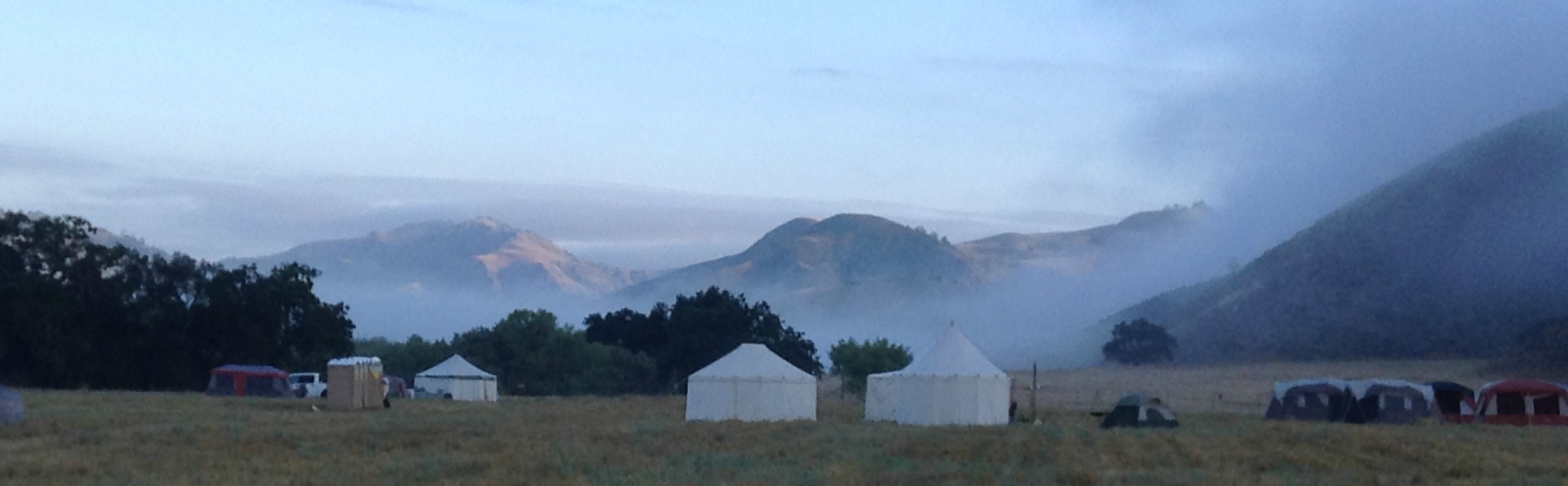
Our last day at West Kingdom Golden Beltane we had fog in the morning.

WK pavilion in fogThere were whispers of Avalon and Brigadoon.

fog at beltane