Papermaking: A Brief History

The name ‘paper’ comes from the original source of paper, the papyrus plant. Renaissance European paper is made of pulped cellulose fibers such as cotton and flax. According to tradition (but not documentable), paper was first made in China about AD 105 by Ts’ai Lun.

An image, describing five major steps in ancie...

An image, describing five major steps in ancient Chinese papermaking process. (Photo credit: Wikipedia)

Paper making is generally recognized as diffusing throughout Europe from the Arabic countries. Arabs in turn acquired the knowledge of paper making in the area of Samarkan located in modern day Uzbekistan. They set up paper mills in Baghdad, Damascus and Cairo, and later in Morocco, Spain and Sicily. Although the Samarkan region grew cotton and used it for making paper, the Arabs generally lacked fresh fibres. Consequently the Arabian paper making tradition was based almost entirely on rags. The breaker mills employed in the Arabic paper making process produced an inferior pulp. But, by using this method, with screens made of reeds, thin sheets of paper could be made with a good quality. These sheets were coated with starch paste as a sizing. This gave Arabian paper its good writing properties and fine appearance.

One of the better documented paper making endeavors in Europe was that of the Nuremberg councilor Ulmann Stromer (Stromeir). In the late 14th century Stromer employed skilled workers from Italy to transform the ‘Gleismühle’ (flour mill ) by the gates of his home town into a paper mill. The dates noted in his diary, 24 June 1390 (start of work on the waterwheel) and 7 and 11 August 1390 (oaths sworn by his Nuremberg foremen), are the first documented records of papermaking in Germany. A facsimile of these diary pages is on display at the Deutsches Museum of Science and Technology in Munich.

The wording of Stromer’s diary entries reinforce the impression that papermaking was a largely unknown and secret art, consistent with practices of secrecy by the Guild system in Europe. Stromer had to convince the immigrant Italians to teach him the necessary papermaking secrets. In addition, he had to overcome many technical difficulties. Stromer’s mill – illustrated in the world chronicle of Hartmann Schedel in 1493 – was initially designed with two waterwheels, 18 stamping hammers (i.e. six holes) and 12 workers using one or two vats.

Italian papermakers had improved the Arabic methods by developing:

  • the use of water power
  • the stamping mill (derived from the stampers and milling machines used in textile handicrafts)
  • the mould made of wire mesh (as a result of progress in wire production), which triggered the introduction of couching on felt
  • the paper press (screw press) with slides for feeding in the material
  • drying the sheets on ropes
  • dip sizing

Handmade paper in the western tradition requires the work of three professionals. First the Vat man scoops the pulp from the vat containing a mixture of water and pulp and forms a piece of paper on the mould. Next the Coucher transfers the wet sheet of pulp to a damp felt to be pressed and give the paper a particular surface. Finally, the Layer removes the wet sheets from the felts and stacks them for further pressing and drawing. The layer is also responsible for removing defective sheets.

Watermarks are created by sewing a formed wire into the mesh of the paper mould, creating a slightly thinner layer that reveals the shape of the watermark when held up to the light. Watermarks were used to identify the paper maker and were first in the forms of circles, crosses and stars and other religious symbols relevant in the 13th century AD.

Next Time – Papermaking: The Process


Prayer Beads Revisted – The Components

Last time we discussed the basic geography of a rosary and what the most common forms were for European Roman Catholics. Now let’s discuss the individual components of the Rosary in greater detail.

Beads, that is what both the Ave and Paternoster beads are. The average person was most likely to have a rosary that was made of wooden, bone or glass beads. Wooden and bone beads were manufactured locally in most places in Europe. The City of London still has a Paternoster Row – a street where Paternosters were once sold and probably manufactured.

Henry VIII’s rosary is a tenner that is made of elaborately carved boxwood beads with a ring at one end and a large gaude/Paternoster at the other. I was fortunate to actually see this rosary in person a number of years ago when it was on tour in Las Vegas at the Bellagio Art Gallery. You can see it online here.

Do glass rosaries surprise you? The import records from England indicate the import of literally thousands of Paternoster strands from Italy during the 1500’s – all made of glass. I have not been able to locate any surviving paternosters that are made of glass. The beads that they were believed to have been made of do appear archaeologically.

What else can the beads be made of? Well, we have already mentioned wood, bone and glass, but all sorts of stones, semi-precious and precious, coral and metal beads were used. There were actually special rules, called sumptuary laws, put into place in some locations to attempt to control the ostentatious display of wealth. The church put specific sumptuary laws in place to prohibit some of their clergy from using rosaries that contained precious stones and coral.

Other materials may also have been used, like clay or rose petals. There is a lot of modern mythology about when mashed rose petals began to be used to make rosary beads. I have not been able to find any reliable scientific information on this technique as a source of medieval rosary beads. I believe that some of the confusion on this topic may be due to the association with the red rose with the cult of Mary. Modern researchers may have taken comments about roses and Mary literally, when they are meant symbolically. This sort of confusion is unfortunately common. For instance, the German word for beads is Perle. Modern English speakers often assume the word means pearl, when it actually just means a bead made of ANY material.

Multi-decade rosaries are often made as loops. The looped rosary is probably the most common form that we find modernly, and it was definitely used prior to 1600. Loops commonly contained 3 or 5 decades. They generally had a decorative tassel or cross. The cross could be a solid cast or carved piece, or it could be made of multiple beads, as demonstrated in this picture. Several rosaries that were found aboard the wreck of Henry VIII’s ship the Mary Rose (July 19, 1545) had constructed crosses like this. Many of the crews skeletons were found with their rosary on their person or in close proximity, indicating that most of the sailors carried rosaries at all times.

English: A rosary found on board the carrack M...English: A rosary found on board the carrack Mary Rose. (Photo credit: Wikipedia)

Rosary ends could be decorated with crosses, tassels, a large beads called a gaude, or a ring. Remember Henry VIII’s rosary – he had a gaude and a ring.

I hope that this brief summary of rosary components helps you better understand what a pre-1600’s rosary should look like.

Prayer Beads Revisited – The Basics

Over a year ago I wrote a blog on Prayer Beads. Chatting with people in my shop over the past year has consistently brought up some specific questions. The majority of my customers who are looking for prayer beads have European personas, they know that they should be “using” prayer beads as an accessory, and they do NOT know what the prayer beads should look like.

The first important thing to realize, if you are familiar with modern rosaries, is that most of the standardization of rosaries for the general public has occurred in the last 100 years. Prior to that time geographic regions, various religious orders, and personal preference and wealth were all very important considerations.

So, you want a set of prayer beads, but you do not have a “totally focused” persona from a very specific town? If you are male – get a tenner, and if you are female get a three decade rosary.

Now what does that mean? Let’s discuss the geography of a rosary. The standard number of Ave beads in a decade is 10. An Ave, or Hail Mary, bead is used to say the prayer that begins, Hail Mary full of grace… But remember, no matter what your native tongue, if you were a regular Roman Catholic in Europe, you said your rosary in Latin during the Middle Ages, so that would have been Ave Maria Gratia Plena. The decades in a rosary are separated by a Paternoster, or Our Father, bead – this is where the Our father who are in heaven prayer goes… in Latin of course (that is what Paternoster means).

Medieval rosaries were usually ended, or decorated, with either a tassel or a cross, the use of a crucifix on a rosary is extremely rare prior to 1600, but becomes more common after that date. And the difference, in case you are not sure, between a cross and a crucifix, is the presence of a representation of the crucified Christ, hence the name, crucifix. Crosses could be one piece or made of several beads.

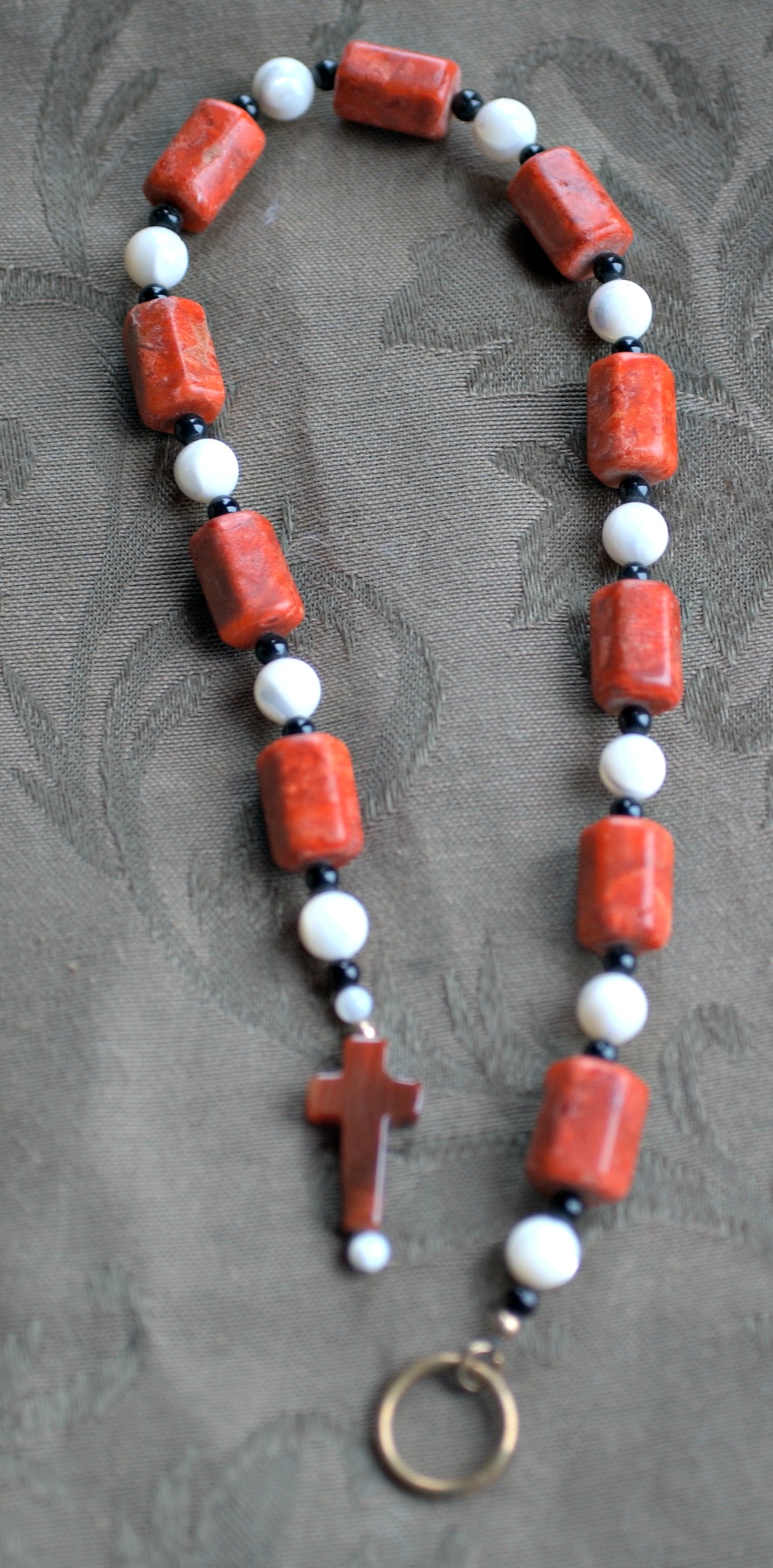
So back to my persona recommendations! A tenner is simply a string of ten Ave beads with an end bead, known as a gaude, or a cross, or a ring, or sometimes a tassel, or a combination of those things. If you are in a German speaking area, it will be called a Zehner – you guessed it – a tenner. Women use them too, but they are definitely the most popular form that we find for men. This picture shows a tenner with coral Aves (the black and white beads are just spacers), a carnelian cross at one end, and a ring at the other end. The ring can be used for hanging the rosary off of a belt, or if it is large enough, it can be placed on a finger to make it easy to carry and use the rosary at all times.

Etsy 125

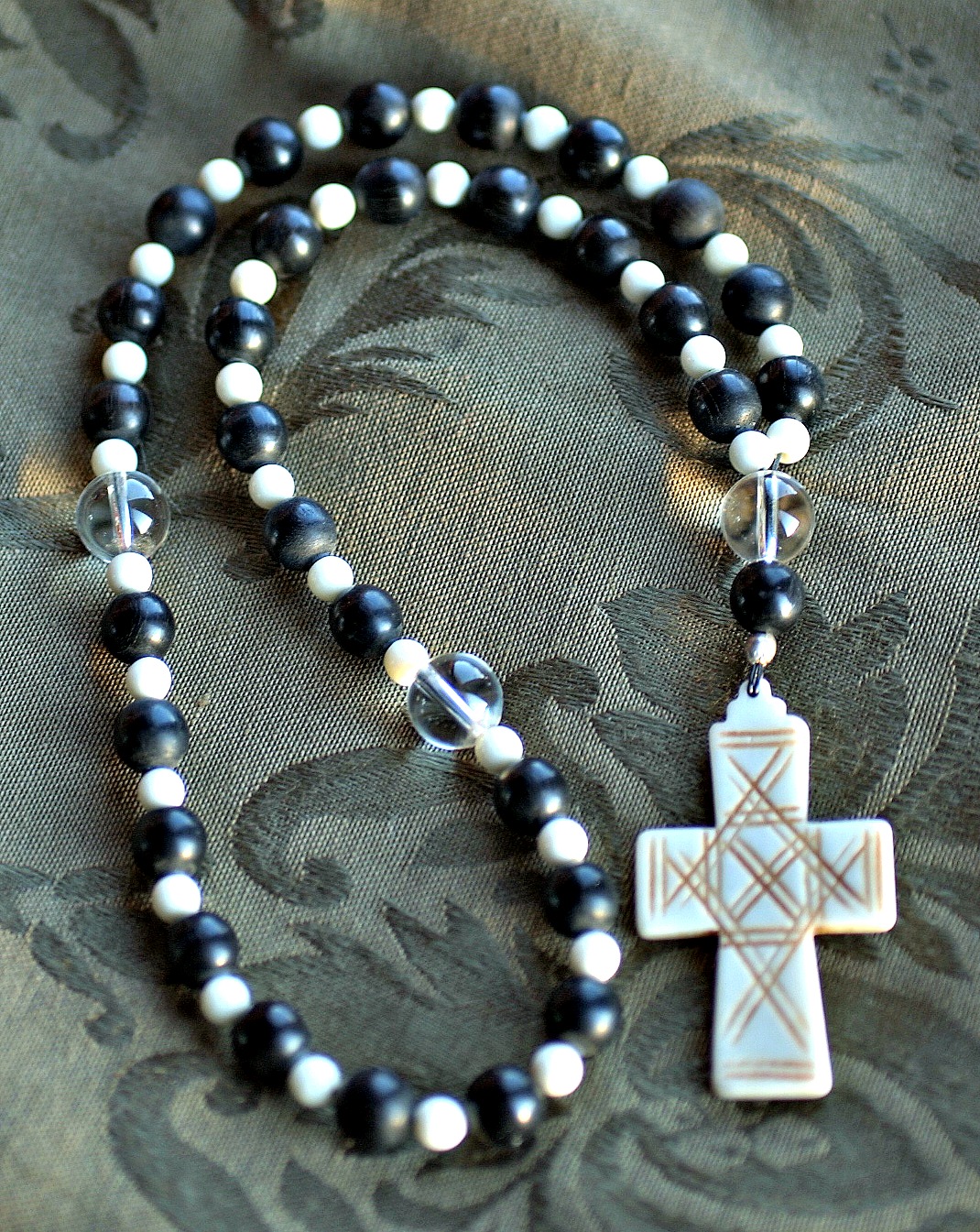
And what about the three decade rosary for women? This form is usually made into a loop, for easier carrying. So we have three sets of ten Ave beads with a larger Crystal Paternoster bead separating them, and a tassel or cross at the end – like this.

Etsy 126


I hope that this brief blog helps to demystify what sort of rosary your persona should be carrying. Next time I will discuss the details of bead choices, tassels and crosses.

Enhanced by Zemanta