What Size Were Brooches in the Middle Ages Part 2 – Bronze Brooches and Other Tiny Things

Last time I mentioned the fact that a lot of pre-1600 items are actually quite a bit smaller than we might modernly assume. In addition I mentioned the easy manufacturing techniques involved in lead and tin items.

Bronze requires dramatically more heat – nearly four times the heat! Temperatures near 2000° F require a furnace, with some sort of blower system, like a bellows. Bronze items would therefore have been a more specialized and expensive production. Not as elite as silver or gold, but not the bottom rung of lead and tin either. And even more important, bronze is much stronger than tin or lead.

Getting back to tiny things, let’s talk a little more about tiny brooches. Tiny brooches can’t be used on thick fabrics. This does NOT mean that they can only be used on linen, cotton, or other plant fiber fabrics. It just means that the fabric needs to be relatively thin.

Brooches like the little one that I bought have a big advantage over penannular brooches. A penannular brooch, if tugged and shaken enough can eventually open. But an annular brooch has to break, bend a lot, or have the fabric that it is attached to tear in order to let go. This gives it a couple of big advantages over the other forms of simple closures that were available pre-1600. It won’t open and it can lay super flat.

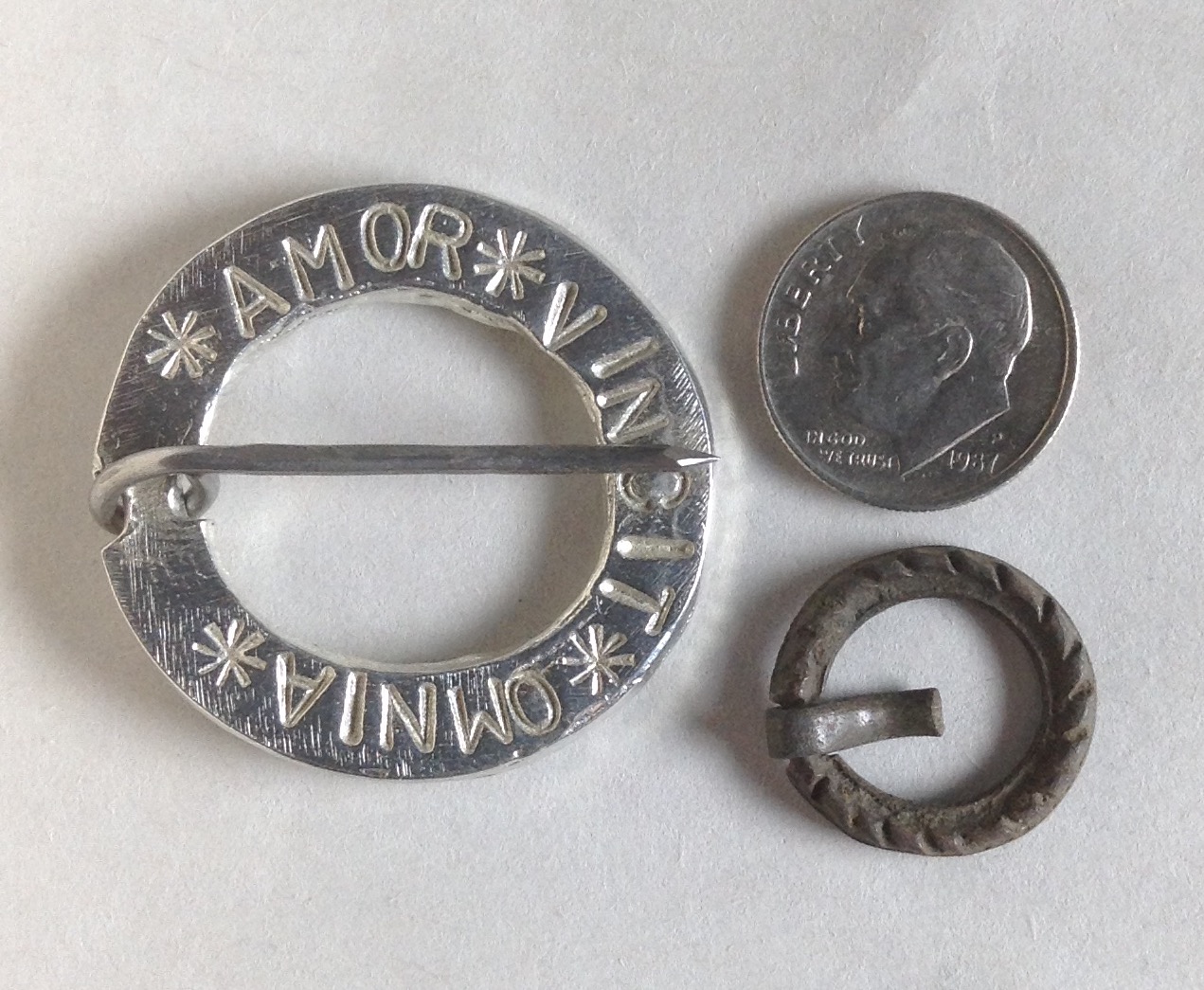
ringandbrokenringbroochesThe brooch on the left is an annular brooch and the one on the right is a penannular brooch, with a dime for scale (18mm). I chose a heart shaped annular brooch because I wanted to make a point about annular brooches. They must form a closed ring, but that ring can be just about any shape.

What forms of closures were available pre-1600? Laces or ties, hooks, hooks and eyes, buttons and toggles, penannular brooches, annular brooches, fibulas, dress pins, and other miscellaneous brooches. We already discussed penannular and annular brooches, so let’s look at the other options – remember we are looking at tiny things here, preferably things under half an inch, because that was the size of my little brooch. And there must have been a reason for that size, right?

Laces and ties. Easy to make, inexpensive and widely used. They can be made by the average person with commonly available supplies. They can be made to lie extremely flat, but they can break or untie, and it is very difficult to make them really tiny and still have sufficient structural integrity.

Hooks, and hooks and eyes. Exactly what is the difference? Modernly hooks and eyes are small metal sewing accessories that are available at any sewing supply store. Pre-1600 folks did have small hooks and eyes that were made out of metal wire, and they were definitely used extensively in the 1500’s, but there were also many other types of hooks used, and even some large cast hooks and eyes. Earlier cultures, like the Celts and Anglo Saxons sometimes used what I call “hooks and eyes on steroids” – sets where the individual pieces are each an inch or more long.

hooks and eyesThis picture shows a modern selection of hooks and eyes in various sizes on the right (the numbers are the sizes) and a 1500’s collection of hooks and eyes, from the Netherlands on the left. The size 3 modern hook is about 7/16th inch tall (12 mm).

So, if size is an issue the large hooks are out. The tiny hooks and eyes can lay fairly flat, and they meet the size criteria, but unlike many of their modern versions they did not have a little “bump” on the inside of the hook that make the hook and eye set “lock”. This means that the older hook and eyes would have to rely on tension pulling on them and keeping them in place. Without the tension, they open.

Next time: Hooks – Sharp and Blunt, and Buttons and Toggles
What Size Were Brooches in the Middle Ages?

I could just as easily have asked this question about any sort of common item, and because of my training I often do. I realized a couple of years ago that many people have a total misconception of the size of a lot of things that people used. Despite years of education and extensive training I am NOT completely immune to this problem. I sometimes buy small metal detector finds, and have been caught in this trap.

A little while ago I purchased a very nice annular brooch (ring brooch). It was a good looking bronze piece which had a sort of twisted rope look. There were no dimensions given for the piece and I assumed that it was at least twice the size that it actually was. I was shocked when I saw how tiny the brooch actually was. This made me wonder how common an issue this really was. So, I looked at the given dimensions for many other items that were on sale. Then I went to a couple of the museum sites and looked at the actual sizes of the finds in the museum. And yes, there were a few really magnificent huge pieces, but in general the brooches and everyday pieces were rather small – at least by modern standards.

Researching the size of the people who wore these items in England shows that women during the Middle Ages were generally about 5 foot 2 inches tall and men about 5 foot 6 inches. The article that I read said that this meant that Medieval Women were only an inch taller than modern women. I am 5 foot 9 inches tall. My grandmother, who was born in about 1890, was 5 foot 2 inches, but most of my female friends are at least 5 foot six. Now I consider myself to be a little taller than average, but not dramatically so. Is it possible that these brooches were sized smaller because the people were smaller, or were they sized smaller because of the value of the metal?

I don’t think that we can give a definitive answer to this question, but I would love to hear people’s opinions on this topic. Metal really was a valuable commodity.

Inexpensive metals like tin and lead were commonly used to make lower end pilgrim’s badges and decorative pieces. These metals both have a very low melting temperature, which means that they can be cast using a simple hearth. Pilgrim’s badges give us other important clues as well. Some tears ago I had the good fortune to meet with the curator of medieval artifacts for the Museum of London. Besides the sheer exhilaration of spending time with John in the bowels of the Museum storage looking at pilgrim’s badges, I also noticed the casual finishing of these ubiquitous items. Many of the badges had flashing left over from the manufacturing process. Modernly, we would expect those “manufacturing defects” to be removed. Casting and finishing of tin and lead are easy, so the condition of the pilgrim’s badges indicates the acceptance of a rough finish for some pieces.

Next time: Bronze brooches and other tiny things

One of my pewter brooches, a dime, and the tiny brooch that I bought.

One of my pewter brooches, a dime, and the tiny brooch that I bought.


Don’t Let Them Spoil Your Fun: How to find or create kindred spirits – Part 2 – Long Distance Assistance

Last time I talked about setting a good example and keeping up your own standards.

When my husband and I moved to Atenveldt, I believed that most people, given the opportunity, would want to learn. It might be the smallest thing, but I believed that there was a spark inside everyone in the SCA that if only fanned with the right stuff, would blossom into a bright light. They would want to make their brews more accurate, their clothing more accurate. I understood budgetary restraints – I had them as well, I understood time constraints – building our new house was a time consuming task, I even understood limitations on people’s ability to fully understand the esthetics of previous periods.

What I didn’t understand was an apparent lack of devotion to the historically based game that we play. Now, I’m not demanding that SCA members spend all of their free time or their free cash exclusively on the SCA experience. But I do look for a spark in every one of us. A good friend explained it to me this way, “For you the SCA is a lifestyle choice, for many other people it is just a hobby – an excuse to get together with friends on the weekend and have a party.” (Smart person!)

But I have found some people who are kindred spirits. Not as many as I have out of kingdom, but there are a few here who really understand my devotion to the game. And I have helped to “corrupt” a few people by encouraging them to take classes that gave them their own passion for some part of the game. We joke that “Resistance is futile “. If you will honestly try a bunch of different things, you will eventually find something that you love.

I prefer the carrot to the stick whenever I deal with people – but I have to admit there are people who I would sometimes like to hit with a stick. Who are those people? The people who just don’t care about trying anything historically accurate AND make fun of those who do. Mostly it’s about their lack of respect for the parts of the SCA that are important to others. It’s your right to play your own game, but don’t rain on my parade. Don’t make fun of people who want to learn, who want to improve their game.

I make a point of ignoring the blatantly bad clothing, the glaringly modern brews, so they should be able to ignore my authenticity. If people want my opinion on an item that I have hard knowledge about, I try to give it as gently as possible. The jokes about authenticity Nazis are not funny. So I counter in my classes that I can’t possibly be an authenticity Nazi, because Nazi’s aren’t period for us. That always at least garners smiles and chuckles.

Extending Your Search for Kindred Spirits

There will be times, no matter how good your collection of local kindred spirits, that you just need more. And that is where internet groups can come in. I belong to several select yahoo groups and several closed Facebook special interest groups. I personally look for groups where quality research and information is shared on a daily basis. Most of the groups that I am on are also totally unforgiving of bad behavior. Snarky comments are just not acceptable, and I like that. These people become your long distance research family. They share a passion for a topic that you simply may not be able to find locally, no matter where you live.

One of my great delights is when I finally actually get to meet one of them at an event. I have had people come to my classes, or into my booth, and be totally delighted to meet me because we have shared information long distance. Is it as good as sitting around a table and chatting while you work on a project? No. But it sure beats feeling totally isolated and on your own. And don’t forget this approach for side-projects, too. The resources that you can access this way, can be totally amazing.

We travel to several large out-of-kingdom events. With a little pre-planning this can be can a great opportunity to expand your circle of kindred spirits. If you’re shy it can be a challenge to get out and meet people, but it’s worthwhile. Look for an event where a special interest group gathers to meet, discuss, and trade information. Go to a class. Meet the people in the class. Trade contact information.

If you are concerned about making information too freely available, consider establishing an SCA-only email account, web page, Facebook page and the like to allow like-minded people to contact you. In short, do research to find kindred spirits. Don’t have the skills to do that type of research? Find a friend who has the skills and will share them with you! Research on!

Don’t let THEM spoil your game!

Society for Creative Anachronism participant i...

Society for Creative Anachronism participant in period garb prepared for feast (Photo credit: Wikipedia)