My Casting Process Up Close – No It Is Not Instant!

I have been chatting with several customers lately at events, and it has become painfully obvious that some of them think that the casting process is almost instant, and that the cast pieces arrive looking as lovely as a shiny new penny.

Not really.

I was trying to figure out where they may have gotten this impression from. Maybe they watched an edition of “How It’s Made” where a giant machine spits out polished pieces, or maybe they have seen pewter casting.

So I thought about the Pewter Casting for a while. I do a little pewter casting for some of my reproduction spindle whorls. The originals were lead, and I am just NOT going to go there, so I use lead free pewter. I also make a few Pilgrim’s badges in pewter and bronze.

Cast Pewter pieces come close to looking like that new penny that we talked about, at least a lot closer than bronze or silver do when they are cast. This picture gives a nice perspective on casting simple pewter pieces. The original soapstone mold that I created for the scallop shell pilgrim’s badge (Santiago de Compostela in Spain), is on the far left. An “almost” cast ( the loop is incomplete and the “wings” on the top of the shell are not squared enough) shows what a fresh casting might look like. Above this is a row of six small spindle whorls, one of which still has it’s sprue intact. The larger spindle whorls on the right side show what flashing looks like (that wobbly bit sticking out on the edge of the spindle whorl).
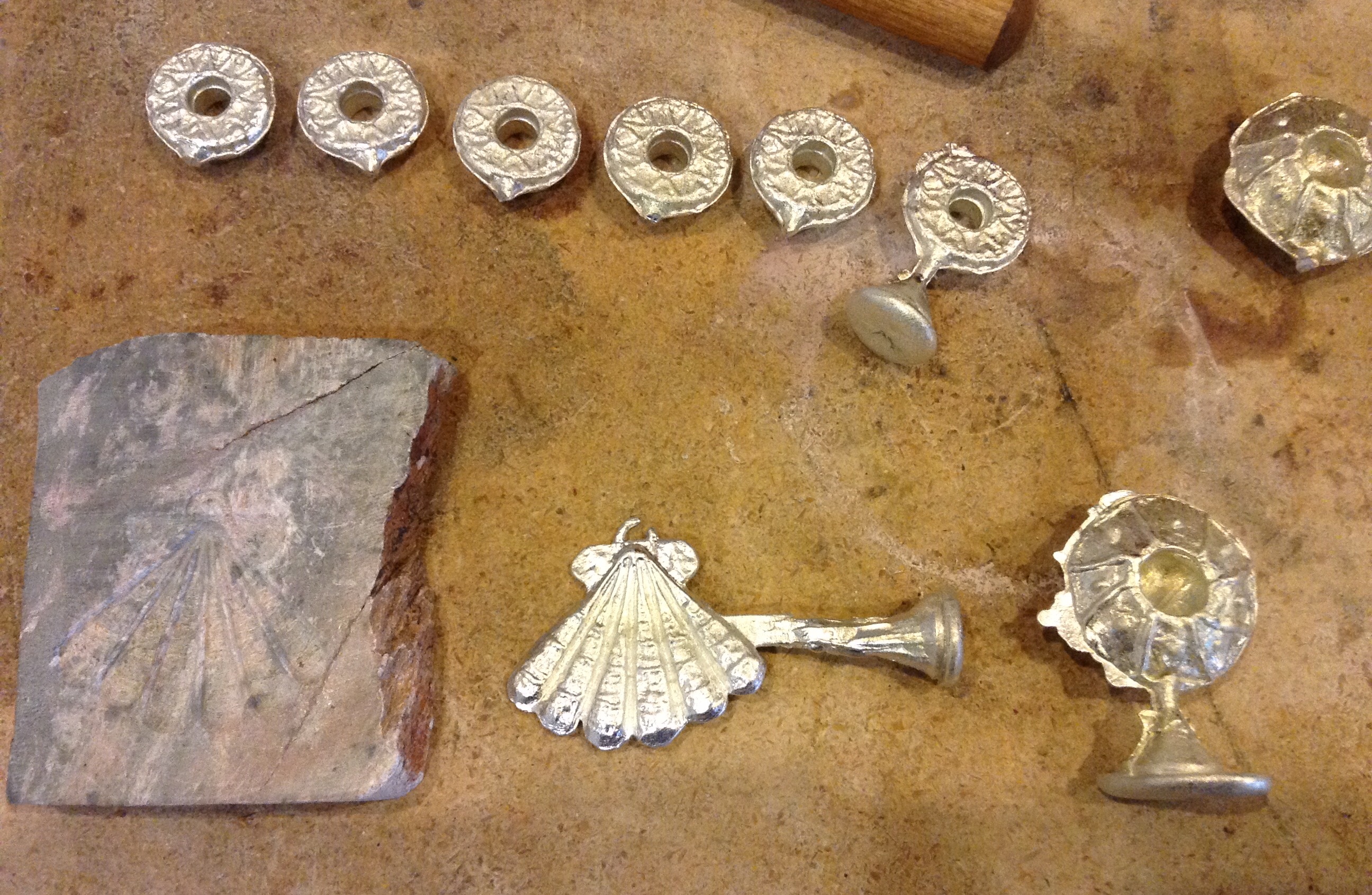
pewter casting

OK, so let’s look at the process objectively. The mold is clamped, and the molten pewter is poured into the mold and allowed to cool. After three or four minutes the cast piece can be taken out of the mold. It will still be hot, especially if it has some bulk, like the spindle whorls do. Depending on the temperature of the room and workbench, a five minute wait is probably a good idea. Then I use a pair of sprue cutters to cut off the sprues. You can see where the sprues have been cut off on both the large and small spindle whorls. I then remove any flashing around the edges of the piece, either with a file, or a wet sanding machine. During this process the remains of the sprue are also removed. I then check any interior “holes”, like the interior of the loop on the scallop and the center hole on the spindle whorls for flashing, and remove it. Now the piece is ready for a quick polish. Twenty minutes in a tumbler with steel shot and burnishing compound will remove any oxides and give the pewter a nice sheen.
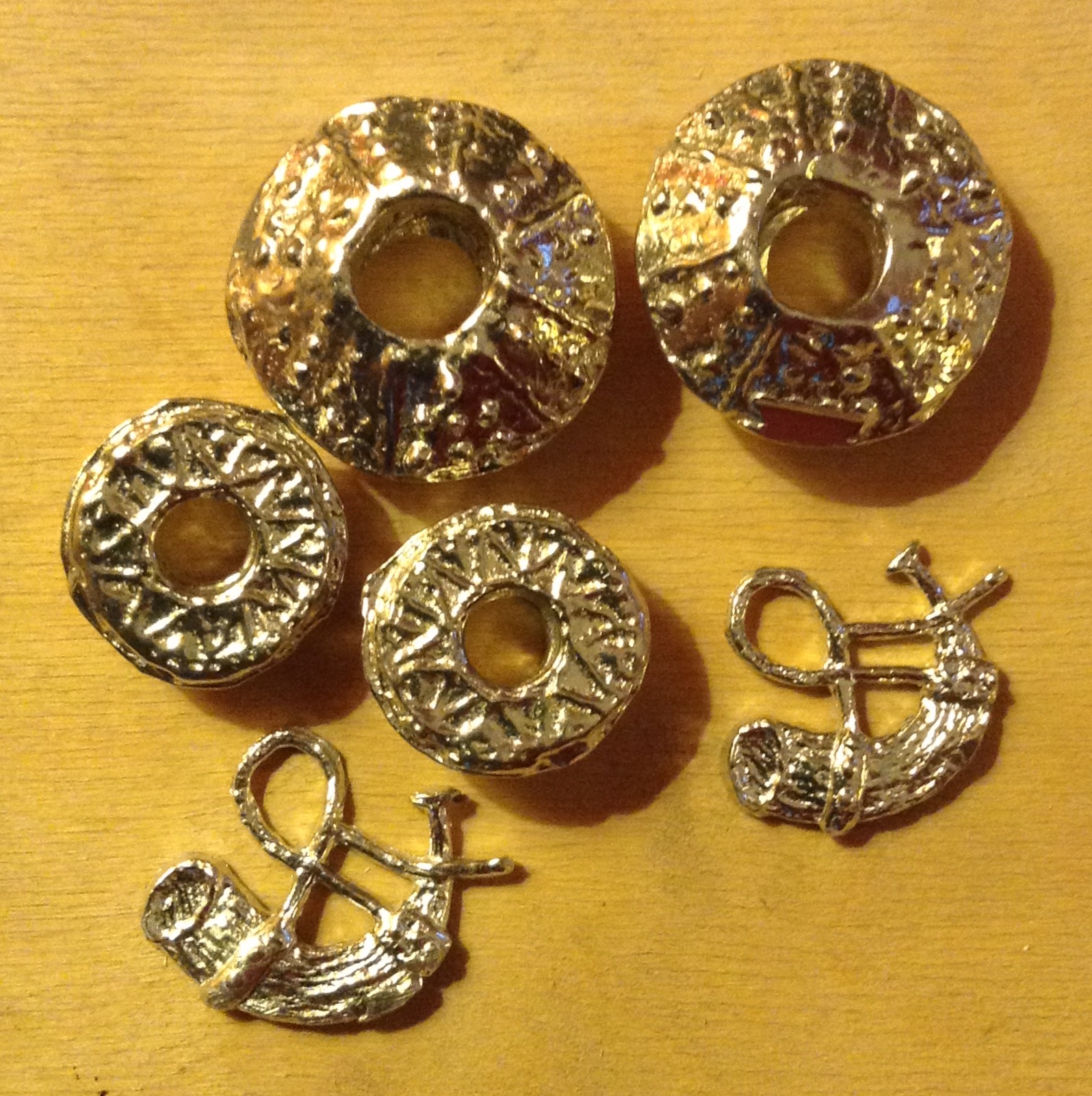
polished pewter

Shiny! This is what the polished pewter looks like. It is really not a complicated process, but even something as simple as pewter casting is definitely not instant.

Next Time: What Happens When We Cast Bronze

Lies My Docent Told Me

I have to admit it, I snatched the name for this blog from a book that helped my daughter get through high school history – Lies My Teacher Told Me. The original book was about the most common incorrect information that is found in history text books. And it was important enough to earn a Wikipedia entry and is well worth the read.

My point is really not that far from the original book. Some of the information that I have heard or seen in museums has been really awesome, and some of it has been patently wrong. Do not hesitate to question the accuracy of information that you see in museums.

My first really glaring experience occurred in the Victoria and Albert Museum, probably about 15 years ago. I was in the Medieval gallery, a general collection of Medieval artifacts ranging from monstrances, to mirror cases, and enameled spoons to reliquaries. I was examining the designs on a reliquary when I heard an authoritative woman’s voice behind me. She was obviously giving a tour of some sort, so of course, I listened, and glanced over my shoulder. The speaker was a distinguished looking matron. Her guests were a young couple, probably in their early 30’s, and obviously upper crust – my instant thought was “donors”. And their eyes were wide with delight at all the marvelous things that they were seeing. I love enthusiasm for historical things, so I continued to listen. And then the words came, “They made these bowls out of bronze because gold would melt if they tried to enamel it”. I never heard another word. My brain was racing. This information was totally wrong. Should I speak up? No. I decided that these folks were probably not even going to remember that casual comment, and if I spoke up I would just be an “obnoxious Yank” and even more important I might affect the long term donor status of the young couple. Donors are the life blood of most museums. It just wouldn’t accomplish anything positive.

So, one of the basic rules that we always have to remember is that science – chemistry, physics, metallurgy, and all the other branches of science, operated according to the same rules in ancient times as they do now. What I knew was that most enamel, especially the often heavily leaded enamels that were used before the 1990’s, melt at between 1100 and 1400 degrees Fahrenheit. Bronze, which is what the bowls were made of, melts at about 1980 degrees Fahrenheit, and Gold, depending on the alloy, melts at about 1948 degrees. Hence, the docent’s statement was really, really, wrong. The bowls were made of bronze to save money. After they were made they could easily be gilded, to make them look as if they were made of gold, without having to pay for the additional cost of solid gold. Sigh. And just for fun, here is one of the reliquaries from the V&A.

VandA Reliquary


What other sorts of things should we be watching for when we go to museums? Generalizations are always a “red flag”. Statements like “The Romans always…” There are very few absolutes when it comes to people.

Next time: Other Hints to Help us Navigate Museum Exhibits.

The Way That I Cast : Lost Wax Process- Part 6

Last time I discussed the most basic casting set-up that I could think of, that was likely to create successful results. I also mentioned the biggest problem with this system – your model is destroyed in the process.

The biggest question about casting that you really need to ask yourself is “Is this something that I want to do just once, or twice, or is this something that I want to be able to continue to do for the foreseeable future?” And along with this question is another important issue – “Do I feel that I have to do all the parts of the casting process myself? Or can I “farm out” some, or most, of the process to a professional?”

So what sort of options do we have? Well, the first thing that comes to mind is to solve the problem of destroying your model yourself. You can make a mold of the model so that you have the option of making copies of the model if you want to make more items, or if the casting process fails. There are a lot of very user-friendly Room Temperature Vulcanizing compounds out there that do not require any special equipment. I have more complex equipment, but I still often use RTV compounds to make molds. Here are a couple of my molds.

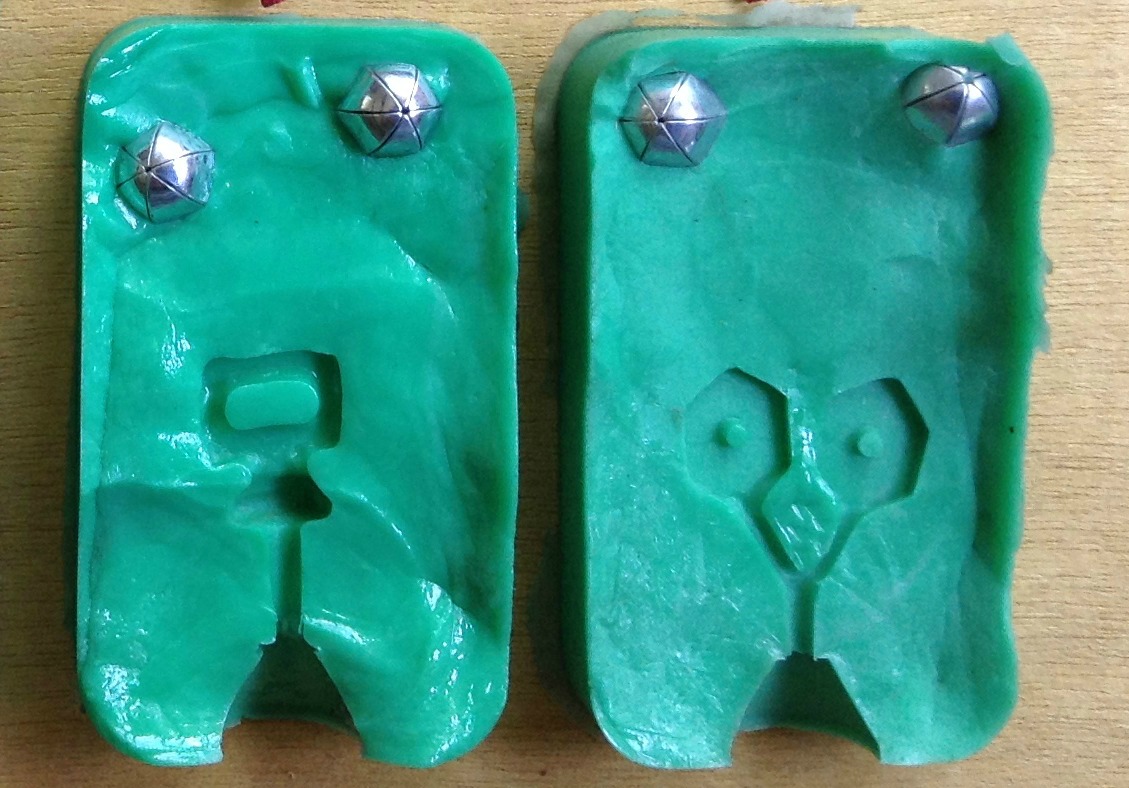
RTV molds

What if you really enjoy the idea of making the model, but you really are just not up to doing the casting yourself? Well there are reputable companies in the US that will take your model and cast it for you. They will generally want to make a mold of the model as insurance against a failed casting. You can arrange to receive the mold yourself, along with the cast piece, or have them archive the mold. Be sure to understand all of the costs, who owns the mold, and whether they archive it, or you get it back.

I do not recommend sending a model “offshore” to places like Pakistan or China. Factories in these areas usually specialize in large quantity production. They often own the molds, and you may not get your master back. Your legal recourse if you are not pleased with the results, is limited, and you will have to pay import fees. I do know people who have their business production done off-shore. The Pakistani company is casting bronze pieces and their minimum order is 1000 of the same pieces. I was not impressed with their quality. The Balinese company is casting silver. They will cast much smaller numbers of items, but still not ones and twos, and their quality is very good.

But back to getting work done in the US. As long as you understand the fees and rules you should be fine. Taking this to the extreme, there are shops that will do custom casting, from design to finish. The most technologically savvy shops will have computer design capabilities that will use 3D printers to create the original model. I have seen them in action, and it is amazing. Small shops may also be willing to do wax models and cast very limited quantities.

I hope that this blog gives you some ideas about your casting options.