Purses Part 1

Purses. They take many forms, they are used by all social classes, and they are an important accessory for just about everyone from at least the Late Stone Age on. The actual definition of what constitutes a purse is a more complex issue than you may think. What are the size limitations, the materials that they can be made of, the method of construction, the method of closure?

Probably the most common materials are leather and cloth, and the most common closures are a draw string or toggle. I know that for the first ten years of my life as a reenactor that describes all of the purses that I, or any of my friends had. Simple bags with drawstrings, or leather belt pouches with some sort of toggle or latch completed our need for carrying small things (like money and eyeglasses). We often had other small bags and pouches in our purses to control the chaos that tended to develop in the purses.

Now that is not a complaint or any sort of put-down. Some of these purses, were truly lovely, embroidered pouches with silver spangles and tassels, leather belt pouches with leather tooling, appliqué, studs, or lacing. Totally documentable, and something that anyone should be proud to wear.

There are some excellent resources out there for people who are interested in making a reproduction of one of these types of purses. Archaeological reports often have very good pictures or drawings of the purse patterns. Probably the most notable collection of solid archaeological information on purses, that has been made much more user friendly with the inclusion of photographs, drawings, Medieval illustrations and good explanations is “Purses in Pieces” by Olaf Goubitz. Although the book focuses on the Archaeology of the Netherlands, the purse forms are fairly universal throughout Europe, just as any important accessory would be today. As a side note, the reason so much leather survives in the Netherlands is because of the soil conditions. The naturally wet conditions often preserve the leather instead of causing it to rot. We find the same sorts of preservation of leather and wood in the Novgorod (Russia) “black earth” areas.

As I mentioned before, the size and materials that an item is made of might also define its name. At what point does a purse become a Pilgrim’s bag? At what point does a net bag become Shepherd’s purse? But I have to admit that my plan is to leave that discussion for another place and time. Despite the fact that the purse forms that I have mentioned are very common in Medieval Illustrations they are definitely NOT the only form of the purse that we see represented. What interests me, and in fact has become something of a research obsession for me, is purses with frames.

Now that may seem a bit confusing at first, but most people are familiar with at least one purse that has a frame, the elaborately decorated purse lid from the Sutton Hoo burial.

Purse-lid from the Sutton Hoo ship-burial 1, E...

Purse-lid from the Sutton Hoo ship-burial 1, England. British Museum. (Photo credit: Wikipedia)


Next time: My first attempt at making a purse with a frame.

168 Blogs Later : Four of My Favorites

Blog Collection Picture

Well it does seem to be that time of year when everyone is doing a retrospective on 2015. To be honest, I have never done that sort of thing before with my blogs, so I decided to do a variation on that theme to start out the new year.

Since I started writing my blogs back in 2012 I have posted 168 blogs. The themes of these blogs have ranged from Prayer Beads, to Gardening Hints, and Metal Working to Medieval Cooking. The majority of the blogs have something to do with pre-1600 accessories, food, and camping. And of course I have my favorites, so I decided to share a few.

This is a blog about an A&S project that I did. It is not a literary gem, but rather a recounting of my process and results. It was the first time that I had ever worked with antler. I only used hand tools, and I tried very hard to make everything as period as I could. And the result was A Viking Antler Comb.

And then there was this blog about Wrist Clasps. I often sell wrist clasps in my shop, I wear them on a couple of my Viking Under Tunics, and I get a fair number of questions about them. I wrote the blog to help people understand how the clasps work and how handy they could be.

My husband and I both love to cook Medieval food. When we cooked a Medieval Feast a number of years ago we went in search of some really yummy recipes that wouldn’t be too shocking to the modern palate. This is still one of my favorite Medieval snacks, and we will sometimes make it for potlucks – Succades, the perfect medieval palate cleanser.

And last but not least, an article about why I do what I do. – Stardust Moments in the SCA.

I hope that you enjoy these blogs as much as I do. Check out some of the other interesting topics in my blog collection, there is something for everyone.


Chains Part 7 – The Last Links

Chains. We have talked about a bunch of the basics. Cutting links correctly with modern tools so that they have nice flush joins. Round links. Cast links. Soldered links. Looped links. Squished figure eight links with extra spiral coils. Figure 8 shaped links. Twisted figure 8 links. 3 D links.

There are probably a ton of other link forms out there. But two more forms really stand out in my mind. I have seen the first one used several times, although I would not consider it to be super common. Most of the pieces that I have seen have been utilitarian, and in fact I am not sure that I have ever seen the form used in piece of historical jewelry, although I don’t see why it couldn’t be. We do see the form used in jewelry all of the time when a bead is added to the center of the link. This piece from the Museum of London collection is an excellent example. It is a steelyard – a type of scale used for weighting things, in this case, pounds and 1/2 pounds. This one is Roman, found in Great Britain. The links on the steel yard are created by taking a length of wire, forming a loop at each end and winding the end of the wire towards the center of the link. If you will click on the “enlarge image” link the site will provide a nice big picture that will allow you to see the details of how the links are made. The longest chain (only two links) is a perfect demonstration of this technique. On the right link, you can see how the two loops are formed, and then the ends are twisted towards the center of the link.

The second type of link, is one that I have seen a lot in Viking Age chains. This is an excellent example from the Swedish National Museum. The chain was found in Gotland and dates to the Viking Age. These links are simply spirals. In fact every single link is a spiral.

While I have seen spiral link chains extensively in Viking Age jewelry in Sweden and Finnish jewelry (Remember that the Finns are NOT Vikings. They speak a different language and have different mythology.) I have really NOT seen a lot of these spiral link chains outside of this area.

The Finns were always particularly fond of spirals in their clothing decorations and were famous for their elaborate Bronze Age dress spiral decorations. This reproduction of an Iron Age Mantle shows the same basic type of spiral decoration that we see in the Bronze Age.

This example of an early Medieval Finnish woman’s jewelry kit shows the use of spiral chains beautifully. Generally speaking the Finns used a lot more chains than they did strands of beads. Whether this was due to the availability of glass beads, or a cultural value that says that chains were better, we may never know, but for them it was the more chains the better.

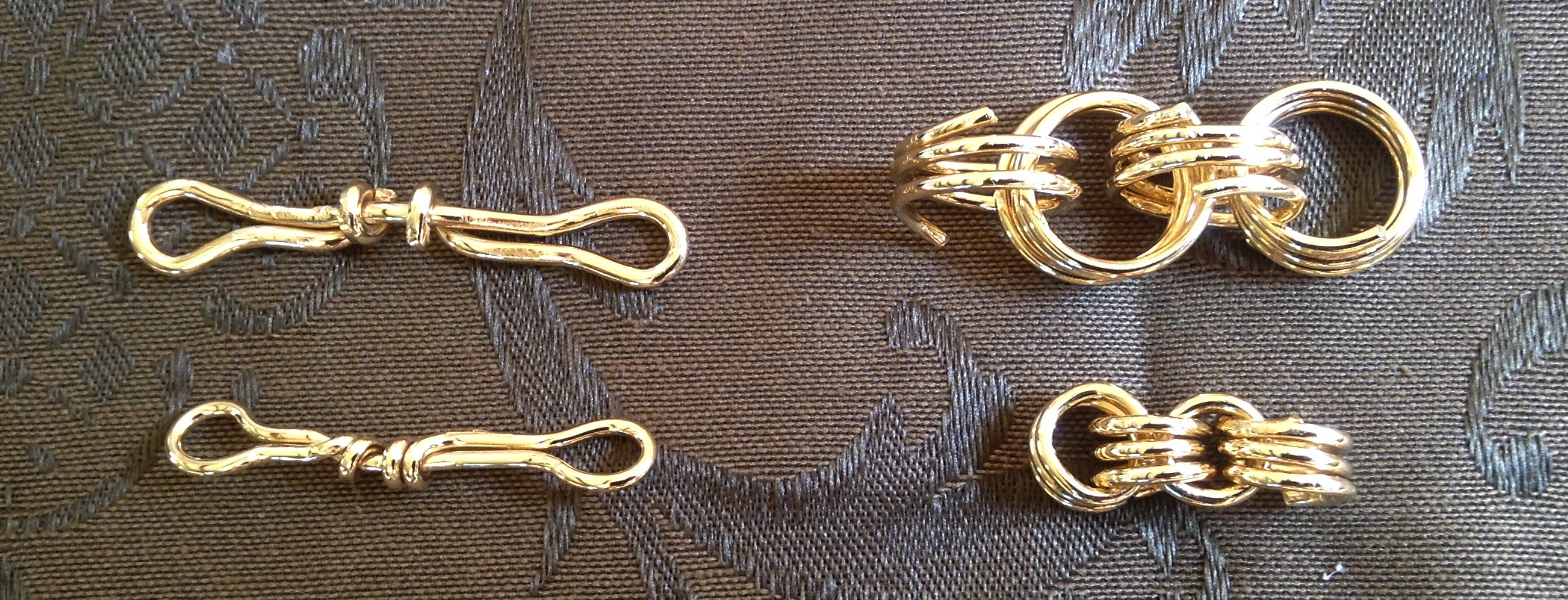
I made up examples of these two links in 14 gauge brass wire so that you could hopefully see the forms a little more clearly. I purposefully made the top row extra big, so that the structure of the wire form really shows. In the case of the left column I also formed the link slightly differently in each example. In the original artifact one of the links was formed with both of the links started on one side, like the top example. The other link had one loop started on one side of the mid-line of the wire and the other is formed on the other, creating a mirror image. If you look at the bottom example on the left you can see the advantage to the mirror image arrangement. If the coils around the center of the link are lined up, and there was no gap in the center, at least one side of the link would look seamless. The twisted part of the link could be made to look like it was one piece of wire.

The right hand column is the spiral in spiral link chain. The form becomes very clear when you make them extra big. The top version shows the form, while the bottom version shows something closer to what the original chain would have looked like a very long time ago.

Last Two Links

I hope that this blog series inspires you to really look at all of the different types of chains that are out there!