How to Determine Power Needs

Xantrex 175 watt DC-to-AC power inverter rebad...

Xantrex 175 watt DC-to-AC power inverter rebadged by Duracell. It has one grounded AC outlet and one USB 5v DC output. It can accept cigarette lighter auxiliary power or battery clips for input. It uses a soft switch for powering on and off. (Photo credit: Wikipedia)


To use an inverter as a source of power for tent camping – decide on the wattage that you will need..


Step 1: Determine what AC appliances you want to operate simultaneously. Add their wattage together and buy an inverter with 20% more capacity. For example, suppose that you want to operate a laptop computer and CPAP machine at the same time. Assuming a few numbers for our example: 75W (laptop typical) + 120W (CPAP machine – your machine will draw a different amount of power) = 195 watts. So, select an inverter of at least 234 watts. For most types of inverters the 20% additional capacity accounts for many manufacturer’s practice of over-reporting the real capacity of their inverter.


Step 2: Determining battery size. Divide watts * number of operating hours by 12 to get amp-hours. Multiply this number by the number of days that you need to operate your devices on battery. Multiply by 2 to determine the number of battery amp-hours required at a minimum.


Step 3: What kind of wire do you use to connect your inverter to the batteries? There are many types of wire, but you’ll want to use either the short wires that come with your inverter, or marine grade wires at least as large as the gauge of the wires that come with your inverters (the smaller the gauge number the larger the wire).  I recommend using one gauge larger than the chart to minimize voltage drop. Voltage drop wastes power and causes the inverter to operate outside its ideal design parameters.


Step 4: Connecting it together – Connect the negative lead for the inverter to the negative post of the battery. Connect the positive lead of the inverter to the positive post of the battery. Some inverters have an on/off switch that can be used to turn the inverter completely on or off. If your inverter does not have a switch you will need to either install a switch or be prepared to disconnect a wire to the battery in order to completely turn off the inverter..


Step 5: To charge your battery for use, disconnect the battery from the inverter  and attach the charger. The charger will take a variable amount of time charge the battery from house current. By using a smart charger you will fill the battery faster than a simple charger. Look for a charger that says “multistage charger.” You will need the charger with you if your batteries won;t last long enough for the entire camping event.


Step 6: Managing your battery. A 12V battery is fully charged when the resting voltage is 2.7V. To measure resting voltage, charge the battery and let it sit with no connections for at least an hour. Use a voltmeter to check the voltage level. Generally, batteries should be kept above 11.95V at a resting level. The fastest charging will occur between 11.95V and 12.5V. Plan to use your battery within this range when camping. NOTE: start with a fully charged battery at home and recharge (if electricity is available to you when camping). A 125Ah battery discharged to 11.95V will take about 7 hours to replenish the battery to 12.5V


For most weekend uses for small medical devices I’ve found that a single 12V 125Ah battery will suffice for most people using modern CPAP machines. As always, make certain that you know how to determine the power requirements for your specific machine. If you aren’t certain, engage a professional who can help size your system to meet your needs.


Camp Beds – Sleeping Beauty or the Princess and the Pea? – Part 2: Something Soft to Sleep On -Purchased Solutions

So now that we have looked at purchased bed solutions, let’s talk about what goes on top before you do.

The basic categories are air mattresses, inflatable pads (commonly used by back packers), foam pads and mattresses. There are also exotic items like feather beds, and any number of combinations of these things.

So what have I tried? Well the obvious choice as a beginning camper was an air mattress.

English: An air matress for use as a guest bed.

English: An air matress for use as a guest bed. (Photo credit: Wikipedia)

We got the “high quality” flocked version. The advantage to this type of air mattress over the super cheap ones is that the flocking will help keep you from sliding off during the night – especially if you have a slick sleeping bag cover. We discovered that the air mattress, assuming that it did not lose air, was OK in hot weather, but in cold weather you could freeze your a@# off! Putting a survival blanket under the air mattress will usually solve this problem. We have used an extra sleeping bag under us, and also a feather bed under us. My favorite was the feather bed – it was comfortable no matter what the temperatures.

Our next upgrade was a queen sized futon. The sheer weight and bulk of the mattress simply became too difficult to deal with in the long run. After a couple of sprains my partner and I started looking for something more portable and not as heavy.

The next “step” for us was the folding foam pads that can be used for “guest beds”. One of our friends uses them with great success. We had trouble finding good ones and settled for some mail order versions. They are a little larger than I would prefer – they create a king-sized bed, and they are moderately comfortable. Ever searching for something more comfortable, we have tried adding a foam bed topper to the top of the mats and also a feather bed. I like the feather bed best (but then I said that last time!).

Our next step was a discovery that we made at a recent camping event. Our truck had broken down and therefore our bedding and tent were not available. Some friends let us borrow their tent and bed because they had one more night paid for in a local hotel. Wow! And I mean WOW! They have a high-tech 4” thick memory foam mattress on their bed. I wasn’t really sure about it when I first laid down, but it really was super comfy. Now, I should mention that I normally wake up several times a night from “pressure pain” in my hips, but not on that bed. I see a 4” memory foam mattress in my future!

English: Memory foam. The picture is taken by ...

English: Memory foam. The picture is taken by pressing my hand in the foam and releasing it. Nederlands: Traagschuim. De foto is gemaakt door mijn hand enige tijd in het schuim te drukken en daarna los te laten. (Photo credit: Wikipedia)

Once again you need to make adjustments according to your personal needs, budget and capabilities. I actually really enjoyed our old futon mattress, but the weight and bulk became too difficult  to handle. To quote Tim Gunn, “Make it work!” Use whatever combination of mattresses and toppers works for you!

Next time: Camp Beds – Sleeping Beauty or the Princess and the Pea? – Part 3:  – Getting off of the Ground – Homemade and Crafted Solutions

Enhanced by Zemanta

Camp Beds – Sleeping Beauty or the Princess and the Pea? – Part 1: Getting off of the Ground – Purchased Solutions

Trail Camp


When I was considerably younger I thought nothing of spending my weekend camping, eating food from cans and sleeping on an air mattress on rocky ground. Now that I have a few more years under my belt, the prospect of crawling up off of an air mattress in the morning, or even worse, for a 2 o’clock potty run, is not a pleasant one. In addition to this basic issue of comfort, I now often camp for a week or more at a time. Things that were tolerable for two nights, just won’t cut it for a ten day campout. So how can we fix this issue? Simple – sleep in a bed.


The “bed” solution breaks down into two basic categories – something you buy or something you make, with an interesting range in between. It also involves two parts, the thing that holds you up off the ground and a soft thing to lay on.


I have seen some amazing bed solutions over the years, some of which were excellent, and some of which are waaay more than I am interested in dealing with. Hopefully I can give you some ideas that will solve your sleep comfort issues. You need to look objectively at what you are capable of transporting and carrying. Do you have a truck, or a sedan, or a bad back? What is your budget? Some cots and frames can cost hundreds of dollars, and some less than $70. Do you own something that you can repurpose? Think about it…


I know folks who truck an entire futon frame, complete with queen sized futon to events. While this may sound outrageous, some of the modern metal framed futon sofas are not that heavy, but they can take up a LOT of packing room unless you want to take them apart.


One of my friends actually uses a lightweight version of one of those fold-in-half rollaway beds, like they have at hotels. He makes up the bed, complete with sheets, blankets and pillow, closes it, and puts it in the back of his pickup truck. When he arrives, all he has to do is set up his tent, put his bed inside, and he is ready to go to bed. This is a particularly practical approach if you are prone to coming in late at night  – going to bed is quick and easy.


The camp cot is another solution. It has the advantage of getting you off of the ground, and is usually quite light. Camp cots come in all ranges of complexity, from super light-

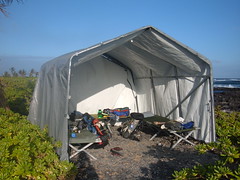
camp at the beach

camp at the beach (Photo credit: muhawi001)


weight back pack versions to ridgid frame “base-camp” versions. My personal interest is in the “base camp” comfort versions (seen along both walls of this “garage tent”).


Cots come in several basic sizes – single, full, and queen are fairly common. You also need to consider weight limits. Cots have recommended weight limits and exceeding those limits can sometimes result in a sudden crash landing. I recommend spending some time on sites like www.Cabelas.com   www.REI.com    www.Walmart.com   www.Target.com  Some of the best prices that I found were actually at Target. Read the fine print and the reviews, and then if possible go look at one in person before you buy.


Next time: Camp Beds – Sleeping Beauty or the Princess and the Pea? – Part 2:  – Something Soft to Sleep On – Purchased Solutions


Enhanced by Zemanta