The Perfect Medieval Palate Cleanser – Succades

If you are a fan of lemon, natural lemon, not any of those strange fake chemical lemon flavors, I have the perfect Medieval palate cleanser and treat for you – succades. A couple of years ago we were involved in the presentation of a Medieval feast as part of our SCA (Society for Creative Anachronism) Yule celebration. It was a Tudor feast, with a fairly large number of dishes and LOTs of meat. We were searching for something yummy, that could be made ahead of time, and be something of a sweeter, lighter, palate cleanser. And there it was in the cookbooks – succades.

Now to the modern individual the concept of eating the peels from lemons may seem a little strange, even yucky. But, if you can imagine this issue from the prospective of a Medieval cook you may begin to understand. The Master of the house has procured a barrel of lemons for the use of the household. Now a barrel is not always the giant size of the metal oil drums that we think of today, but regardless of its size this is a valuable commodity! You use the insides of the fruit as flavoring or ingredients for making lemonade and now you have the skins left. Do you throw them away? Not on your life! They smell great – there must be a way to make them taste great, too! So what do you do to remove bitterness? Boil them! Now one of our modern mavens of domesticity has a recipe for succades that is much quicker and uses an oven for at least a portion of the process. Her recipe will keep for a week or two – the original will keep for months. The original purpose of creating the succades was to use and preserve a precious commodity.

The Original Recipe :   Succade of Lemon Peels from The Treasurie of Commodius Conceites and Hidden Secrets by John Partridge, 1573

To make sucade of peeles of Lemmons First take off your peeles by quarters and seeth them in faire water, from three quartes to three pintes, them take them out, and put to as much more water and seeth them likewise, and doo againe, till the water wherein they are sodden have no bitterness at all of the peeles, then you are ready, now prepare a Sirop [of] the same liquor . . . one pint of rosewater, and for every quart of liquor one half pound of sugar; seethe them againe together on a soft fire of coles till the Sugar bee incorporated with the liquor, then put in your peeles, let them seeth softly till you percieve that your sirop is as thicke as lite honey. Put them in a pot of stone.

Modern Recipe:  Cut the lemons into quarters and use the juice for another purpose. It can be frozen for later use. Most of the pulp of the lemons and the bitter white layer on the inside of the lemon peals needs to be removed. The simplest way to do this is by using a spoon. With a little practice you should be able to remove the pulp and a good bit of the white layer in one piece. Start at one of the points of the peel, hook the spoon under the white layer and peel the white layer and pulp away from the peel.

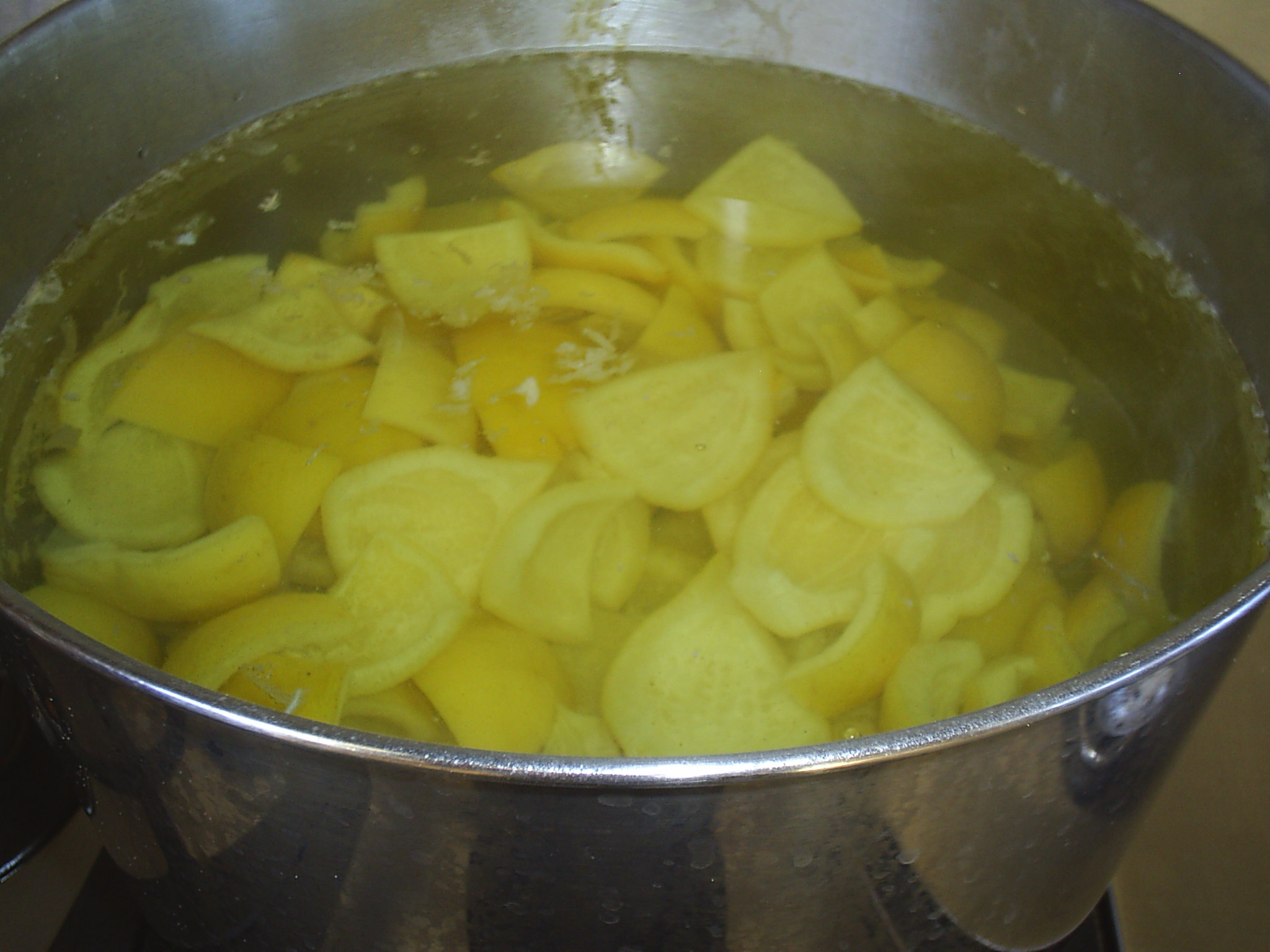
Once the peals are cleaned, they need to be boiled with 4-5 changes of water. It’s important that you start with a large quantity of water and boil until it is reduced by half. When you think the peels have cooked long enough and with enough changes of water, taste the water. If it is still bitter the lemons are NOT ready. Change the water again and boil them longer.

The cleaned lemon peels in their first pot of water. You can see how we cut the peels and how clean the insides of them are – very little white layer.M3361S-3034
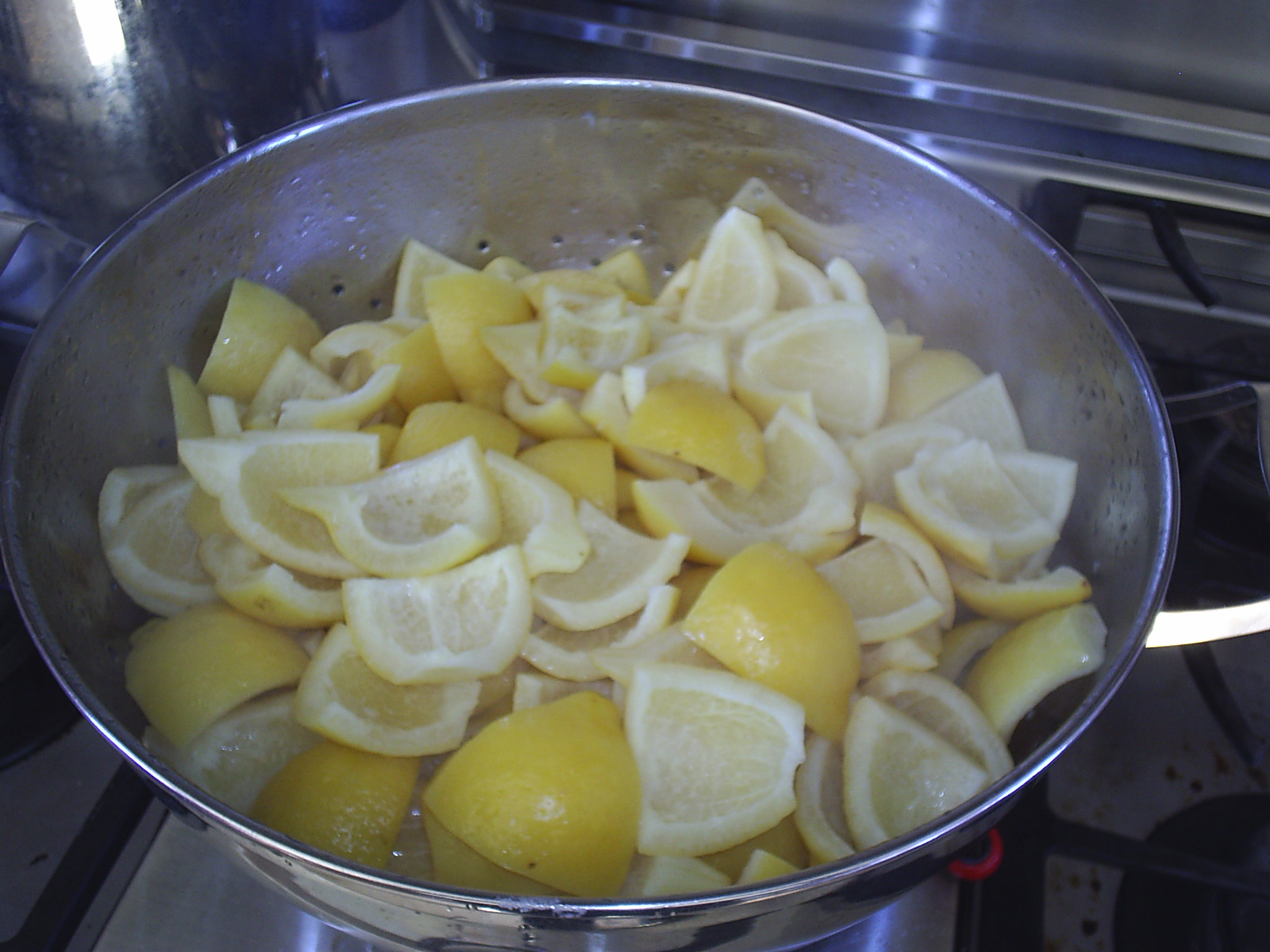
In a colander in between batches of water. The lemon peels are beginning to become more translucent.
M3361S-3034

To candy the peels, pour off the last batch of boiling water. Replace with enough water to barely go over the top of the peels. Add sugar enough to make a light syrup – it is hard to give exact amounts because we have NO idea how many lemon peels you have. When we made these for the feast we did it on the scale of a small industry – buying 20 pound bags of lemons and processing them all for juice (we served fresh lemonade) and succades. Simmer until the sugar/water mixture achieves a medium weight of syrup. Remove the peels from the pot and place over a wax paper on a rack to cool – I recommend using tongs – the sugar syrup is REALLY not. Do NOT leave the pot unattended once the level of syrup in the pot gets low. Sugar can burn and once it is burned the only solution is to start over.

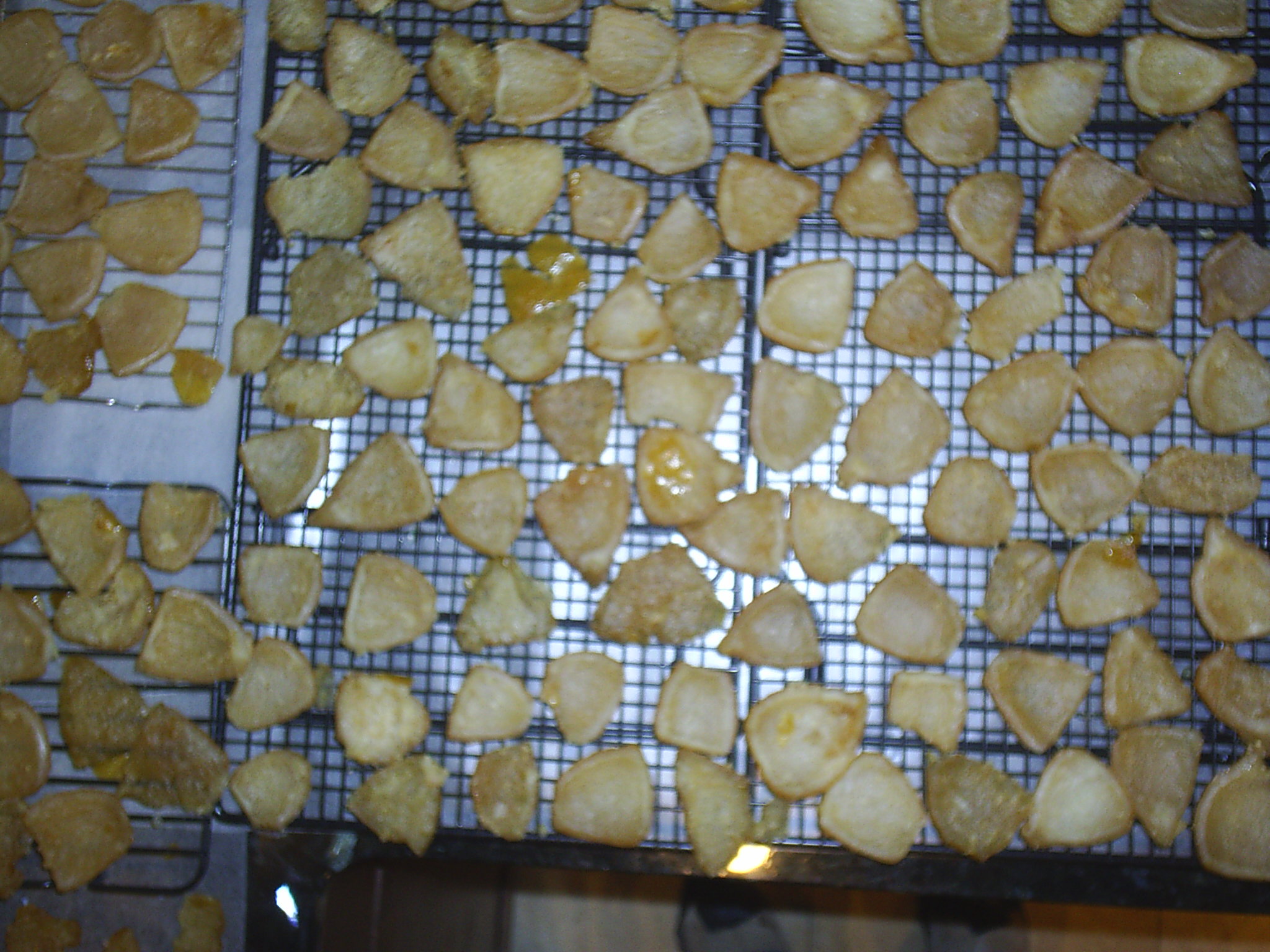
Here is a picture of some of our racks full of drying succades.
M3361S-3034

Once the peels have dried, layer them in a jar with sugar. Cover loosely. Let stand for 3-5 days. Serve. The “scraps” of lemon “jam” in the bottom of the pot can either be used as jam or rolled in sugar and served as lemon candy. If you roll them in sugar, allow them to dry overnight before you pack them in more sugar in jars. They will resemble the “fruit jelly” candies that you can buy, only they will taste waaay better. If you wish to use the jam as jam – it is really good on toast or with shortbread.

I hope that you will give this process a try. It takes several hours, but does not require a large amount of attention until the final stages of candying. I usually just set the timer and check the water level every fifteen minutes while the lemons are cooking. Our family has added this item to our lists of Medieval “goodies” to take to potlucks and they always disappear rather quickly.
Annular and Penannular Brooches

Annular, Penannular, Ring, and Open Ring Brooches? What the heck are they talking about? All I want is something that works! How many times have I heard comments like those? Lots! But let’s try to unravel the confusion – it really isn’t that complicated. Why bother? I like knowing the correct names of things, but more important, if you ever want to do research on these sorts of brooches, you need to know what to call them when you go to the web or the index of a book.

As with many historical items, these types of brooches have two sets of names, based at least partially on where the writer lives in the world. In Europe, and among some American academics, they are called Ring Brooches and Open Ring Brooches. Others, mostly in America, choose to call Ring Brooches – Annular Brooches, and Open Ring Brooches – Penannular Brooches. According to Harold Newman, in “An Illustrated Dictionary of Jewelry” Penannular Pin Brooches must have “a long pin whose length is at least double the diameter of the circle.” My personal research has not found any sort of consistency among authorities in the use of these terms. For the sake of simplicity, I’ll use the terms Ring Brooch and Open Ring Brooch– as they are fairly straight forward descriptive terms that can help eliminate confusion.

So what do they look like? Well a Ring Brooch is simply a solid ring with a pin and an Open Ring Brooch is just a giant almost closed “c” shape with a pin. But more on that later!

History

According to the Metropolitan Museum of Art the Open Ring Brooch was developed by the Iron Age Celts of Britain. The gap between the two sides of the brooch gradually became smaller, was then filled with a bar. The bar widened to become a complete ring and the Ring Brooch developed. Whether this is completely accurate or not, the open ring brooch can be reliably dated to at least the 1st century BC and ring brooches to at least 3 AD.

 What were Ring and Open Ring Brooches Used For?

…Just about anything that we would use a button for – like closing the neck opening of a tunic, or holding a cloak closed. I know people who use them to close their shawls or brats, and modernly fancy versions are sold to hold women’s knit lace shawls closed. Archaeologists find large numbers of tiny (less than 1 inch in diameter) Ring brooches during the 15th and 16th centuries. It is believed that they were used to attach portions of the undergarments and layers of clothing together. It’s particularly common to find one on each leg for men – to attach the hose to the under drawers. Ring Brooches lie very flat and would not open by themselves.

In addition to practical uses as closures, these brooches were often used purely for decoration. There are many thousands of decorative Ring and Open Ring brooches. The materials and level of decoration on these brooches ranges from simple cast lead or tin brooches, made in the style of pilgrim’s badges, to solid gold enameled and engraved brooches of the highest quality and craftsmanship. There are, of course, also many intermediate level brooches – simple silver brooches with cast, stamped or engraved designs. These brooches often included inscriptions on the back that were designed to protect the wearer. These inscriptions could be used in their full form, or in the form of abbreviations. One commonly used example of this type of inscription are the words “Ave Maria Gracia Plena” – the “Ave Maria” of the rosary – abbreviated as A M G P. The names of the three Magi – Caspar, Melchior, and Balthasar, were also considered to be very prophylactic. This inscription is often found in the form C M B. The letters in either abbreviation may be left with simple spaces between them or separated by dots or asterisks – as in the following example:  *A*M*G*P*.

Using Your Ring and Open Ring Brooches

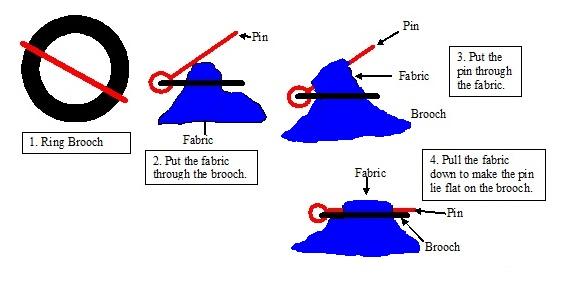
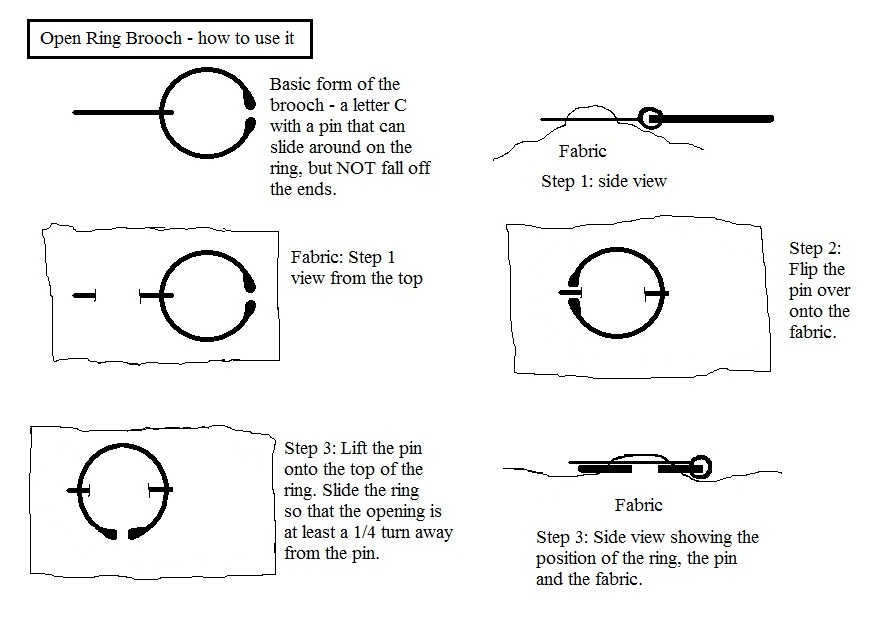
Ring and Open Ring brooches come in many shapes, but the principal behind the use of all of the shapes is the same. A Ring brooch forms a complete ring – therefore the fabric must be pulled up through the center of the brooch before the pin can be inserted through the fabric. The Open Ring brooch has a break in its outside ring, which means that the pin is inserted through the fabric before the end of the pin is placed up on the ring.

Annular brooches

Penannular brooches

penannular brooches

This is an example of just a few of the sizes and forms that basic Open Ring Brooches come in.

This example of a Ring Brooch is in the form of a heart. Ring, simply means a closed ring, but the ring does NOT have to be round.

Etsy 183

I hope that this helps give you a better understanding of Ring and Open Ring and Annular and Penannular Brooches, and how they work!

Simple Subtleties to Spice up a Medieval Feast

First of all what is a subtlety? A subtlety is a special dish. It is often a charade – something that looks like something else… something that is designed to delight the observer… sometimes something that is not even intended to be eaten.

As a child I remember learning a little song:

Sing a song of Sixpence,

A pocket full of Rye,

Four and Twenty Blackbirds baked in a pie,

When the Pie was opened the Birds began to sing

Now wasn’t that a Dainty Dish to set before the King.

But what does this have to do with real food? Well this sort of presentation was a real part of top-of-the-line Medieval Feasts. The feast was not only supposed to feed you, it was also designed to delight and amaze, and show how truly important the host was. In order to accomplish this some amazing things were done. Was there ever a pie with blackbirds? Probably. A special crust would be baked – a bottom container and a lid to go on top. When it was time to serve the dish, live creatures, usually something like birds or frogs, could be safely placed into the bottom half of the crust, the lid put on and the pie served. When the lid was removed, the guests, anticipating some sort of meat pie, would be surprised and delighted by the live creatures emerging, like magic, from a freshly baked pie. Not very subtle by modern standards, but highly appreciated during Medieval times.

Having read of some of the elaborate contrivances that were presented, and not desiring to risk any of the issues associated with live creatures, I was concerned about my ability to present something fun and unusual for a Tudor feast. I had the pleasure, a couple of years ago, of seeing a rather large castle sublety in the Arts and Sciences display at the Pennsic War in Slippery Rock, PA. The castle was built to scale out of individual shortbread bricks, glued together with something edible. It was stunning, but I knew that I did not have the time or resources to construct something that large or difficult to transport. My goal was something small and unique and easily transported. I had access to sugared violets, and I had made sugar paste confections and plates before, so my solution was a natural one. The Tudor feast was part of a Yule event, held in the higher elevations of northern Arizona in early December. What a more perfect interlude for the feast that to announce the miracle of spring brought forth in the middle of winter!

Sugar, being relatively expensive during Medieval times, was often used in ostentatious displays of wealth during feasts. So I used a significant amount of sugar to produce sugar paste. The recipe that I used came from The Good Housewife’s Jewel by Thomas Dawson, 1597. The original recipe follows.

*************************************

To Make a Paste of Sugar, where of a man may make all manner of fruits and other fine things with their form, as plates, dishes, cups, and suchlike things, wherewith you may furnish a table.

Take gum and dragant, as much as you will, and steep it in rose water till it be mollified. For four ounces of sugar take of it the bigness of a bean; the juice of lemons, a walnut shell full, and a little of the white of an egg. But you must first take the gum, and beat it so much with a pestle in a brazen mortar till it become like water. Then put to it the juice with the white of an egg, incorporating all these well together. This done, take four ounces of fine white sugar, well beaten to a powder, and cast it into the said mortar by little and little, until they be turned into the form of paste. Then take out of the mortar and bray in upon the powder of sugar, as if it were meal or flour, until it be like soft paste; to the end you may turn it and fashion it which way you will.

When you have brought your paste to this form, spread it abroad upon great or small leaves, as you shall think it good. So shall you form or make what things you will, as is aforesaid, with such fine knacks as may serve a table, taking heed there stand no hot thing nigh it.

At the end of the banquet they may eat all, and break the platters, dishes, glasses cups, and all other things, for this paste is very delicate and savorous. If you will make a thing of more finess than this, make a tart of almonds stamped with sugar and rose water, of like sort that marchpanes be made of. This shall you lay between two pastes of such vessels or fruits, or some other things, as you think good.

***************************************************

Modern Recipe

½  teaspoon gum tragacanth
1 tablespoon rosewater or other flavoring, peppermint works well for the modern palate
2 teaspoons lemon juice

½ egg white (use pasteurized egg white for safety)
up to 1 lb. powdered sugar

Combine the gum tragacanth and flavoring in a bowl and mix until it becomes a runny paste. Add the lemon juice, the egg white and any food color that you desire until smooth. You may want to add a little hot water (a TBS or two) if your paste is not smooth, or if it seems too thick. Gradually add as much sugar as needed to make a smooth, kneadable dough. Sugar paste lightens in color as it dries, so make the dough a bit darker than the final color that you want. After the paste has been kneaded wrap it tightly in plastic wrap and let it rest for at least ten minutes. When you work with the paste remove only as much as you need and keep the remainder well wrapped to keep it from drying out. The paste can be cut with cookie cutters, or molded in molds or by hand.  Dry on parchment paper, or a drying rack. Turn occasionally as they dry. Drying time will depend on the thickness of the piece and the humidity in the air. Make extra pieces – they often break during handling or transport. Also allow a couple of weeks for the item to dry – some pieces can be particularly stubborn. You can use purchased gum paste from a cake supply store, but it does not taste as good as the real thing.

*****************************************************************

Many original sugar paste recipes use rose water as a flavoring. Unfortunately for many modern people rose water reminds them of soap, so I bowed to modern tastes and used peppermint oil instead.

Candied Flowers

The Holy Roman Emperor Frederick II issued an order to his courtiers to have sugared violets prepared (1239), but no recipe is given, because, of course, they knew how to do it. Some versions of Hugh Platt’s “Plyne delites” say that dareioles (custard tart) may be decorated with sugared violets but they give no recipe. There was one recipe from slightly after 1600.

*****************************************************************

From “The Queen-like Closet” or “Rich Cabinet”, Hannah Wooley, 1670
149. To keep Flowers all the Year.

Take any sort of pretty Flowers you can get, and have in readiness some Rosewater made very slippery by laying Gum Arabick therein.

Dip your Flowers very well, and swing it out again, and stick them in a sieve to dry in the Sun, some other of them you may dust over with fine Flower, and some with searced Sugar, after you have wetted them, and so dry them.

Either of them will be very fine, but those with Sugar will not keep so well as the other; they are good to set forth Banquets, and to garnish Dishes, and will look very fresh, and have their right smell.

Modern Recipe

Edible Flower blossoms (we used Violets)

1 –2 egg whites (or about ¼ cup of the pasteurized variety)

Extra fine white sugar

Clean artist’s brush (tiny)

Parchment paper

Paper Towels

Pick the best looking blooms that you can find, leaving a couple of inches of stem as a handle. The flowers must be clean and not sprayed with ANY chemicals. Wash them gently in cool water and dry gently with paper towels. Place some of the sugar on a clean plate. Beat the egg whites until they have become slightly frothy and, using the clean paint brush, coat the entire flower blossom with egg white. Do NOT dip the flower in the egg white, it will pick up too much egg-white and it will not dry properly. Lay the “painted” flower on the sugar covered plate and sprinkle on more sugar until every petal is covered. Gently shake off any extra sugar. Place the flower on a piece of parchment and cut the stem short. Allow the flower to dry completely and then place in an airtight container. The flowers will keep for several weeks. They retain an amazing amount of their color if you store them out of the sun, and they taste good, too!

*********************************************************************
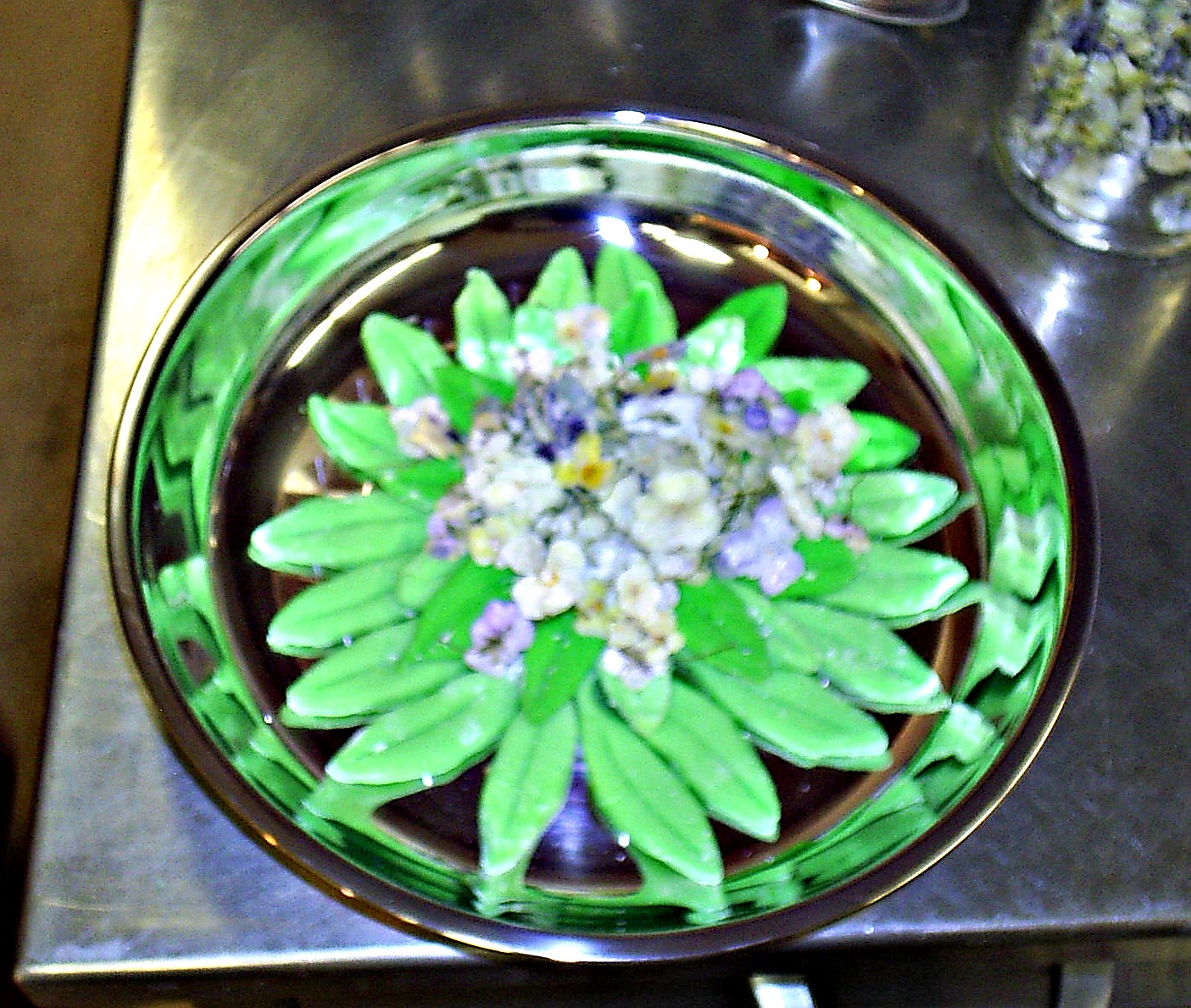
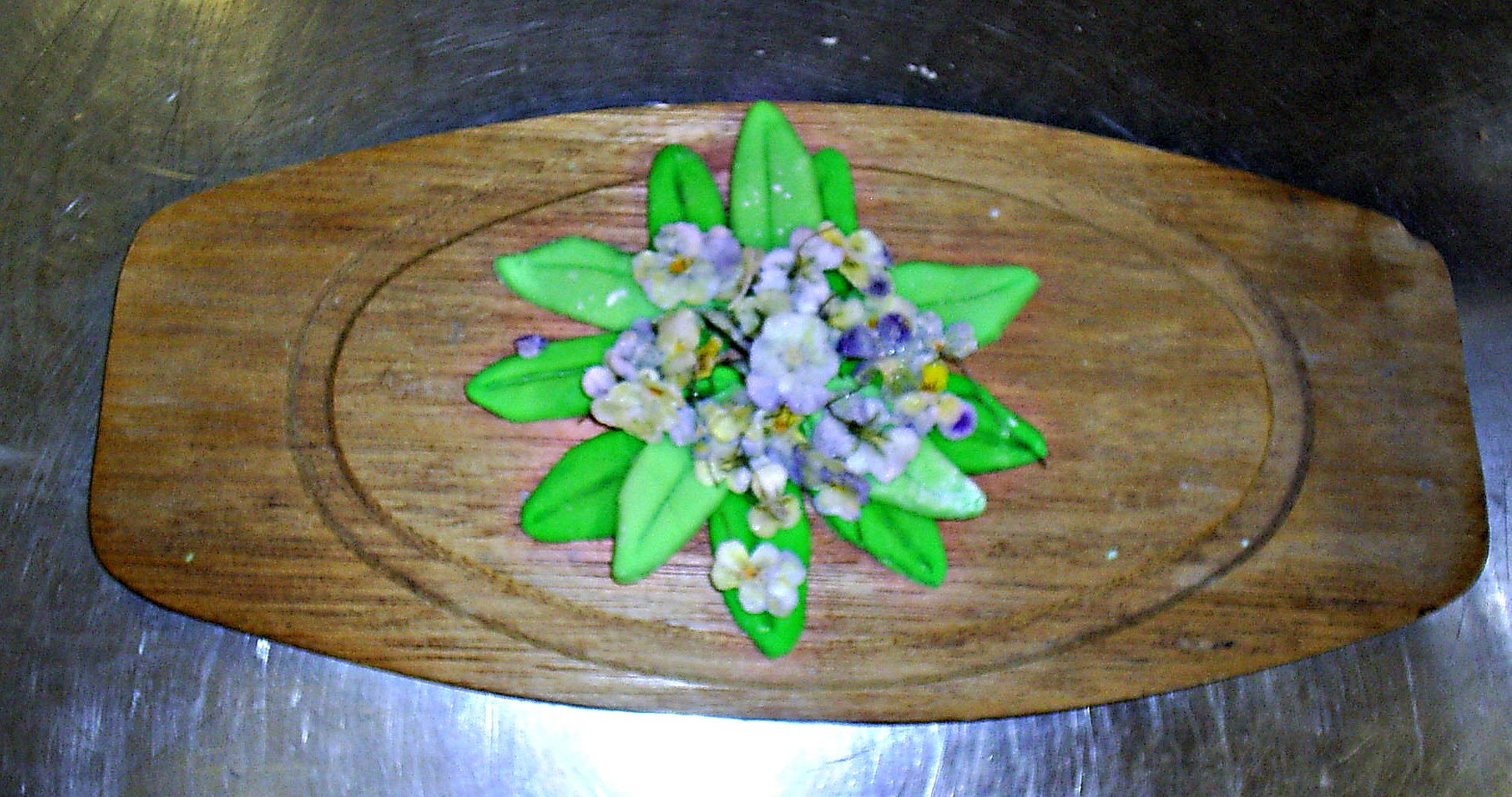
Each table was presented with a plate. On the plate was a rosette of green leaves, and in the center of the green leaves was a small pile of sugared flowers. The violets have a faintly flowery taste, and the green leaves tasted like peppermint!

The head table received a large “bouquet”.

M3361S-3034

While the regular tables received wooden trenchers with smaller bouquets.

M3361S-3034

The vast majority of the people at the feast had never eaten flowers, much less sugared flowers, and the peppermint flavored leaves were consumed with delight.

SUCCESS!