
Why Should I go to a “Great War”?

Many people that I know in the Society for Creative Anachronism (SCA) only go to local events. For some it is a choice based completely on finances, the quality of their car, and the amount of time that they can get off from work. But for others it is just a lack of interest.

The kingdom that I currently live in, Atenveldt, is my third kingdom. I started my SCA journey in the East, lived in the West for many years, and only later moved to Atenveldt. My collection of “great wars” includes Pennsic War in PA, Great Western War in CA, Gulf War in MS, and Estrella War in AZ. And I have been to many “second tier” events such as Battlemore and Potrero War.

Fighters practising at Gulf Wars XIII (2004)

Fighters practising at Gulf Wars XIII (2004) (Photo credit: Wikipedia)

I sometimes hear the statement, “Why should I bother to go that far? I can have just as much fun closer to home.” Well, there is no doubt about having fun close to home. Fun is generally an important part of the reason that we play this game in the first place. But going to a great war can really change your perspective on the game.

I had only been playing in the SCA for about six months when my husband and I packed up and drove 14 hours to go to Pennsic with our local group. Fourteen hours. And that is nothing compared to our friends from Canada who drive 24 hours to attend Pennsic. And people wonder why I have a low tolerance for folks who refuse to drive an extra hour to attend an event …

The first year that we attended Pennsic we only went for one of the two weeks, but it was AMAZING! There were more classes than I had ever imagined, including classes on Rapier and Heavy Fighting techniques, the basics of making your own archery equipment, costuming, and a zillion different crafts techniques. And that brings up another issue, if the war is longer you can settle in, and still have LOTS of time to do a bunch of different things – fighting AND Arts and Sciences, Rapier AND Archery. Why choose, when you can do it all?!?!

The battles at Pennsic were monumental, with entire groups in matching armor and tabards. The bands of Celtic fighters, marching to the field singing with small herds of women and children banging drums behind them. The Japanese units in full Samurai armor, and the Roman legions, complete with helms, armor and shields.
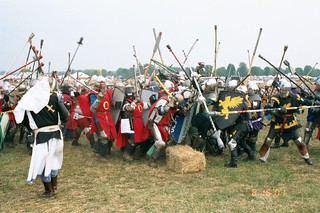
Pennsic XXX . c

Pennsic XXX . c (Photo credit: danielle_blue)

In short, it was amazing, exciting, and inspiring. Even more important, it made me realize just how many legitimate games there are available to be played within the Society. Dramatically different levels of costuming, fighting, archery… you name it. European Dance performed to a live band. Middle Eastern Dance performed to a live band, with stringed and wind instruments, not just a drummer.

It is all out there for our enjoyment, but sometimes we need to leave our own backyards in order to truly experience it. In the western US there is West Antir War, Great Western War and Estrella War. In the eastern US there is Pennsic War, Lilies War, and Gulf Wars. And once you have been to one great war, go to another in a different part of the US. Dare to step outside your own local area- you might be amazed at what you discover!

Enhanced by Zemanta

So Where did You get Your Information on the Web? Part 2: Specific Sites

Last time we talked a little about doing general searches. These sorts of searches are good for gaining a better understanding of basic topics. But what if you need really specific information? Much of my research is limited to historical artifacts, recipes, metal working and glass working, and gardening. Nothing like a little variety.

Each topic will have “specialty websites” that do a good job on that topic. For historical artifacts I have a favorite collection of museums with good online searchable databases.

Metropolitan Museum of Art 

Victoria and Albert Museum

British Museum

Freer/Sackler Galleries at the Smithsonian (Asian Art – which includes portions of the Middle East)

Swedish National Museum

And then there is a database in England for all of the metal detector and occasional finds – The Portable Antiquities Scheme.

Egyptian, first half of Dynasty 12, 1981 - 188...

Egyptian, first half of Dynasty 12, 1981 – 1885 BC. Famous blue faience hippopotamus statuette which is an informal mascot of the Metropolitan Museum of Art. (Photo credit: Wikipedia)

When I am looking for special recipes my first stop is usually the Food network. I have a particular affinity for recipes by Alton Brown, but since I am familiar with many of the personalities on the food network I also have a sense for who else I might to search for.

I get the newsletter from Cooking.com, but to be honest I probably save about one out of 100 recipes, at the most. If you enjoy making things using pre-made biscuits and such this may be a great choice for you. I am generally looking for “from scratch” recipes, partially because of food sensitivities.

Don’t forget Pinterest when you are looking for recipes! I mentioned it last time, but I should reemphasize that a HUGE number of people trade and share recipes on this site. I was able to find some very specialized Indonesian/Dutch recipes there that I simply could not find anywhere else.

Another one of my favorite areas of research is metalworking. Generally I will go to a reference book for most of this information, but every once in a while I need something new. One of my suppliers, Rio Grande Jewelry Supply has a considerable number of basic charts of information on their website. Rio also has a You tube Channel with all sorts of how-to videos. Another source for all sorts of jewelry information is Ganoksin.com You can search this website for almost every topic from workbench safety to enameling and soldering.

Glass working is another one of my favorite research areas. The best glass museum that I have found is the Corning Museum of Glass in Corning NY. In addition to the actual museum database, which they are constantly working to improve, the museum is also a working glass studio with all sorts of glass topics. There are videos and live streaming opportunities available.

English: Photograph of William Willet's “Dante...

English: Photograph of William Willet’s “Dante and Beatrice” c. 1913-1920. On exhibit at the Corning Museum of Glass, Corning, NY (Photo credit: Wikipedia)

Gardening is a very broad topic, but for serious scientific articles on pest control, or plant pathology I go to the U.C. Davis Integrated Pest Management site, or the U.C. Davis publications and videos site. This site sells books, several of which I own, but they also have LOTS of free publications that you can download.

For more home gardener oriented information I often go to Mother Earth News for information. Some of the seed companies, like Johnny’s Select Seeds, have excellent growing guides and videos.

I hope this brief discussion of good websites is helpful. If you are interested in specific areas of research, please drop me a note and I will be glad to share any information that I have in a future blog.

Enhanced by Zemanta

So Where do You get Your Information on the Web? Part 1: Simple Searches

So Where do You get Your Information on the Web?

I hear this question ALL the time. People are amazed at the details that I can find on the web.

Now I am not a genius, but the amount of research that I have done over the last twenty years does aid in the process. You can also get good results by being systematic. The Internet isn’t everything! I also have an extensive library of real honest-to-god books at home, but sometimes it is just not enough. A customer will often approach me with an idea for jewelry or a dress accessory. Other times they want something that they have seen someone wearing and ask me to make it. Now obviously if it is a fantasy piece I really don’t need to do much research, unless they want me to incorporate some specific symbolism in the piece. But if the piece is supposed to resemble, or copy, a historic piece, then I usually need to do some research.

So where do I start? Google it! No, I am not kidding. A lot of really good information will come up and plenty of garbage, too. The quality of most of the information becomes easy to spot as you become more familiar with the topic. www.google.com

If you really don’t know anything about a topic go to www.Wikipedia.com and do a search there. I think of Wikipedia as an encyclopedia. If you are old enough to remember how cool it was to be able to browse in a REAL encyclopedia, then you should realize that encyclopedias are not always accurate. Well, neither is Wikipedia, but it often has enough good information for you to be able to learn enough to do better quality research. And some of the articles there really ARE incredibly accurate and detailed. Even if the article that you read is not perfect, it will probably give you enough information to do a more detailed search.

So, say I am looking for a picture. I once spent over three hours online looking for a picture of a lesser known painting by a specific Spanish Renaissance artist. Where did I finally locate a photo of the picture? Google Images. The museum where the painting is on display did not have a picture online, but Google Images did. I have learned the hard way to go to them early in my search. They often have links to really good websites, like museums or academic sites, where there is an article about the picture.

Image representing Google Images as depicted i...

Image via CrunchBase

How about letting other people do some of your work for you? Pinterest is the place for that. There are literally thousands of people on Pinterest. Many people use their boards to collect very specific information on very specific topics. You say that you are interested in Historic Slavic Costuming? Or Metal Casting? Or Japanese Gardens? Or Recipes? Not a problem! You will find these and much more on Pinterest. I even use Pinterest to actively share recipes with my daughter.

English: Red Pinterest logo

English: Red Pinterest logo (Photo credit: Wikipedia)

While there are many other locations to find things on the web, I hope this blog helps you find more of what you are looking for!

Next time: Specific websites that I use for research.


Enhanced by Zemanta