But What Do I Do With Those Dress Pins?

For anyone who follows me on Facebook, my Etsy shop, or in my actual shop, you probably already know that one of my big selling items is dress pins. I have been getting enough questions about these pins lately that I decided it was time to write another blog about them. I originally wrote a basic blog about dress pins a couple of years ago, called Pins, Pins and More Pins, and another called Authentic Dress Pins about the fact that we make spiral headed dress pins.

Now I do make the early period dress pins that are three to five inches long – the kind that are usually used to clothes shawls and brats and such. But right now I am talking about the small wire spiral headed dress pins that appear in the archaeological record in the 1200’s and are made the same exact way solidly into the Victorian era.

For those who may not be certain exactly what I am talking about, here is a picture of the two sizes of dress pins that I sell in my shop. In pre-1600 Europe they came in a virtually infinite selection of sizes, from really short (about 3/4 of an inch) to ridiculously long (three or four inches long), but these two sizes seem to work for most people.
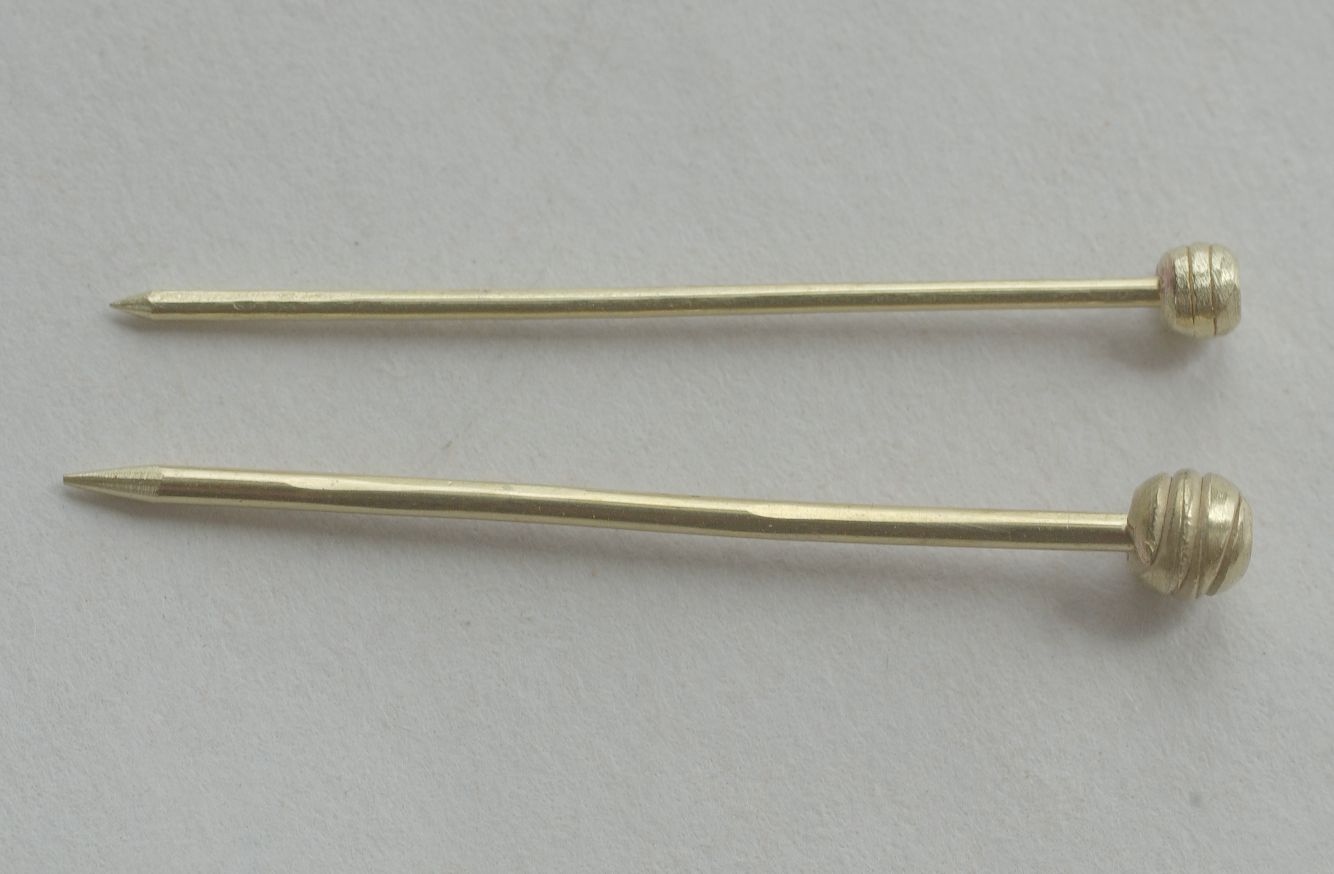
two pinsAnd here is a link to some pre-1600 pins that were found in Great Britain. They find thousands of these all over Europe.

So the most common question that I am asked is, “what are they used for?” And my semi-wise-guy answer is: holding your clothes together. This is actually an understatement, since they are used for holding clothing, hats, veils, and just about any other dress accessory that you can think of in place.

How do we know what pins were actually used for? Well, they show up in inventories, but they also show up in a fair number of paintings and portraits. The earliest portrait that I could find is dated to about 1410 – A Portrait of a Lady. If you zoom in on her head coverings there is no attempt to disguise the use of pins to hold everything in place.

I should mention, that several people have told me that men also used these dress pins to hold their clothing in place. I have not spent a lot of time actually looking for pins in men’s portraits, but so far I have not found any. This does not, of course mean that they did not use pins, only that they did not either show, or that the artists did not paint the pins into the portraits.

The Portrait of Marie de Pacy (1425) also clearly shows the use of pins, a fancy one in the middle and many smaller pins on other parts of her headcovering.

The Master of Flémalle painted the Merode Alterpiece in 1427 and this detail of the left wing of the alterpiece shows a woman with several pins in her headpiece. A couple of years later he painted a Portrait of a Woman (1430) which shows several pins being used to hold a lady’s complex, multi-layered veil system in place.

Next time we will look at a couple of very prolific artists and some of the things that they showed pins being used for!

What Size Were Brooches in the Middle Ages – Part 13 – What other things were little?

Well, this is back to where this series originally started out – looking at tiny brooches and buckles and other things. Ideally I would have planned out the entire series, written all the installments and then just published them, one at a time. The reality is that I wrote one installment and then started reacting to questions and comments that I received from readers. So it may have not been a literary gem, but my goal was to answer questions. And I think that I have been doing that. Perhaps I have encouraged people to pay more attention to the historical facts, at least as we know them, instead of just accepting modern mythology. We have fashion, availability of materials, and the size of the people to thank for some of the size issues. But functionality is also a consideration.

I learned to do tablet weaving quite a number of years ago, and my original cards were a solid four inches square. Huge cardboard squares the size of bar drink coasters, with 1/4 inch holes in all four corners. Years later, my cards are 2 1/2 inches square and they are still larger than many of the real pre-1600’s weaving cards that I have seen.

To me, learning to tablet weave was a very cool thing. An opportunity to be creative and make something the same way it was made hundreds, or even thousands of years ago. And then I saw these videos – videos of women had learned to do the same sort of crafts that I was learning. Except that they had been doing it for decades – not as a fun hobby thing, but because they actually needed to make things for everyday use. There are a bunch of these movies out there, on You Tube, under the search term “Norsk Stumfilm”. They show women and men, filmed in the 1940s, doing some of the crafts that I do for fun. This one, called bandvev, shows several techniques for weaving bands and cords. They are black and white, and have no sound, but they were designed to show the actual hand movements of the women. They actually slow down the film for us so that we can see the hand movements.

Some of the equipment is small and some larger. The last woman does what I was taught to do as a Viking Cord. I learned to do it using two people. By using four very large weighted bobbins, she can do it by herself. Yes, I will be looking into this. While the technique that I was taught is a great project for children, or for forcing adults to cooperate with each other on a productive task, I always had a hard time believing that they would actually have made the cord that way.

And then there is this lady. This is a new color video that was made in Sweden to show an old technique for weaving bands quickly on an Inkle style loom. Again her hand movements are slowed down in order for us to be able to see what she is doing. Her bobbin is just large enough to hold the weft thread and the weaving knife that she uses is of a modest size.

And the point of all of this? Do not assume that just because we use something in a specific size modernly, that it was the same size before 1600. Do not assume that all things before 1600 were large, or small, or standardized in size in any way (they may vary greatly in size from time to time and place to place). And whatever you do, do NOT assume that because it is “traditional”, or because you saw it at a Renn Faire, it is correct for the timeframe before 1600. Go forth and do research!

frühmittelalterliches Webbrettchen (Augsburg, ...

frühmittelalterliches Webbrettchen (Augsburg, Inneres Pfaffengässchen) (Photo credit: Wikipedia)

What Size Were Brooches in the Middle Ages – Part 12 – Figuring out Earlier Cultures

So last time we asked the question – but what about earlier time frames? What can we do to understand cultures like the Romans and the Vikings?

To be blunt, the less figurative art that we have (art with actual life-like representations), the harder it is to be completely confident of our interpretations. Cultures like Rome, Greece, and Egypt, despite having existed a very long time ago, actually left an amazing collection of sculpture, frescoes, paintings, and mosaics.

An excellent example of using this sort of information to help us understand a culture, is the Camomile Street Soldier. I found a single line reference in a book about this being a source of information on the use of buttons in Roman Great Britain. So I Googled it. I quickly discovered that it was a carving that is believed to have been part of a frieze on a tomb. This sculpture clearly shows the clothing of a soldier. I found a small collection of pictures of the carving. You can see the buttons on the front of his tunic, as well as how he wore his sword and how his belt was decorated. In addition, through the generosity of the internet, you can read J.E. Price’s original report on the discovery.

And you can read a follow-up report that reevaluates the frieze in modern terms.

All from one search based on a single reference in a book. Now obviously this was a lucky find.

But sometimes we make our own luck.

The Egyptian tombs had wonderful paintings in them. The Roman frescoes in Pompeii and Herculaneum are legendary for their details. If the culture that you are interested in does not have any surviving carvings or paintings with that level of detail, look at archaeological reports. Join academia.edu (FREE) and start reading the articles that are posted there. You can even set up your preferences so that every time an article is posted in one of your areas of interest, you are notified. Many theses and dissertations will do all of the extensive research that is necessary to interpret the archaeology that is available. Don’t be afraid to let someone else help you do your research – just always approach any research with at least a little healthy skepticism.

Many of the earliest large burials were very poorly excavated by treasure hunting antiquarians, but occasionally we find someone, like Johann Karl Bähr, whose original training was as an artist. He recorded every inhumation grave that he excavated in extreme detail. Unfortunately, his records were for Livian graves, not Vikings, but records like these can provide us with insights into cultures that did not leave good pictures of their members.

Professor Bӓhr’s work is also a good example of a problematical area of study – Vikings vs. Scandinavians vs. Finno-Ugaric cultures. Now this could be a blog series all by itself, but my point is that the Vikings were not a unified culture. They were a generalized group of people who started out in Norway, Denmark, Sweden, and northern Germany and spoke the same language – Old Norse. Each area had different influences – the Hanseatic League, the Finno-Ugaric cultures, the Slavs…and different levels of access to imported goods. I would expect the different groups to have dressed and looked differently, with different dress accessories and styles.

But going back to our original theme – what other things are little? More next time!

Territories and voyages of the Vikings

Territories and voyages of the Vikings (Photo credit: Wikipedia)