Would You Know a Fertility Symbol if it Bit You?

This topic might not be something that many of us think about much in our modern existence, but it is an important concept for those who study pre-1600 civilizations. And to be honest, it can be pretty interesting to investigate. There are probably literally thousands of different fertility symbols, but I feel that people should at least be aware of some of the more obvious ones and understand why they were so important. If you are offended by mater-of-fact discussions of body parts and sexuality, this would probably be a good place for you to stop reading.

Some fertility symbols, like goddesses, vulvae, and phalli are pretty obvious. It always makes me laugh when people ask about something that I am selling in my shop, and when I explain that it is a fertility symbol, they respond with something like “Oh, I don’t need any fertility in my life!” Really? You don’t want a raise at work, and un-expected gift, or a winning lottery ticket?

Modernly many people often think of fertility purely as animal reproduction, but in a culture based on natural resources, which most pre-1600’s cultures were, the best thing that could possibly happen was fertility. Without fertility there was no grain for people and animals, no fish to dry for the winter, no animal offspring, and starvation. In a pre-modern society there was no international aid organization to rescue your group if the crops failed.

And people understood where fertility came from – sex! So the exaggerated female form, the vulva, the penis, and testicles were natural representations of a desire for fertility. Good crops, a good sailing voyage, a good trading expedition, even a battle that was won, were all viewed as fertility.

The Roman legionnaires wore an interesting assortment of decorations that were shaped like penises and testicles on their gear. Some of them were very realistic and three-dimensional, but others were much simpler. This is an example of a Roman strap end.

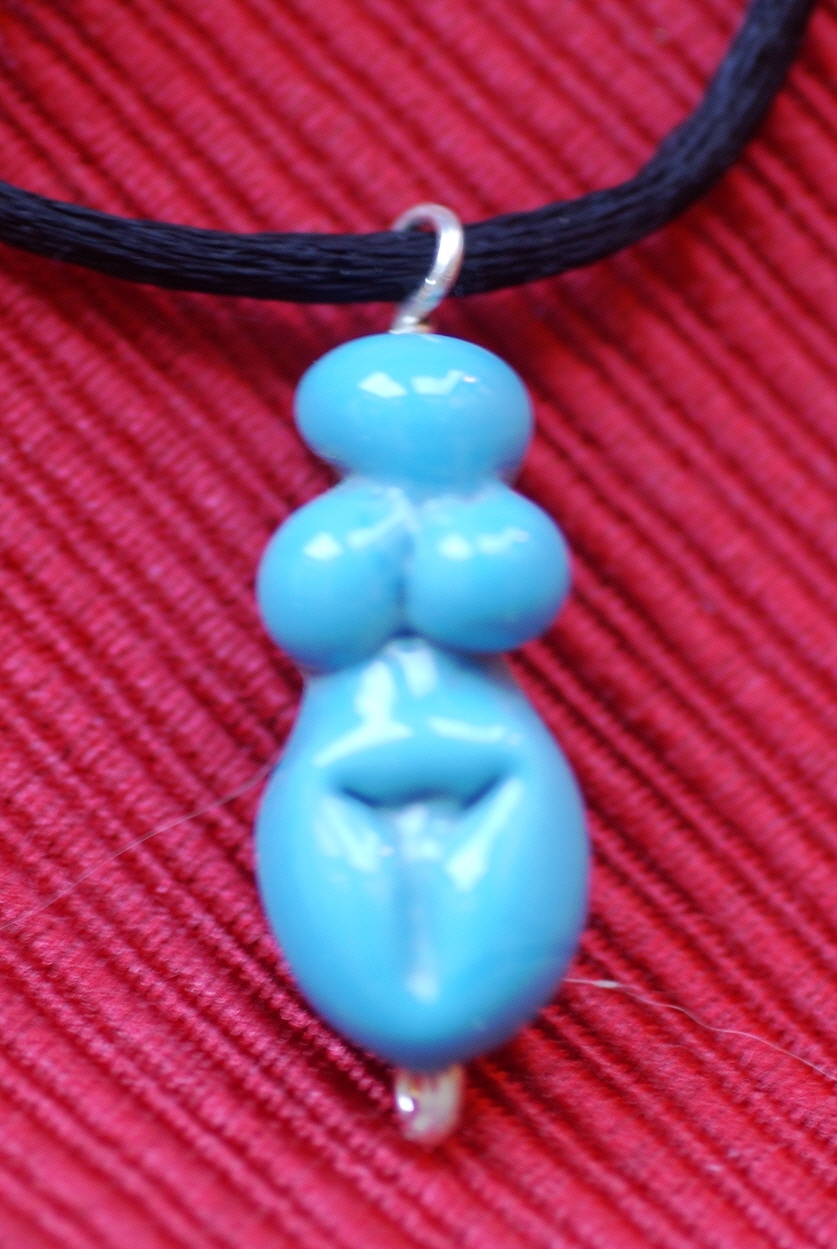
Roman Phallic pendantI am also perpetually amused by the “prude factor” in modern society. In a culture where everything from beer, to toothpaste, to cars, uses sex to sell their products, the matter of fact presence of a penis, or other sex organ totally freaks some people out. When I started making glass goddesses to sell in my shop, I actually had parents refuse to let their children in my shop because of the goddesses being there. A couple told me that they just didn’t want to have to explain them to their children. Now as this picture demonstrates, my goddesses are not exactly graphic content. I still sell them, along will any glass crosses, or phalli that I make, up on the counter, so that young children can’t easily see them.
etsy 76 close

So what else is out there that you might have missed? We will talk about that next time.

A Day of Decadent Research – A View Backwards in Time

The other day I got lost on the internet. Well, not really lost, just sort of tucked away into some sort of strange time warp. This started as a research project, of course. I had gone on a quest for portraits that showed dress pins in use in women’s clothing. Projects like this can take hours as each picture is downloaded and scanned visually for any likely pins. But the project became much more.

I went to the Web Gallery of Art. Now this website collects pictures of art from all over Europe and makes it available for people to see, purchase prints, or send as postcards. It can be very dangerous location for me because it is easy to just start browsing. It is also unique because it covers such a broad range of time and has such a huge number of pieces of art. But this time I was determined to take a particular approach, and I did.

The search functions on the website allow the user to search by medium: painting, sculpture, etc., artist, dates, school of art, and many other things. I choose to look for portraits, beginning in the 1300’s. The search function works in fifty year blocks, so I was able, for instance, to tell the search engine to show me all of the paintings that were portraits, from any location or school, for the years 1301 through 1350. I would scan down the thumbnails of paintings that the computer presented me with, and choose which picture to look at in greater detail. If I spotted something that interested me, a simple click would present me with a large zoomable view.

Now I have gone to this website many times, usually on a quest for the work of some specific artist. But I am not sure that I had ever stepped through half centuries systematically before.

The results? I was fascinated. Not only was I looking at a panorama of faces, frozen in time, but I was seeing a snapshot of what they wanted to look like at their best. We know that some of the late Renaissance artists painted multiple portraits using the same dress – sort of a studio prop approach to portraits. But many of the faces in this collection, especially in the 1400 and 1500s belong to the emerging “middle class”. Call them Bergermeisters, donors, or minor dignitaries, they were wearing their best outfits. And there they were, warts and all.

Stepping though time gave me a much better understanding of the progression of fashions and the variations between the fashions that were popular at any given time. I would highly recommend it to anyone who would like a “bird’s eye view” of European fashion through the ages.

I am not a costumer, but I am interested in getting the right “look”. Of course I found a bunch of outfits that I would really love to have and a few that I am very thankful that I will never have to wear. I viewed each outfit as a whole, not just a dress, or a hat, or a belt, but the entire “package”. I think I see more “browsing” in my future. I might even get a little lost.

This portrait

This portrait (Photo credit: Wikipedia)

But What Do I Do With Those Dress Pins Part 2

So last time we discussed a little about dress pins and started looking at portraits that show pins in use as a dress accessory. One of the most important things that we have to look for when researching the use of pins is artists who do very precise and detailed portraits.

Rogier van der Weyden is definitely one of those artists. He painted a portrait known as Lady Wearing a Gauze Headdress (1445) that shows at least two pins being used for a complex headdress.

He also painted the Braque Family Triptych (1450). The right wing of the triptych shows Mary Magdalene, and it also clearly shows the use of a pin to hold a sleeve in place.

Another Rogier van der Weyden painting, also known as Portrait of a Lady (1455), shows several pins being used to anchor a fine veil to the top of a tall cap.

And this Portrait of a Lady by Rogier van der Weyden (1460) shows pins being used on both her headress to hold her veils in place and to anchor the sheer fabric of her neckline.

You may have noticed all of the paintings entitled “Portrait of a Lady” – all that means is that the name of the person in the painting has not been determined.

Ercole dé Roberti painted a portrait of Ginevra Bentivoglio (1480) that shows exactly one pin at the very top of her bun. You will definitely need to hit the “200%” button, but it is clearly there.

This portrait of Mary of Burgundy (1490), by Michael Pacher, shows a pin being used to attach a decorative pendant to her headdress.

Quentin Massy’s portrait, The Moneylender and His Wife (1514) shows a pin used to hold a veil in place under a hat.

Lucas Cranach the Younger painted a portrait of Katharina von Mecklenburg (1545), that shows a number of pendants or earrings hanging off the bottom of her hat. Unfortunately it is impossible to tell how these items are attached, but there are other portraits that show pins holding the pendants/earrings in place. My friends and I used to joke about the Italian women sending earrings to their cousins in Germany, but they didn’t have pierced ears, so they would just hang them on their hats. There is no way to know if this is true or not, but the lack of women in German portraits without earrings is notable.

A Portrait of Martha Thannstetter by Bernhard Strigel (1515) shows a pin being used to hold a wrapped veil.

And of course there are tons of portraits where we assume that there is a pin being used, but the artist has not painted them. Pieter Aertsen’s and Joachim Beuckelaer’s paintings of women working in the marketplace show several examples of what appears to be pins in use to hold on sleeves and partlets, but there are no actual pins showing in the paintings.

And then this post 1600’s painting by Louise Moillon shows two women in a marketplace. Both of them have pins holding their partlets in place.

We know that pins could also be used to pin the front plackets into women’s dresses. I could not find any portraits that show this, but records show that they were still doing this in Colonial America.

People used dress pins to close or decorate their clothing the same way that we would use safety pins, or velcro, or even a zipper.