168 Blogs Later : Four of My Favorites

Blog Collection Picture

Well it does seem to be that time of year when everyone is doing a retrospective on 2015. To be honest, I have never done that sort of thing before with my blogs, so I decided to do a variation on that theme to start out the new year.

Since I started writing my blogs back in 2012 I have posted 168 blogs. The themes of these blogs have ranged from Prayer Beads, to Gardening Hints, and Metal Working to Medieval Cooking. The majority of the blogs have something to do with pre-1600 accessories, food, and camping. And of course I have my favorites, so I decided to share a few.

This is a blog about an A&S project that I did. It is not a literary gem, but rather a recounting of my process and results. It was the first time that I had ever worked with antler. I only used hand tools, and I tried very hard to make everything as period as I could. And the result was A Viking Antler Comb.

And then there was this blog about Wrist Clasps. I often sell wrist clasps in my shop, I wear them on a couple of my Viking Under Tunics, and I get a fair number of questions about them. I wrote the blog to help people understand how the clasps work and how handy they could be.

My husband and I both love to cook Medieval food. When we cooked a Medieval Feast a number of years ago we went in search of some really yummy recipes that wouldn’t be too shocking to the modern palate. This is still one of my favorite Medieval snacks, and we will sometimes make it for potlucks – Succades, the perfect medieval palate cleanser.

And last but not least, an article about why I do what I do. – Stardust Moments in the SCA.

I hope that you enjoy these blogs as much as I do. Check out some of the other interesting topics in my blog collection, there is something for everyone.


Chains Part 7 – The Last Links

Chains. We have talked about a bunch of the basics. Cutting links correctly with modern tools so that they have nice flush joins. Round links. Cast links. Soldered links. Looped links. Squished figure eight links with extra spiral coils. Figure 8 shaped links. Twisted figure 8 links. 3 D links.

There are probably a ton of other link forms out there. But two more forms really stand out in my mind. I have seen the first one used several times, although I would not consider it to be super common. Most of the pieces that I have seen have been utilitarian, and in fact I am not sure that I have ever seen the form used in piece of historical jewelry, although I don’t see why it couldn’t be. We do see the form used in jewelry all of the time when a bead is added to the center of the link. This piece from the Museum of London collection is an excellent example. It is a steelyard – a type of scale used for weighting things, in this case, pounds and 1/2 pounds. This one is Roman, found in Great Britain. The links on the steel yard are created by taking a length of wire, forming a loop at each end and winding the end of the wire towards the center of the link. If you will click on the “enlarge image” link the site will provide a nice big picture that will allow you to see the details of how the links are made. The longest chain (only two links) is a perfect demonstration of this technique. On the right link, you can see how the two loops are formed, and then the ends are twisted towards the center of the link.

The second type of link, is one that I have seen a lot in Viking Age chains. This is an excellent example from the Swedish National Museum. The chain was found in Gotland and dates to the Viking Age. These links are simply spirals. In fact every single link is a spiral.

While I have seen spiral link chains extensively in Viking Age jewelry in Sweden and Finnish jewelry (Remember that the Finns are NOT Vikings. They speak a different language and have different mythology.) I have really NOT seen a lot of these spiral link chains outside of this area.

The Finns were always particularly fond of spirals in their clothing decorations and were famous for their elaborate Bronze Age dress spiral decorations. This reproduction of an Iron Age Mantle shows the same basic type of spiral decoration that we see in the Bronze Age.

This example of an early Medieval Finnish woman’s jewelry kit shows the use of spiral chains beautifully. Generally speaking the Finns used a lot more chains than they did strands of beads. Whether this was due to the availability of glass beads, or a cultural value that says that chains were better, we may never know, but for them it was the more chains the better.

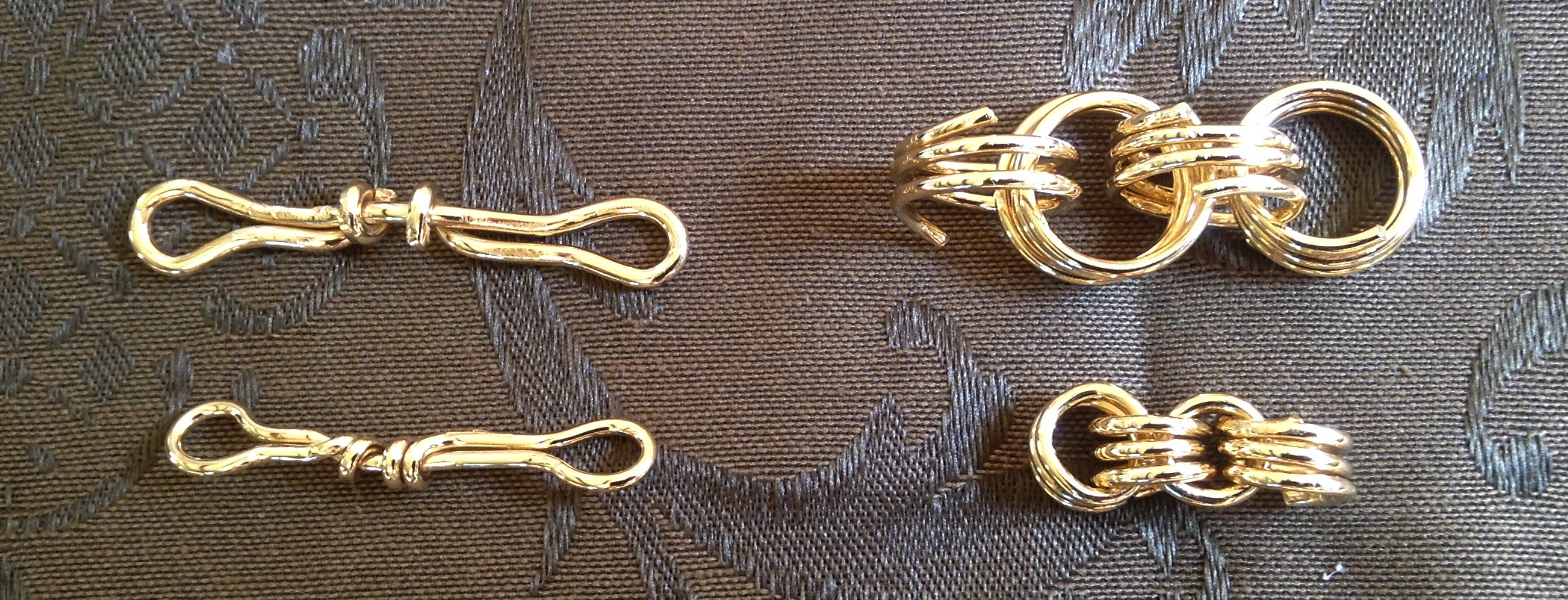
I made up examples of these two links in 14 gauge brass wire so that you could hopefully see the forms a little more clearly. I purposefully made the top row extra big, so that the structure of the wire form really shows. In the case of the left column I also formed the link slightly differently in each example. In the original artifact one of the links was formed with both of the links started on one side, like the top example. The other link had one loop started on one side of the mid-line of the wire and the other is formed on the other, creating a mirror image. If you look at the bottom example on the left you can see the advantage to the mirror image arrangement. If the coils around the center of the link are lined up, and there was no gap in the center, at least one side of the link would look seamless. The twisted part of the link could be made to look like it was one piece of wire.

The right hand column is the spiral in spiral link chain. The form becomes very clear when you make them extra big. The top version shows the form, while the bottom version shows something closer to what the original chain would have looked like a very long time ago.
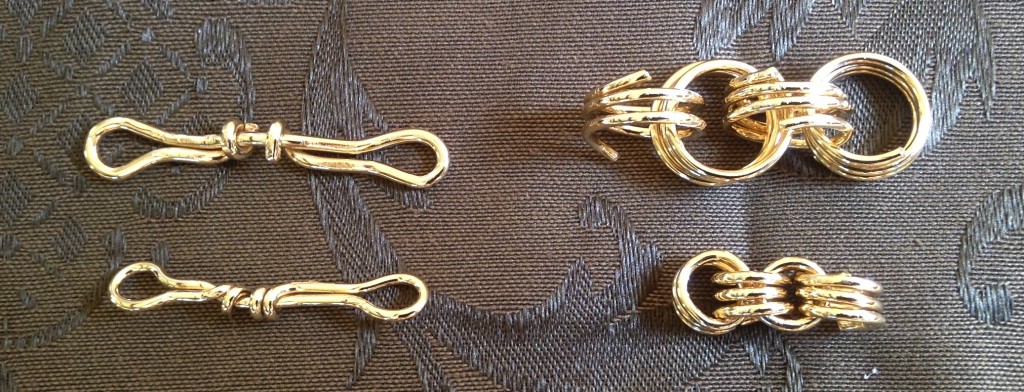
Last Two Links

I hope that this blog series inspires you to really look at all of the different types of chains that are out there!
Chains Part 6

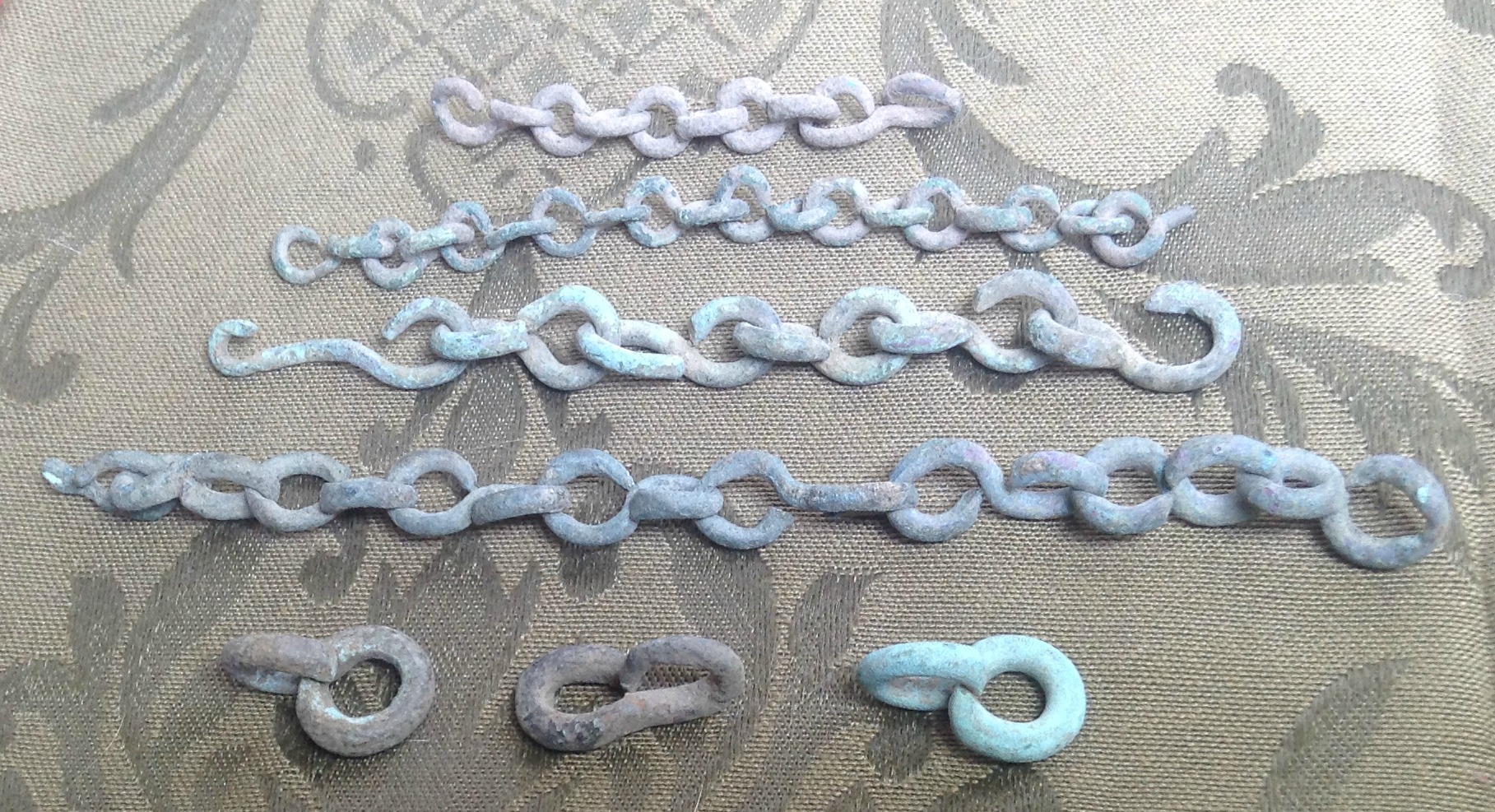
Last time we talked about chain links that start out as figure 8s, and I said that my next area of focus would be on a capital letter B. Before I do that I want to share a picture of some links that I couldn’t find last week in time for the blog. These were purchased from an old collection of metal detector finds from the Balkans. They are supposed to be Medieval, which is plausible. The most poorly crafted chain in the batch is actually the forth down from the top. The links look like they were cut with a chisel (there is at least one double strike) and no attempt was made to make the ends of the links square. It reminds us that not all “old” craftsmanship was good (but that is still no excuse for lousy modern craftsmanship).

old twisted 8 links

I admit that another week of research on the topic of link forms has changed my mind a little. I have talked about this before. One of the dangers of continuing to do research in digital archives all over Europe, while writing blogs, is that sometimes you change your mind. A thing is not exactly what you thought it was. So in this case “B” is for bent.

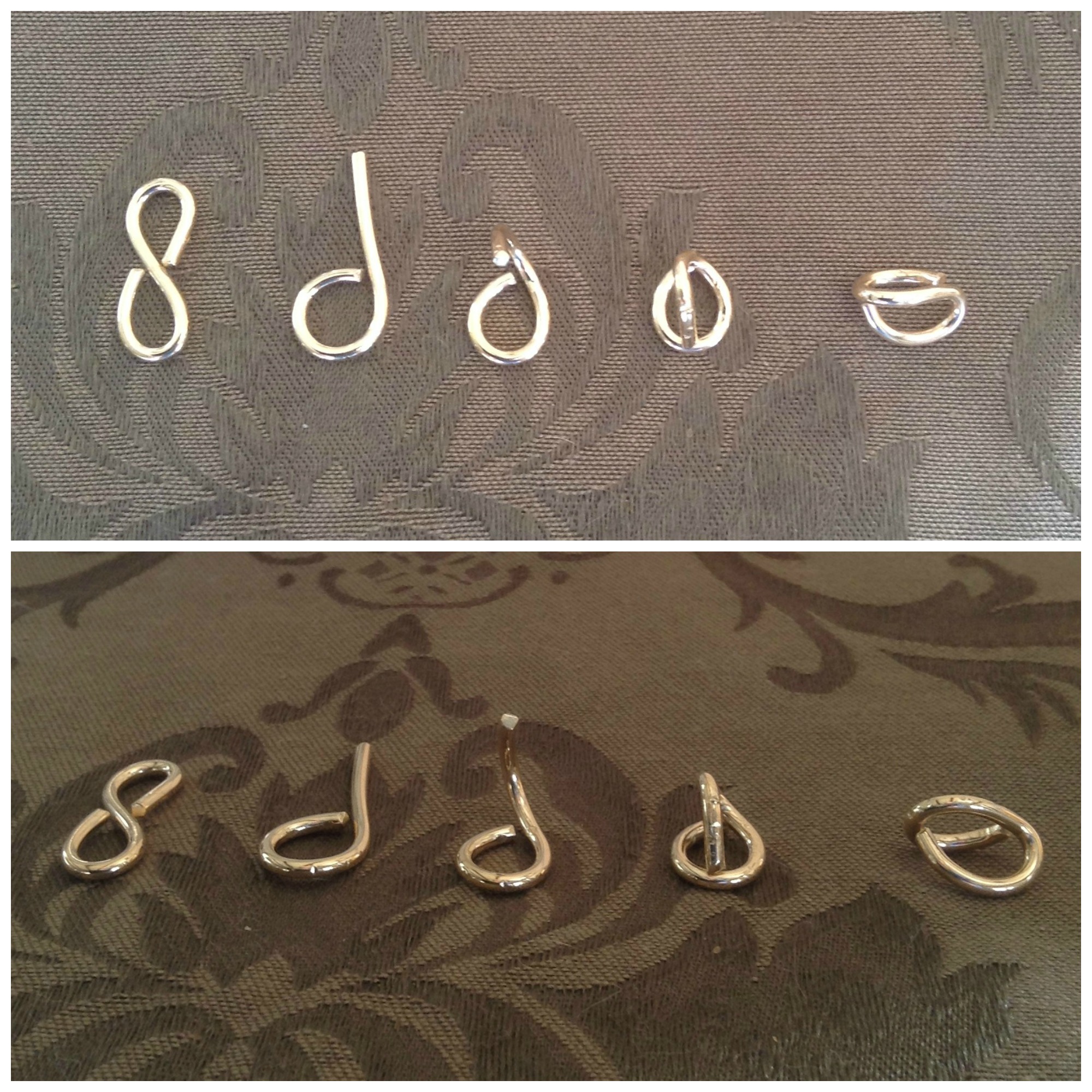
Now “bent” may seem a bit obtuse, but imagine that you have made half of one of those last figure eight links that we talked about, and then instead of making the other half, you simply bent the remaining wire down in a gentle arch until it reached the bottom end of the formed bottom of the eight… confused? Here is a photo of some links to clarify. The top picture shows the links from straight down, and the bottom picture shows them from the side so that you can see how 3D they are. The figure eight link is the one that I mentioned. The link to the right of that shows what I mean by only making half of the figure 8, then the middle link shows the beginning of the bending process, and the forth link from the left shows the completed link. The link all the way to the right is the same link form flipped on to its side so that you can see the half circle clearly. Better?

bent link collage

Take a look at the chains on this chatelaine at the British Museum. This 7th century Merovingian piece has three identical chains hanging from it. But if you look at the last link on the bottom of the center chain you can see exactly the form that I am talking about. It is half of an eight with the other end of the wire bent to form a half circle.

Now I think that this link form was one of the ones that really confused me when I first looked at it about five or six years ago. So I went in search of other similar links in other areas of Europe. I like to see how pervasive a form is, and how long we seem to find the form. Is it a local fad, or do we find it in a lot of places? I found several chains with the ‘bent” links in the Swedish National Museum, four from Gotland and one from Öland, and all from the Viking Age. I was trying to locate the museum’s technical definition of the Viking Age, since not everyone uses the same exact dates, but I couldn’t find it, so we will go with A.D. 793–1066. This picture has three pieces of chain, from the island of Gotland. If you click on the small picture it will bring up a bigger one. The top piece is a simple two in one link pattern, but the bottom two are both the “bent” links. The middle chain is particularly nice because the last two links on the left side are both slightly open, which allows you to see exactly how they were formed and put together.

I was still looking for a few more examples from other places in Europe, I am sure that there are more, it is just a matter of spending enough hours going through digital archives. At the last minute I found this piece from Germany in the Metropolitan Museum of Art. It is a Censor for burning incense, dating to the 12th Century. This close-up shows the form of the links really nicely.

And Next Time: A couple of other unusual, but not uncommon, link forms.